
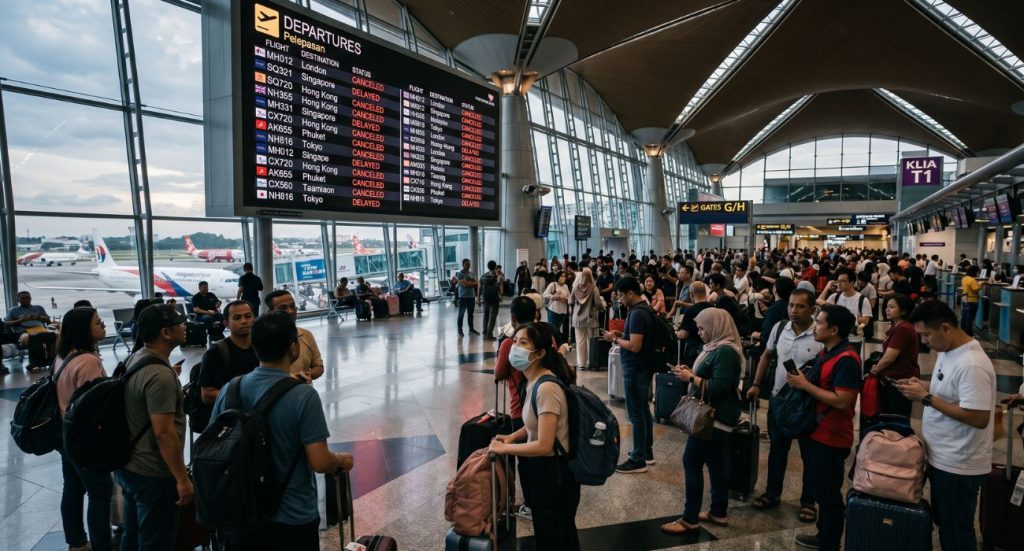
Travel disruptions in Malaysia have intensified at Kuala Lumpur International Airport (KLIA), where 174 flights were delayed and 21 were cancelled on April 25, 2026, significantly affecting passenger movement across domestic and regional routes. The disruption hit a wide group of carriers, with AirAsia, Malindo Air, Air Mauritius, and several other airlines facing operational setbacks that left travellers dealing with missed connections, revised schedules, and growing uncertainty.
The impact has been especially noticeable on routes to Johor Bahru, Penang, Sabah, Tangerang, Sandakan, Kedah, and other destinations linked through Kuala Lumpur International. As one of Southeast Asia’s busiest aviation hubs, KLIA plays a critical role in Malaysia’s tourism and business connectivity, and disruptions of this scale quickly ripple across both domestic and international networks. Passengers travelling for leisure, business, and onward international connections have all felt the effects of the operational strain.
Major Airport Affected
Kuala Lumpur International Airport has emerged as the centre of this latest disruption. As Malaysia’s primary international gateway, KLIA handles a heavy volume of domestic, regional, and long-haul traffic every day. On April 25, however, the airport faced major operational stress as widespread delays and cancellations disrupted normal traffic flow and placed additional pressure on airport systems and airline handling teams.
The operational interruptions created a domino effect across the day’s schedules. Departures were pushed back, passenger queues grew longer, and airline support desks likely faced increased rebooking demand. Because KLIA functions as a central transfer point for travellers moving around Malaysia and beyond, the disruption extended well beyond Kuala Lumpur itself, affecting passengers bound for cities including Johor Bahru, Penang, Sabah, Tangerang, Sandakan, and Kedah.
Impacted Airlines
| Airline | Cancelled | Cancelled % | Delayed | Delayed % |
|---|---|---|---|---|
| AirAsia | 17 | 4% | 42 | 10% |
| Malindo Air | 3 | 2% | 22 | 20% |
| Air Mauritius | 1 | 50% | 0 | 0% |
| SriLankan Airlines | 0 | 0% | 1 | 50% |
| Indonesia AirAsia | 0 | 0% | 10 | 35% |
| China Airlines | 0 | 0% | 3 | 150% |
| Air China | 0 | 0% | 2 | 100% |
| Cebu Pacific Air | 0 | 0% | 1 | 50% |
| China Eastern | 0 | 0% | 3 | 25% |
| Cathay Pacific | 0 | 0% | 3 | 37% |
| Spring Airlines | 0 | 0% | 3 | 50% |
| Shanghai Airlines | 0 | 0% | 5 | 45% |
| China Southern Airlines | 0 | 0% | 3 | 15% |
| Shenzhen Airlines | 0 | 0% | 2 | 50% |
| XiamenAir | 0 | 0% | 3 | 21% |
| EVA Air | 0 | 0% | 2 | 100% |
| FIREFLY | 0 | 0% | 5 | 22% |
| IndiGo | 0 | 0% | 1 | 25% |
| Japan Airlines | 0 | 0% | 1 | 50% |
| Korean Air | 0 | 0% | 1 | 50% |
| Malaysia Airlines | 0 | 0% | 42 | 14% |
| Philippine Air Lines | 0 | 0% | 2 | 50% |
| Qingdao Airlines | 0 | 0% | 2 | 200% |
| Turkish Airlines | 0 | 0% | 1 | 16% |
| TransNusa | 0 | 0% | 4 | 66% |
| US-Bangla Airlines | 0 | 0% | 1 | 50% |
| AirAsia X | 0 | 0% | 5 | 16% |
| Air India | 0 | 0% | 3 | 75% |
The heaviest impact appears to have fallen on AirAsia, Malindo Air, and Air Mauritius. AirAsia recorded 17 cancellations and 42 delays, making it one of the most significantly affected carriers at KLIA during the disruption period. Malindo Air also faced a notable operational hit, with 3 cancellations and 22 delayed flights, while Air Mauritius registered 1 cancellation and no delays.
Other carriers experienced a wide range of delay patterns, including Indonesia AirAsia, China Eastern, Cathay Pacific, Shanghai Airlines, and Malaysia Airlines. Several global and regional airlines also saw reduced schedule reliability, including Japan Airlines, Korean Air, Turkish Airlines, Air India, EVA Air, and Philippine Air Lines. Together, these figures show that the disruption was not isolated to one airline group but spread across a broad mix of operators serving Kuala Lumpur International.
How the Disruption Is Affecting Travellers
For passengers, the disruption means more than simply waiting longer at the gate. Delays at a major hub like KLIA can cause missed domestic connections, lost onward international links, rebooking complications, and added accommodation or transport costs. Travellers heading to tourist-heavy destinations such as Penang and Sabah may face shortened itineraries, while business travellers could see meetings and planned schedules affected.
The concentration of delays at one airport also increases congestion across check-in zones, transfer counters, baggage handling systems, and customer service desks. When multiple carriers are affected at once, even passengers whose flights remain scheduled may still experience knock-on delays or slower airport processing.
Probable Impact on Tourism
Disruptions at Kuala Lumpur International Airport can carry broader implications for Malaysia’s tourism sector. KLIA is the country’s main air gateway, connecting international visitors to top destinations across the nation, including Kuala Lumpur, Penang, Johor Bahru, and Sabah. When operations at the airport are heavily disrupted, visitor confidence can be affected, especially among travellers working with tight itineraries or multi-city bookings.
Malaysia’s tourism economy depends heavily on reliable air access. Repeated or highly visible disruption can influence booking decisions among international passengers, particularly from key travel markets that depend on major carriers serving KLIA. Travellers may become more cautious if they begin to see the airport as vulnerable to schedule instability.
There is also the wider regional competition factor. If reliability concerns grow, some passengers may look more favourably at nearby hubs in Singapore or Thailand for smoother connections into Southeast Asia. Over time, that could affect airline competitiveness, passenger volume, and sectors that rely on tourism-linked spending.
What Affected Passengers Can Do Now
Passengers impacted by the Kuala Lumpur disruptions should act quickly and stay informed. The first step is to contact the airline directly and explore rebooking or refund options. Most carriers provide support through airport counters, mobile apps, websites, and customer service channels, and quick action can improve the chances of securing a workable alternative.
Travellers should also monitor real-time flight information throughout the day. Conditions at a heavily disrupted airport can shift quickly, and a delayed flight may later be rescheduled again or cancelled altogether. Keeping an eye on live updates helps passengers make better decisions about when to remain at the airport, when to head back later, or when to seek a different route entirely.
Travel insurance may also become relevant in cases involving significant delay, additional hotel needs, or missed onward connections. Where coverage applies, passengers should keep receipts, boarding documents, and communication records from the airline.
For those facing long waits, it is wise to prepare for extended time inside the airport. Access to lounges, food outlets, charging points, and basic travel essentials can make the disruption more manageable. Domestic passengers who miss short-haul or regional routes may also want to consider alternative ground options, especially where train or bus connections are practical.
Final Outlook
The scale of disruption at Kuala Lumpur International Airport shows how quickly operational issues can cascade through a major regional hub. With 174 delays and 21 cancellations affecting a wide range of airlines, travellers across Malaysia and beyond have been forced to rethink schedules, absorb extra waiting time, and remain flexible with their plans.
The disruption also underlines the importance of real-time communication, strong rebooking support, and resilient airport operations. For airlines and airport authorities alike, rapid updates and effective contingency planning remain essential when network pressure begins to affect such a large portion of daily traffic.
All information is subject to real-time change. Airlines regularly adjust schedules and routes in response to operational conditions and safety considerations. In disruption scenarios, passengers should remain calm, monitor live flight status, review airline rebooking policies carefully, and stay flexible with alternate travel plans.