
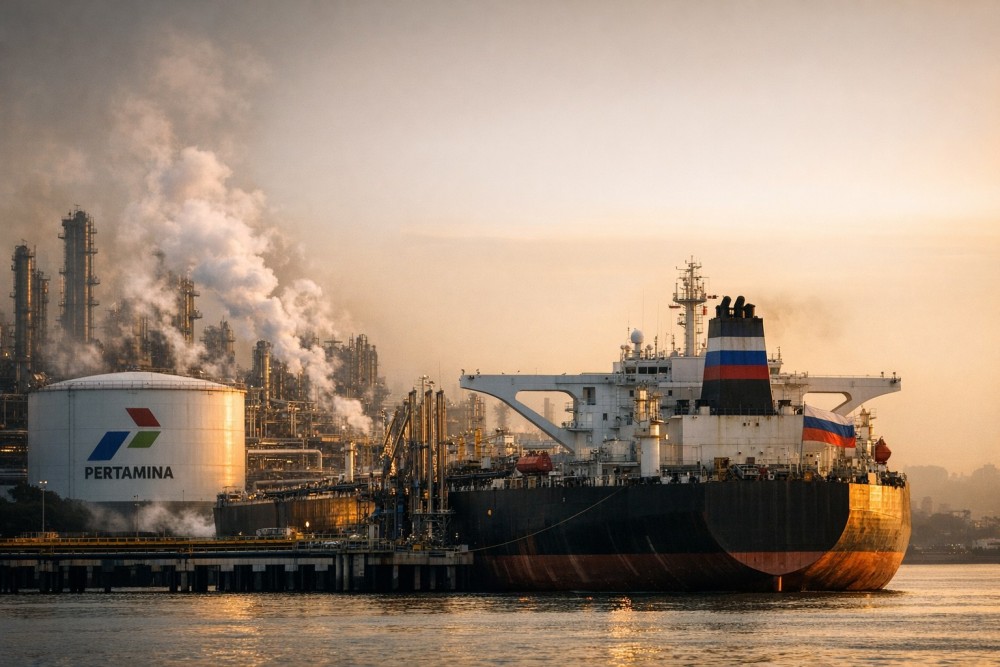
Gotrade News – Indonesia will import 150 million barrels of Russian crude oil through the end of 2026. The volume is equivalent to roughly half the country’s annual fuel consumption.
Deputy Energy Minister Yuliot Tanjung announced the commitment on Friday, April 24, 2026. Deliveries will arrive in phases due to Indonesia’s limited domestic storage capacity.
- The deal stems from President Prabowo Subianto’s April 13 Moscow meeting with Vladimir Putin
- Jakarta is weighing two execution models, direct Pertamina purchases or a new Public Service Agency (BLU)
- Supply will be routed across industry, mining and petrochemicals, not only state oil firm Pertamina
Yuliot said the purchase aims to cover Indonesia’s full-year energy needs through year-end. He added that Indonesia also committed to import liquefied petroleum gas (LPG) from Russia, with the volume still under negotiation.
The government is deciding between direct procurement through state-owned Pertamina or setting up a new Public Service Agency (BLU). Yuliot said bulk purchases via Pertamina carry higher financial risk than the BLU route.
A dedicated BLU would streamline transactions and improve financing flexibility using the national budget (APBN). The regulatory framework for the agency, however, is still being drafted internally.
The imported crude will not go exclusively to Pertamina. Manufacturing, mining, and petrochemical industries are also expected to draw from the supply pool.
The deputy minister did not disclose pricing discounts relative to Brent, which traded above US$106 per barrel this week. The lack of pricing detail leaves markets unable to project the fiscal impact on Indonesia’s energy subsidies.
The announcement comes as global oil prices climb on Middle East tensions and stalled US-Iran talks. Alternative supply sources have become a priority for major Asian oil importers.
The government targets phased deliveries throughout 2026 in line with domestic refining capacity. The first wave of shipments will be the early test of how smoothly the new procurement scheme runs.