
Leather Dyes Market
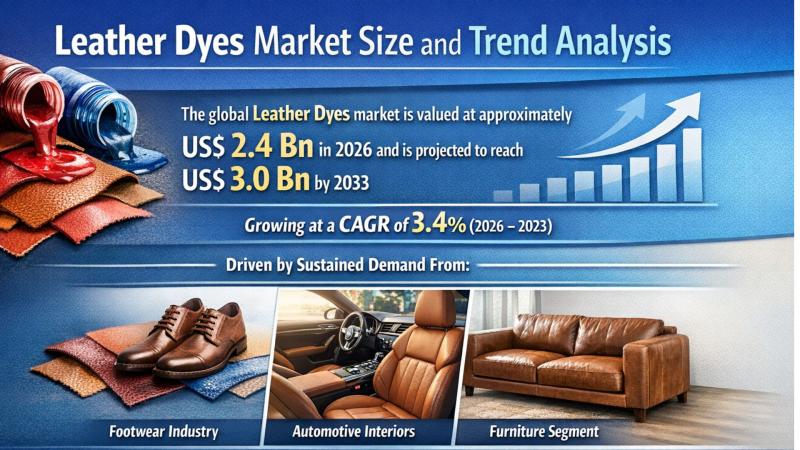
The global Leather Dyes Market is witnessing steady growth as industries such as footwear, automotive, and fashion increasingly demand high-quality and durable coloring solutions. According to the latest study by Persistence Market Research, the market is valued at approximately US$ 2.4 Bn in 2026 and is projected to reach US$ 3.0 Bn by 2033, growing at a CAGR of 3.4% between 2026 and 2033. This growth is supported by rising consumer demand for premium leather goods, evolving fashion trends, and advancements in dyeing technologies. Leather dyes play a crucial role in enhancing product aesthetics, durability, and resistance to environmental factors, making them indispensable across various industries.
Get Your FREE Sample Report Instantly – Click Now: https://www.persistencemarketresearch.com/samples/36544
Rising Demand from the Footwear and Fashion Industry
The footwear and fashion industries are among the largest consumers of leather dyes, driven by constant innovation in design, color trends, and material finishes. Global fashion brands are increasingly experimenting with bold shades, customized textures, and eco-friendly dyeing techniques to attract consumers. This has resulted in a consistent demand for high-performance leather dyes that offer color consistency, durability, and resistance to wear and tear.
In addition, the growth of fast fashion and premium footwear segments is contributing significantly to market expansion. Consumers are now more inclined toward stylish, high-quality leather products, which require advanced dye formulations to maintain visual appeal over time. Manufacturers are therefore focusing on developing dyes that not only meet aesthetic expectations but also comply with environmental regulations, ensuring sustainable growth within the industry.
Shift Toward Sustainable and Eco-Friendly Dye Solutions
Sustainability has become a central theme in the leather dyes market, as environmental concerns surrounding traditional dyeing processes intensify. Conventional solvent-based dyes often involve harmful chemicals and generate significant waste, prompting manufacturers to shift toward water-based and eco-friendly alternatives. Water-based or aqueous dyes are gaining traction due to their lower environmental impact and reduced toxicity.
Governments and regulatory bodies across regions are enforcing stricter environmental norms, pushing companies to adopt greener technologies. This transition is further supported by increasing consumer awareness regarding sustainable products. Brands that incorporate eco-friendly dyes in their manufacturing processes are gaining a competitive edge, as sustainability continues to influence purchasing decisions globally. As a result, innovation in biodegradable and low-impact dye formulations is expected to shape the future of the market.
Technological Advancements in Dyeing Processes
Technological innovation is playing a key role in enhancing the efficiency and quality of leather dyeing processes. Advanced techniques such as digital color matching, automated dye application, and improved penetration technologies are enabling manufacturers to achieve consistent and precise coloring. These advancements not only improve product quality but also reduce production time and operational costs.
Furthermore, research and development efforts are focused on creating dyes with enhanced properties such as UV resistance, water resistance, and long-lasting color retention. The integration of smart manufacturing practices and automation is also transforming the industry by improving scalability and reducing waste. As technology continues to evolve, leather dye manufacturers are expected to adopt more sophisticated solutions to meet the growing demands of end-use industries.
Get a Customized Market View in One Click: https://www.persistencemarketresearch.com/request-customization/36544
Expanding Applications in Automotive and Furniture Sectors
The automotive and furniture industries are emerging as significant growth drivers for the leather dyes market. In the automotive sector, premium and luxury vehicles increasingly feature leather interiors, requiring high-quality dyes that offer durability and resistance to fading. Similarly, the furniture industry relies on leather dyes to enhance the appearance and longevity of sofas, chairs, and other upholstery products.
As consumer preferences shift toward high-end and customized interiors, the demand for specialized dyes is rising. Manufacturers are developing dyes that can withstand varying environmental conditions, including exposure to sunlight and moisture. This expansion into diverse applications is broadening the market scope and creating new opportunities for dye manufacturers to innovate and differentiate their offerings.
Growth in Emerging Markets and Regional Expansion
Emerging economies in regions such as East Asia and South Asia and Oceania are experiencing rapid growth in leather production and consumption. Countries like India, China, and Vietnam are major hubs for leather manufacturing, supported by abundant raw materials and skilled labor. This has led to increased demand for leather dyes to support large-scale production activities.
Meanwhile, developed regions such as North America and Europe continue to focus on high-quality and sustainable leather products. Latin America and the Middle East and Africa are also witnessing gradual growth due to expanding industrialization and rising consumer spending. Regional expansion strategies, including partnerships and local manufacturing, are enabling companies to tap into these growing markets and strengthen their global presence.
Regulatory Framework and Environmental Compliance
The leather dyes market is subject to stringent regulations aimed at minimizing environmental impact and ensuring product safety. Regulatory authorities are imposing limits on the use of hazardous chemicals in dye formulations, encouraging manufacturers to adopt safer alternatives. Compliance with these regulations is essential for companies to maintain market access and avoid legal challenges.
In response, manufacturers are investing in research to develop dyes that meet international safety standards while maintaining performance. Certification programs and eco-labeling initiatives are also gaining importance, as they help build consumer trust and enhance brand reputation. The focus on regulatory compliance is driving innovation and promoting the adoption of sustainable practices across the industry.
Market Segmentation
By Formulation
Water-based/Aqueous
Liquid Form
Powder/Dust Form
Solvent-based
Others
By Application
Footwear
Garment
Automobile
Furniture
Others
By Region
North America
Europe
East Asia
South Asia and Oceania
Latin America
Middle East and Africa
Competitive Analysis
TFL Ledertechnik GmbH
Stahl Holdings B.V.
DyStar Singapore Pte Ltd
Archroma
Everlight Chemical Industrial Co.
Colourtex Ind Ltd
Burboya
NK ITALIA
Gayatri Industries
Reactive Dyes
Mordant Dyes
For In-Depth Competitive Analysis, Buy Now: https://www.persistencemarketresearch.com/checkout/36544
Competitive Landscape and Strategic Developments
The competitive landscape of the leather dyes market is characterized by the presence of both global players and regional manufacturers. Companies are focusing on innovation, product differentiation, and strategic collaborations to strengthen their market position. Investments in research and development are enabling the introduction of advanced dye formulations that cater to evolving industry requirements.
In addition, mergers, acquisitions, and partnerships are becoming common strategies to expand market reach and enhance technological capabilities. Leading players are also prioritizing sustainability initiatives, such as reducing carbon emissions and adopting eco-friendly production processes. As competition intensifies, companies that successfully combine innovation, quality, and sustainability will be better positioned to capture market share and drive long-term growth in the global leather dyes market.
Explore the Latest Trending Research Reports:
• Electronic Chemicals Market – https://www.persistencemarketresearch.com/market-research/electronic-chemicals-market.asp
• Aluminum Die Casting Mold Release Agents Market – https://www.persistencemarketresearch.com/market-research/aluminum-die-casting-mold-release-agents-market.asp
• Gear Oil Market – https://www.persistencemarketresearch.com/market-research/gear-oil-market.asp
Contact Us:
Persistence Market Research
Second Floor, 150 Fleet Street,
London, EC4A 2DQ, United Kingdom
USA Phone: +1 646-878-6329
UK Phone: +44 203-837-5656
Email: sales@persistencemarketresearch.com
Web: https://www.persistencemarketresearch.com
About Persistence Market Research:
At Persistence Market Research, we specialize in creating research studies that serve as strategic tools for driving business growth. Established as a proprietary firm in 2012, we have evolved into a registered company in England and Wales in 2023 under the name Persistence Research & Consultancy Services Ltd. With a solid foundation, we have completed over 3600 custom and syndicate market research projects, and delivered more than 2700 projects for other leading market research companies’ clients.
Our approach combines traditional market research methods with modern tools to offer comprehensive research solutions. With a decade of experience, we pride ourselves on deriving actionable insights from data to help businesses stay ahead of the competition. Our client base spans multinational corporations, leading consulting firms, investment funds, and government departments. A significant portion of our sales comes from repeat clients, a testament to the value and trust we’ve built over the years.
This release was published on openPR.