
For Noor Al Qasimi, filmmaking began with the decision to take a risk.
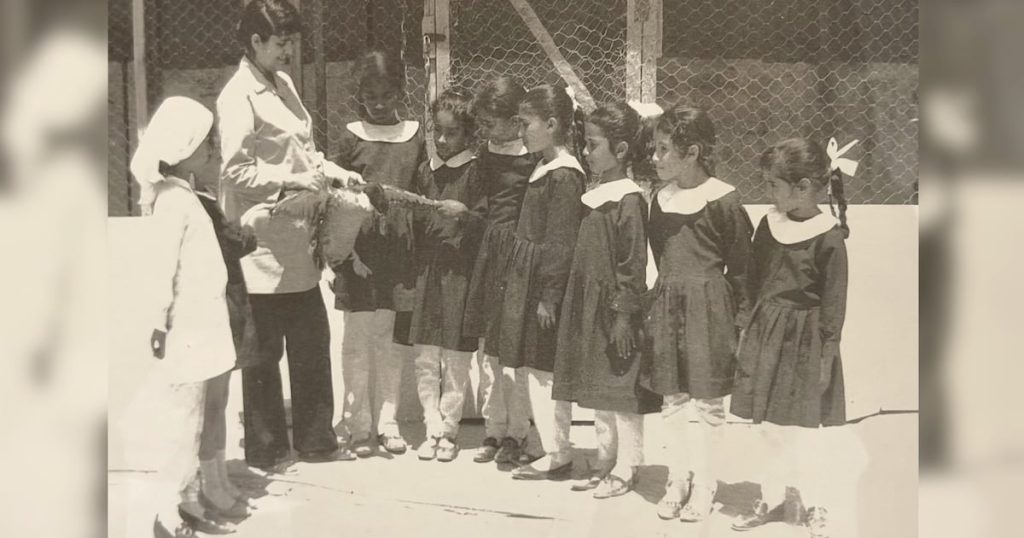
The American University of Sharjah student, who is studying film and new media, turned the camera on her own family, documenting the life of her grandmother, Sheikha Nama bint Majid Al Qasimi, widely recognised as the UAE’s first female teacher.
“I didn’t want to start off with something very simple,” Noor tells The National. “I could have done any type of interview, but I wanted to challenge myself.”
That decision has since led to international recognition. Noor’s documentary, The First, won the Best Culture Film award at the Mannheim Arts and Film Festival in Germany in February and has been selected for other festivals.
Created as part of a third-year documentary production project at AUS’s College of Architecture, Art and Design, the film blends personal storytelling with national history. Rather than a conventional biography, it is structured as a letter from granddaughter to grandmother, weaving interviews with reflective narration.
“The documentary is not just about her,” says Noor. “It’s also a letter from me to her.”
That approach allows the film to move beyond a straightforward record, becoming an exploration of memory, affection and legacy, grounded in the relationship between two generations.
In the film, Noor reflects on the values her grandmother embodied, both as an educator and as a woman navigating a different era. “She was the first to show me what it felt like to receive love without having to give anything in return,” she says.
Sheikha Nama’s story is rooted in a time when education, particularly for women, was far from guaranteed. In the 1950s and 1960s, she was among the first women of her generation to attend school. She later became one of the UAE’s earliest teachers, instructing students across several subjects at a time when specialised teaching roles were uncommon.
“There were not that many people who could read or write,” Noor says. “She was among the first.”
Hearing those stories first hand left a lasting impression on Noor. When speaking about her years in the classroom, it was her grandmother’s sense of pride that stands out. The film also highlights the scale of change that has taken place in the UAE within a relatively short span.
“In her time, it wasn’t common for women to go and get an education,” Noor says. “Now she looks at women getting their master’s degrees and doctorates and notes how much things have changed.”
The film arrives at a moment when questions of cultural preservation and historical documentation are gaining renewed urgency. For Noor, the project is part of a wider effort to capture stories that might otherwise be lost.
“The UAE has changed so much in just 50 years,” she says. “We don’t have a lot of recorded history. Whatever we can do to preserve it, whether it’s through books or films or interviews, we should do it.”
Noor’s interest in these themes has shaped her emerging filmmaking style. She describes her work as rooted in cultural storytelling, with a strong emphasis on sound and emotional impact. Those elements, explored in The First, are already informing her next film, titled Rohi (My Spirit).
“I learnt what kind of effect I want to have on people,” she says.
As The First continues its run on the festival circuit, its subject remains at the centre of its impact. A story that began as a private conversation between granddaughter and grandmother has reached a wider audience, carrying with it a reminder of the women who helped shape the country’s foundations.
At university, her development has been supported by a practice-led approach to film education, with access to equipment, editing tools and production resources. Assistant professor and filmmaker Mohammed Mamdouh, who encouraged Noor to pursue her grandmother’s story, describes the film as displaying an impressive level of maturity and craft.
For Noor, the recognition has been encouraging, particularly as it comes at the start of her career. But The First‘s significance remains personal.
“This film is close to my heart because telling the story of my grandmother allowed me to connect my personal history with the cultural history of the UAE,” she says.