
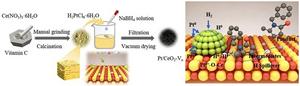
image:
Interfacial engineering of Pt/CeO2 with oxygen vacancies boosts hydrogen activation for pyrrolidone synthesis
Credit: Xie, W.; Zhang, Y.; Li, J.; Tang, Y.; Shi, Y.; Lin, L.; Tang, X. Journal of Bioresources and Bioproducts (2026).
The conversion of renewable biomass into value-added chemicals has become a key research focus in response to the depletion of fossil resources and increasing environmental concerns. Among various biomass-derived intermediates, levulinic acid is widely recognized as a versatile platform molecule that can be upgraded into high-value chemicals. One important class of products derived from levulinic acid is N-substituted pyrrolidones, which are widely used as solvents, intermediates, and functional chemicals due to their favorable physicochemical properties.
Despite their potential, the efficient synthesis of these compounds under mild conditions remains challenging. Conventional catalytic systems often rely on elevated temperatures, high hydrogen pressures, or long reaction times. Even noble metal catalysts, although more active, typically require several hours to achieve high yields. A major bottleneck lies in the activation of molecular hydrogen, which is intrinsically difficult under ambient conditions due to its high dissociation energy barrier.
To address this challenge, the study developed a platinum-based catalyst supported on oxygen-vacancy-rich cerium oxide (Pt/CeO2–Vo). The design focuses on constructing abundant interfacial sites between platinum and the oxide support. Structural characterization shows that platinum species are highly dispersed on the CeO2–Vo surface, forming Pt/PtO2 heterostructures with intimate Pt–O–Ce interactions. The introduction of oxygen vacancies plays a central role in this system, as these defect sites modify the electronic environment and promote strong metal–support interactions.
Mechanistically, the catalyst enables heterolytic hydrogen activation at the Pt–O–Ce interface. Electron-deficient platinum sites and electron-rich oxygen atoms cooperate to split hydrogen into reactive Hδ⁺ and Hδ⁻ species, which can readily participate in hydrogenation reactions. This interfacial activation pathway significantly lowers the energy barrier for hydrogen dissociation and enhances the availability of active hydrogen species. Experimental results and spectroscopic analysis confirm that hydrogen spillover from platinum to the support further contributes to catalytic activity .
The catalytic performance demonstrates clear advantages over conventional systems. Under ambient conditions (25 °C and atmospheric pressure), the Pt/CeO2–Vo catalyst achieves a pyrrolidone yield of 95.2% within one hour, with a high formation rate of 476.0 mol/(mol·h). This rate is nearly twice that of comparable Pt/CeO2 catalysts and exceeds many previously reported systems operating under similar conditions. Importantly, the catalyst maintains high efficiency even at elevated substrate concentrations, indicating its potential for practical applications.
Beyond activity, the catalyst also shows excellent stability. Recycling experiments demonstrate consistent performance over multiple cycles, while continuous flow tests confirm stable operation for more than 80 hours under ambient conditions. Metal leaching is negligible, suggesting strong structural robustness and good durability for long-term use.
Further mechanistic studies reveal that the reaction proceeds through a condensation–cyclization–hydrogenation pathway. Levulinic acid first reacts with amines to form intermediate species, which subsequently undergo intramolecular cyclization. The final hydrogenation step, which determines the overall reaction efficiency, is significantly accelerated by the Pt/CeO2–Vo catalyst. This finding highlights the critical role of hydrogen activation in controlling the overall reaction rate.
Overall, the study demonstrates that tailoring oxygen vacancies and interfacial structures in metal–oxide catalysts can effectively enhance catalytic performance under mild conditions. By enabling efficient hydrogen activation and rapid hydrogenation, the Pt/CeO2–Vo system provides a practical approach for biomass upgrading. The strategy may also be extended to other hydrogenation reactions, offering broader implications for sustainable chemical manufacturing.
See the article:
DOI
https://doi.org/10.1016/j.jobab.2026.10025
Original Source URL
https://www.sciencedirect.com/science/article/pii/S2369969826000253
Journal
Journal of Bioresources and Bioproducts
Journal
Journal of Bioresources and Bioproducts
Method of Research
Experimental study
Subject of Research
Not applicable
Article Title
Heterolytic H2 Activation over Platinum Supported on Oxygen‑Vacancy‑Rich CeO2 (Pt/CeO2–Vo) for Efficient Reductive Amination of Levulinic Acid to Pyrrolidones under Ambient Conditions
Article Publication Date
15-Apr-2026
Disclaimer: AAAS and EurekAlert! are not responsible for the accuracy of news releases posted to EurekAlert! by contributing institutions or for the use of any information through the EurekAlert system.