
For a long time, the industry revolved around distribution. The core questions were straightforward. Who could reach the audience first? Which platform commanded the widest reach? And who could scale content fastest? That dynamic is gradually evolving. Across the global entertainment landscape, there is a growing recognition that long-term value does not lie in distribution alone.
As content expands across streaming platforms, social media, television networks and newer digital environments, stories now move far beyond their original platform. In this kind of landscape, the ideas that endure are the ones that can sustain relevance across formats and over time.
India is at an interesting moment in this journey. PwC’s Global Entertainment and Media Outlook projects that the country’s media and entertainment sector will expand from 32.2 billion dollars in 2024 to roughly 47.2 billion dollars by 2029. That’s growth at nearly twice the global pace. When an industry grows at this rate, the focus naturally moves. It becomes less about the amount of content and more about which stories will endure over time.
In many ways, the industry is slowly and steadily moving toward an IP-driven model of storytelling.
From individual projects to expanding story worlds
Most content followed a fairly straightforward lifecycle. A show aired on television. A film ran in theatres. A series premiered on a streaming platform. Once that window closed, the commercial life of that content was largely over.
However, the patterns are shifting. Today, when a narrative truly connects with people, it is rarely limited to a single channel or medium. What began as a single series can evolve into multiple seasons, spin-offs, language adaptations, and, in some cases, whole new forms.
What these examples make clear is that powerful intellectual property rarely remains just a single project. When audiences connect with a story, it continues to evolve. Over time, it becomes an asset that can keep generating value in different ways.
India’s expanding opportunity
As digital access and connectivity improve, the audience expands significantly. A generation that can easily flip between many monitors consumes content in ways we have never seen before. Along with that, there are a lot more websites available for finding articles. The same audience is contested by social media sites, digital video networks, broadcast television, streaming services, and FAST channels. This may seem to split the ecosystem, but it also opens up new avenues for stories to spread.
These days, a show may start on a streaming platform, expand internationally through international licensing, and then continue its career through digital adaptations or expansions. The usefulness of stories created with this extended time horizon in mind goes much beyond the first publication timeframe. In many respects, modern storytelling is more about how an idea develops over time than it is about the first launch.
In other words, storytelling is no longer just about the initial launch. It is about the long-term journey of the idea itself.
The changing role of content studios
This transition is also changing the way studios think about crafting pieces.
For ages, production houses largely operated within a fairly straightforward commissioning market. A platform or broadcaster commissioned a show, and the studio’s role was simply to develop it and bring it to life. That model is still very much in place. Increasingly, studios are looking to think beyond individual projects and are focusing more on the kind of stories they want to build long-term that have depth and the flexibility to grow over time.
Collaboration with creators plays an important role in this. Writers, showrunners and storytellers often arrive with ideas that already hint at a much larger world. When studios collaborate with creators from the earliest stages of development, ideas can be shaped in ways that allow them to grow beyond a single project, expanding across formats, seasons and sometimes even platforms.
What might begin as a single project can gradually inflate into something bigger.
Technology has also been playing a silent but important role here. With better development tools, smoother production workflows and stronger data insights, studios move faster and operate with a clearer vision. As the mechanics of production become more efficient, creative teams land up spending less time on logistics, avoid operational friction and finally get a space to focus on what really matters i.e, which stories are worth investing in long term.
The power of multi-format storytelling
Another important dimension of IP ownership is the ability to extend stories across different formats and markets.
Instead of depending on a single release window, a strong story can develop through multiple ways such as licensing, international sales, adaptations, brand partnerships and digital extensions. When a story hits the right spot, it can travel far beyond its origin.
This is particularly relevant in a country like India, where regional storytelling is increasingly driving mainstream entertainment. A compelling tale that’s told in one language may frequently be adapted for another, conveying the same concept to an entirely new audience. With Class, for instance, a globally recognised premise with an Indian context, is connected strongly with a younger audience. It was retold from an Indian lens, which made it feel culturally specific while still speaking to universal themes.
Over time, intellectual property becomes a thread that ties the entire entertainment ecosystem together. Weaving creators, studios, platforms into a shared fabric of a narrative universe.
Looking ahead
None of this reduces the role of platforms. Broadcast channels, streaming services and digital networks yet remain an essential partner for financing, distribution and viewer reach.
However, the comprehensive direction that the industry is taking is becoming clear. As the content ecosystem grows, the stories that last will be those written with its viability in mind.
Ownership makes it possible for studios and creators to make contributions from the start of the journey and throughout its evolution across many formats, platforms, and markets. It also allows you to react to shifting audience behaviour while still building long-term value around the same basic idea.
Distribution by itself is no longer the decisive factor in a world where audiences may find stories from anywhere and material can travel anywhere. The uniqueness of the concept and the capacity to develop it over time are the true distinguishing factors.
Because ultimately, in the future of the media business, the most valuable asset will not just be the platforms that deliver stories. It will be the stories themselves.
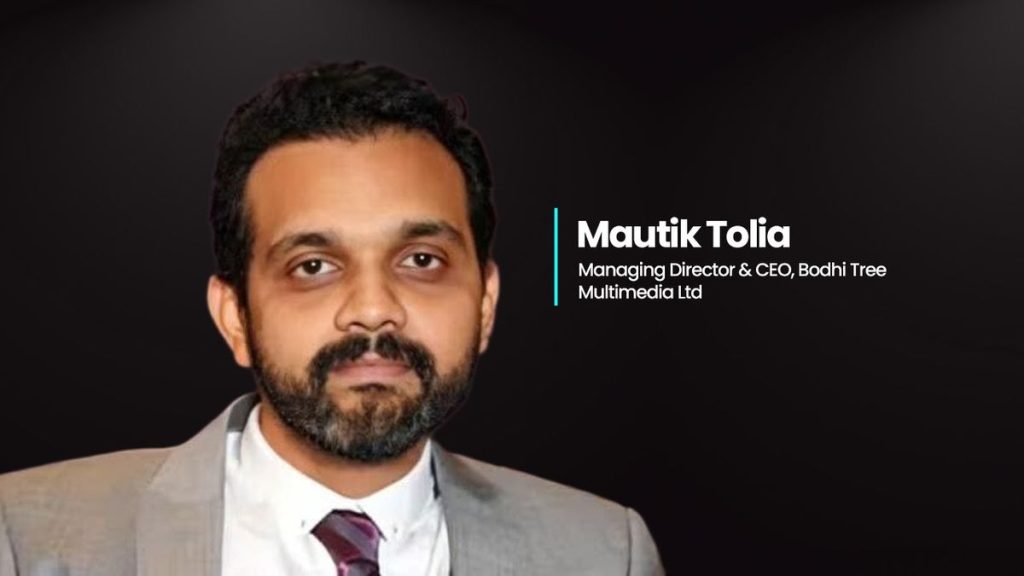
This article is penned by Mautik Tolia, Managing Director & CEO, Bodhi Tree Multimedia Ltd
Disclaimer: The article features the opinion of the author and does not necessarily reflect the stance of the publication.