
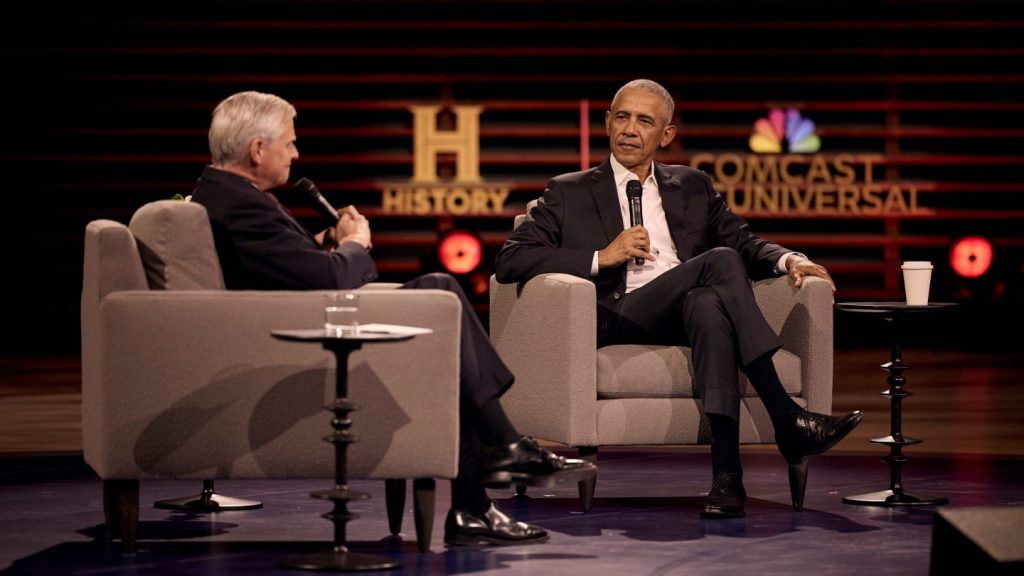
Barack and Michelle Obama, Joe and Dr. Jill Biden, Bill and Hilary Clinton and George W. Bush convened in Philadelphia on Saturday alongside leaders in media, sports and entertainment as part of a celebration of the 250th anniversary of the United States.
The historic convening of every living former U.S. president and three out of four former first ladies was accompanied by conversations with actors like Nicole Kidman, current and former Saturday Night Live head writers Tina Fey and Colin Jost, Super Bowl champion Tom Brady and future NFL player Joshua Fernando Mendoza and musician Garth Brooks. Conversations were moderated by actor Ted Danson, former SNL cast member Kate McKinnon, former Philadelphia Eagle and Super Bowl champion Jason Kelce, Today show hosts Jenna Bush Hager and Hoda Kotb, TV Guide Magazine’s Damian Holbrook, On Purpose podcast host Jay Shetty and more.
Outside the Kimmel Center, where the event took place, black SUVs lined the block, with police shutting down side streets as part of a concerted security effort, highlighting the rare and high profile nature of the day. Inside, a buzzing, captivated crowd packed the 2,500-seat Marian Anderson Hall, where more than 10 panel conversations were held. Those were conducted alongside emotional tributes honoring every day Americans, from veterans to immigrants to genocide survivors, as well as trailer material for upcoming projects like the 20-part documentary World War II with Tom Hanks and the Obamas’ eight-part podcast with Malcolm Gladwell on the Reconstruction Era.
The starry lineup was part of the live speaker series HISTORYTalks, produced by the HISTORY channel in conjunction with Comcast NBCUniversal and A+E Global Media. The day-long 2026 edition explored a number of themes, especially the role of legacy and leadership in the country’s past, present and future, and kicked off with a morning performance by the United States Army Field Band. Directly after, welcome statements were delivered by Brian L. Roberts, chairman and co-CEO of Comcast NBCUniversal, and Paul Buccieri, president and chairman of A+E Global Media.
Roberts spoke to the patriotism and “collective pride” shared in moments where Americans come together, from the nation’s 250th anniversary to the Olympics. “My dad started Comcast 60 years ago here in Philadelphia,” he recalled. “So much has changed, but the mission of bringing people together for our company remains the same. As we approach the 250th anniversary, and we’re searching, many of us, for that feeling of unity, I think we’re reminded of the special role that we get to play in helping to try to achieve that.”
A+E Global’s Buccieri offered a rousing recounting of the historic nature of the event, taking place in the city that is home to the nation’s founding. “Right here in Philadelphia, 250 years ago, people dared to imagine something that had never been done before — our great American experiment. And even with all its imperfections, and we know we have a lot of them, there remains the promise of a more perfect union,” said Buccieri. “Hope is the fuel that drives us to build, to discover, to act, even when the outcome is uncertain. It’s contagious, and it’s that same energy that founded this country. Today, you’re going to hear from cultural icons and change makers reminding us of what hope can achieve.”
Across the series of 20- to 30-minute panels, the scope of conversations was wide, with guests touching on the role of family in shaping them, their personal relationship to American identity, how constitutional ideas, adversity and optimism emerge in their work and philosophies, as well as life during and after the White House, SNL, or the NFL. “We’re really focused on getting out of the way and nurturing the next generation of leaders,” said former First Lady Michelle Obama during her panel. “The Presidential Center is opening [in June], and I’m beginning to look at the next phase of work that I want to do in girls education. We’ll probably have an announcement of what that looks like in about a year or so.”
Throughout the day there was intermittent discussion of personal projects, including footage and a guest highlighting W. Bush’s book Out of Many, One: Portraits of America’s Immigrants. Fey noted she had no plans to do more Mean Girls, before playfully considering an animated turn within a larger conversation about comedy and SNL‘s relationship to American politics. And during their separate panels, both the Obamas spoke about their work with Higher Ground, with the former president specifically noting that after multiple years of working exclusively with Netflix and being “very grateful for the launch that happened,” the duo is “in the process now of transitioning to a more independent [company] where we can work with a bunch of different studios.”
Among the day’s political speakers, discussions frequently tackled historical and present expectations of the U.S. government and the wider interpretation of the country’s founding documents. “This central question I just talked about — who are we? What kind of democracy do we have? At the heart of it has been this debate about who’s included. I think it is fair to say that we were not approximating the ideals that had been set forth in those early documents until 1965, but even then, that was still imperfect,” said former President Barack Obama. “And of course there’s been this continuing contest throughout our history around those who would try to interpret those original documents as being able to accommodate caste and hierarchy and privilege and preferences to exclude versus an idea that says no, no, we the people.”
None of the conversations with former U.S. leaders explicitly named current President Donald Trump or directly criticized the actions of any particular administration. Instead, they largely presented a unified front and spirit of collaboration that reflected a shared understanding of what they believe are the necessary principles of holding the highest office. They also discussed the general successes — and occasionally the regrets — of their respective administrations and their own nation.
“A lot of things that happened are part of the truth of who we are, but the whole idea is to keep trying to form a more perfect union and to keep moving forward in a positive direction,” said former First Lady and Secretary of State Hilary Clinton. “The idea that you would try to write out the bad things that happened because you don’t want people to ignore the good things — how do you do that with a life? You can’t do it with a life. You can’t do it with a country.”
“If the only time you love your country is when you win — what is that? It’s not democracy,” Biden said in a separate panel with Dr. Jill Biden. “Democracy is people who collectively decide what’s in the best interest of themselves and their country, and if you only love your country when you win, then what happens to this place?”
Conversation struck a balance of candor and hope while discussing personal or national adversity. That includes dialogue about how aspects of modern politics have become less unified and more challenging amid, among other things, competing understandings of individualism versus collectivism.
“In my sixth or seventh year as vice president, things began to get a little tough in the Senate. They weren’t treating Senators the way they used to,” Biden recalled during his joint panel. “So I went… to have a lunch in the Senate dining room. I walked over to the dining room and it’s not there anymore. There’s not a single place in the United States Senate, other than a Senator’s office, where a Democrat and Republican can sit down in Washington. They don’t know each other. I think it’s one of the major problems we have. We don’t talk to each other, we don’t engage one another.”
Several panels also explored how guests’ managed public political life and how their own unique experiences informed the choices they made as leaders. “I had already dealt with the worst of what would come at me over the course of the campaign. The labels, the fear, the criticism, the manipulation of my voice, my tone, the racism, the sexism that had happened. I figured out my own way to emotionally and strategically deal with that,” Michelle Obama said while discussing her approach to maintaining a sense of normalcy during Barack’s two-term presidency. “So I knew going into the White House that I just needed to define myself.”
“I was the only white kid that I knew that played with Black kids. I never thought of it as any big deal, but it prepared me as I watched other people react to living a life where some people want to be inclusive and others don’t,” Bill Clinton recalled about growing up poor in rural Arkansas and how it informed his approach as a political leader. “And here we are today, all these years later, and it’s the number one question facing us. Do we believe on our 250th anniversary, are we willing to stake our lives on the fact that we are all created equal and that our diversity is a blessing, not a curse?”
Within the slew of =stories shared across the day-long event, Barack Obama highlighted the power of storytelling not just in his own campaign and presidency, but for U.S. leaders looking to understand what makes a shared American identity and democracy.
“We’ve got competing stories at all times, right? We’ve got stories that encourage us to be greedy or encourage us to be afraid and mean,” Obama said. “Those are a set of stories. And then there are another set of stories that encourage us to be kind and generous and thoughtful and truthful and serious and responsible. A lot’s at stake in what story captures people’s attention.
“I think we are going to get through these challenging times, but we will get through them not simply because we have a better 10-point policy. It’s going to be because we find a way to reset course on these moral commitments to treat other people as we would like to be treated,” the 44th president of the United States told the Philly audience. “That we are caring for the poor and vulnerable and that we recognize our duty to something larger than ourselves and to the next generation, and we don’t think about things like war in terms of glory or domination.”
Ultimately, Saturday’s conversations covered how rights have evolved in America since its founding, how various presidents have interpreted that and how the country’s evolution over two and a half centuries consciously reshaped opportunities as well as what one can hope for within greater American society.
“We’re living through a challenging time. There’s no doubt in my mind that we’ll get through it, but [this moment] is one that’s posing a lot of new questions about power, unaccountable power, and some very old questions about how we organize ourselves and whether we stay faithful to our founding values and the rule of law — everything that got us to where we are today,” Hilary Clinton said.
“I do see lots of things to be optimistic about, but it doesn’t come just because we wish it,” she added, before recalling a conversation with Warren Buffet about the scope of human history. “As he likes to say, ‘Would you have picked any other time in which to live?’ Because really, when you think about it, despite all of our problems, if you look back at everything… we are so lucky. We still live in the greatest country in the history of the world. We have so many opportunities. And it is, as Benjamin Franklin said while coming out of the Constitutional Convention and he was asked, ‘What have you created?’ He said, ‘A Republic, if you can keep it.’”