
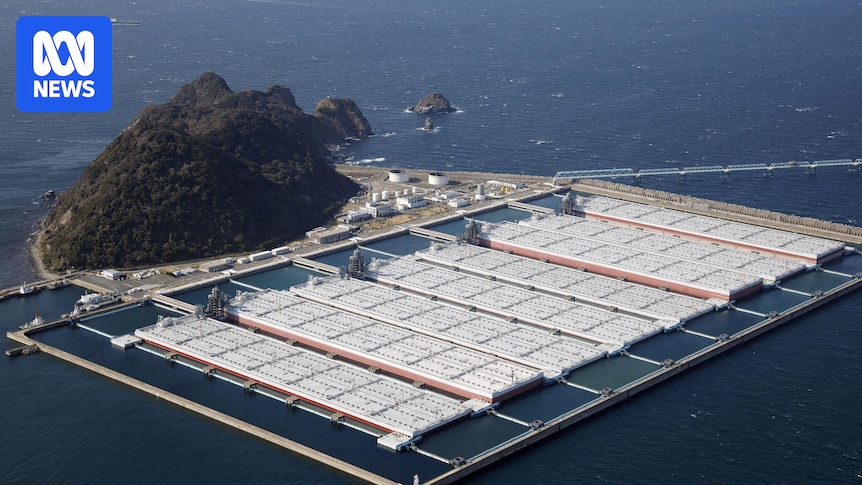
Less than 10 kilometres off the coast of Japan, eight large barges are floating in the sea. Inside them are about 35 million barrels of oil.
Japan has nine other similar stockpile sites around the country, making up one of the world’s biggest oil reserves.
The 400-million-odd barrels have provided a buffer against the closure of the Strait of Hormuz, which has caused a global fuel crisis and left many other countries scrambling for supplies.
Australia’s prime minister, Anthony Albanese, is far from the only leader jetting around the region trying to shore up fuel supplies. Several neighbours in Asia have also been turning to Japan for assistance.
It has already guaranteed it will maintain regular supplies to Australia, and it has been in discussions about swap deals, but Japan is cautious about tapping its reserves to meet additional international requests.
“Unfortunately, Japan is a resource-poor country,” said Hiroshi Hashimoto from the Institute of Energy Economics, Japan.
Instead, Prime Minister Sanae Takaichi this week announced Japan will offer almost $14 billion in loans and financial assistance to Asian countries to purchase alternative crude oil supplies and build stockpile systems.
“Japan may have limitations to supply from its own sources, but [it] still has the ability to coordinate things between countries or economies,” Mr Hashimoto said.
Asia’s outbreak of fuel bartering
Amidst an outbreak of bartering and deal-making during the fuel crisis, several countries have come calling on Japan.
Japex, a local gas and oil exploration and production company. (ABC News: Natalie Whiting)
China’s fuel export bans and the now double blockade of the Strait of Hormuz have added to the frenzy.
Vietnam has asked for oil supplies from Japan’s reserves, and the Philippines also requested assistance and recently received diesel.
Indonesia and India have both reportedly discussed swap deals, offering liquefied natural gas or naphtha and crude oil in exchange for liquefied petroleum gas.
Meanwhile, a South Korean envoy made trips to Kazakhstan, Oman and Saudi Arabia this month to try to lock down crude oil supplies for its large fuel-refining industry.
This week, Seoul confirmed it had secured 273 million barrels, and the following day, Australia announced it would receive an extra shipment of diesel from the country.
Japan will provide Australia with a normal level of fuel supply as the Strait of Hormuz remains blocked. (ABC News: Natalie Whiting)
Earlier in the crisis, Japan requested Australia boost its gas output to help fill demand. It provides about 40 per cent of Japan’s gas.
Energy security in the region is likely to be a talking point during an expected visit to Australia by Ms Takaichi next month.
Japan’s stockpiling model
Ms Takaichi’s $14 billion framework to assist other countries handling the fuel crisis is being sold on a win-win premises of securing supply chains, which the country relies on.
Japan has made it clear its oil reserves are there to ensure local needs first. (ABC News: Natalie Whiting)
She announced the financial assistance for countries and companies to purchase crude oil and build stockpiling systems after an online meeting with leaders from around the region.
Mr Hashimoto said the framework could be “very significant” for the development of the region’s energy markets in the future.
“Japan has to some extent demonstrated the effectiveness of the oil stockpiling system by stabilising the market by releasing some of the stocks,” he said.
“This kind of system can be spread around the region to expand the buffers to supply shocks among different countries.”
Japan ramps up domestic production
Despite being a fuel-refining powerhouse, Japan produces a negligible amount of the raw materials.
Less than half a per cent of Japan’s oil comes from domestic extraction, and only about 2 per cent of its gas.
It imported more than 90 per cent of its crude oil supplies from the Middle East at the outset of the Iran war and about 10 per cent of its gas.
Japan produces a negligible amount of the raw materials. (ABC News: Natalie Whiting)
The country started releasing 80 million barrels from its oil reserves in March to stabilise the market and ensure domestic supplies. Further releases will begin next month as it continues to try to secure alternate sources of crude.
“We have received requests to increase production,” said Hiroyuki Katayama from Japex, a local gas and oil exploration and production company.
While it is working to ramp up output from gas and oil fields outside the port city of Niigata, Mr Katayama warns it is not immune from the fallout of the global crisis.
“With crude oil shipments currently stalled, we’re having trouble getting the chemicals we need to operate our facilities,” he explained.
“If we continue at the current rate of consumption, our stock will run out in about three to four months.”
Japan’s Prime Minister Sanae Takaichi is planning a visit to Australia. (ABC News: Natalie Whiting )
Ms Takaichi has said Japan should be able to source more than half of its oil imports from routes outside the Strait of Hormuz by next month, but few details have been provided.
Oil reserves for local economy
The fuel crisis comes amid an uncertain regional security environment, and as countries, including Japan and Australia, seek to strengthen defence and political relationships in Asia.
Despite the broader geopolitical considerations, Japan has made it clear its oil reserves are there to ensure local needs first, and it is facing domestic political pressure.
While its government says the country’s energy and critical supplies are secured, there have been industries reporting shortages, including the agriculture, transport and medical fields.
Ms Takaichi has been holding specific cabinet meetings on the “Middle East situation” and announcing measures, including the release of 50 million pairs of medical gloves from a state stockpile designed to respond to pandemics.
Tokyo taxi driver Takeshi Sayama is watching the situation closely.
“We’re only paid by the meter, even if gas prices go up, that’s all we can charge,” he explained.
His boss at Shoei Motors Taxi, chairman Toshiharu Takei, said if the situation continues, “our stockpiles aren’t really that substantial”.
Toshiharu Takei is the chairman at Shoei Motors Taxi. (ABC News: Natalie Whiting)
“I don’t think we can rely on our stockpiles; we have no choice but to respond while anticipating that they might run out.”
He is introducing hydrogen and electric taxis to try to diversify, but believes Japan should also help other countries in the region.
“I don’t see any problem with it as long as there are no adverse effects on us,” he said.
“Given the various issues currently arising in the region, I believe it is only natural that we work with Australia and other Asian partners with whom we can collaborate.”
Taxi driver Takeshi Sayama is following the situation in the Middle East closely. (ABC News: Natalie Whiting)
Loading…