
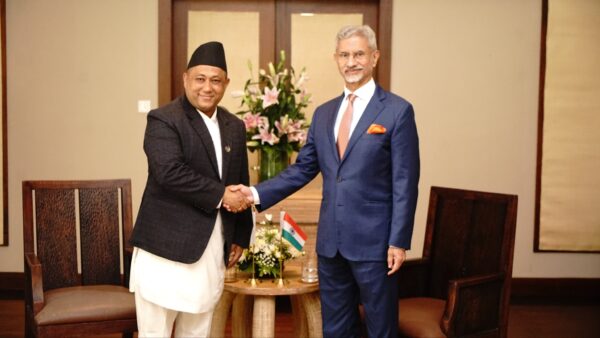
Balendra Shah became the prime minister of Nepal on March 27. India, it has now emerged, invited him for an official visit on the same day. The impending visit, the date for which is yet to be finalized, could herald a new phase of Nepal-India relations that is characterized by greater trust and cooperation.
Following the Gen Z uprising and ouster of Prime Minister K.P. Sharma Oli in September last year, an interim government under Sushila Karki was quickly formed. India supported her government from the start and kept putting pressure on key Nepali political actors to support Karki’s single focus on timely elections. Prolonged instability on the Nepali side of the border, India feared, could spill over into its own territory. The sooner power was transferred to an elected government in Kathmandu, the better.
Following the uprising, India made a concerted effort to improve ties with Shah, the popular former mayor of Kathmandu who was also the de facto leader of the uprising. As the country burned for two days, the lead actors in the protests had requested Shah to assume the role of interim prime minister and steady the ship. But he declined — instead waiting for the right time to be elected prime minister for a full term in office.
Indian interlocutors also started engaging the top ranks of the Rastriya Swatantra Party (RSP), the party helmed by former TV show host Rabi Lamichhane, which Shah joined just months before the March 5 national polls. The RSP projected Shah as its prime ministerial candidate. Under his leadership, the party swept the polls, winning nearly two-thirds of all contested seats for the federal lower house.
Indians had rightly sensed the turning of the tide in Nepali politics — and chose to ride it. There was an ulterior reason for this. Oli, the pre-uprising prime minister and chair of the Communist Party of Nepal-United Marxist Leninist (CPN-UML), the largest communist force in the country, had become the pivotal Nepali politician following the promulgation of the new constitution in 2015. Since then, he either led the government (thrice) or played the key role in shaping coalitions in Kathmandu.
Yet he had increasingly testy ties with India. First, he and his party won the 2017 polls on an openly anti-India plank. Even after that, he continued pestering the Indians. He sometimes claimed that Lord Rama, the poster god of India’s ruling Bharatiya Janata Party, was born in Nepal. He mocked India’s national emblem. Perhaps most egregiously in Indian eyes, he included the territories around Kalapani, which India also claims, in the official Nepali map, and permanently included the map in the new constitution.
If the Indians wanted one outcome from the March 5 polls, it was the diminishment of Oli and his UML party. And it got exactly that: trounced in the polls, the UML was reduced to a shadow of its former self.
In this new context, India wants to reset its relations with Nepal. India and Nepal are now busy discussing how to make Shah’s impending India trip more result-oriented.
As the dominant power in South Asia, the onus will be on India to show some generosity towards Nepal. For instance, it could give Nepal an additional air route, something which could drastically improve the country’s air connectivity with the rest of the world. Or it could announce that it will conduct trade with China through the Lipulekh pass, the Nepal-India-China trijunction, only with Kathmandu’s consent. Whenever India and China unilaterally announce trade through Lipulekh, there is a furor in Kathmandu. If India makes such a substantive concession, it would be seen as a big coup for the new Shah government and also improve India’s image in Nepal.
Yet as the prime minister of a landlocked country precariously wedged between two big powers, Shah has to tread carefully. While India and China both backed timely elections, Beijing does not seem happy with recent developments in Kathmandu. Even during the Gen Z uprising, there were reports of pro-Tibetan activists infiltrating the protests, something to which the Chinese took strong exception.
Later, in his election pledge, then-election candidate Shah quietly dropped from his manifesto the plan for a China-funded industrial park in his constituency, which lies close to India’s Siliguri Corridor.
More recently, Beijing has conveyed its unease with what it sees as Kathmandu’s tolerance of pro-Tibetan and pro-Taiwan activities. Beijing also believes the Gen Z uprising provided ground for the Americans to increase their meddling in Nepal, and thus undercut its own influence.
During Shah’s India trip, while New Delhi will be expected to make big concessions, the Nepali prime minister will be more cautious: it will be insalubrious for his political health to be seen as sidling too close to the “big brother” so early in his tenure.
The Shah government has started on the right foot in foreign policy conduct. On assuming office, the new prime minister gave a collective audience to foreign ambassadors, rather than individually meeting them behind closed doors. It has revived a tradition of senior government officials meeting foreign dignitaries only in the presence of foreign ministry officials. It also seems careful about cultivating an image of neutrality. Whenever senior government officials meet Indian officials, they are seen meeting Chinese officials soon after.
In that vein, perhaps Prime Minister Shah may well plan a Beijing trip after he comes back from New Delhi.
Yet it would be a mistake to believe any government in Nepal can so easily escape the pressures of geopolitics. In a space increasingly contested between India, China and the “sky neighbor,” the U.S., Kathmandu will have to continue its delicate balancing act to safeguard sovereignty. That burden now rests on the young shoulders of Balendra Shah. The planned India trip will be his first major diplomatic test.