
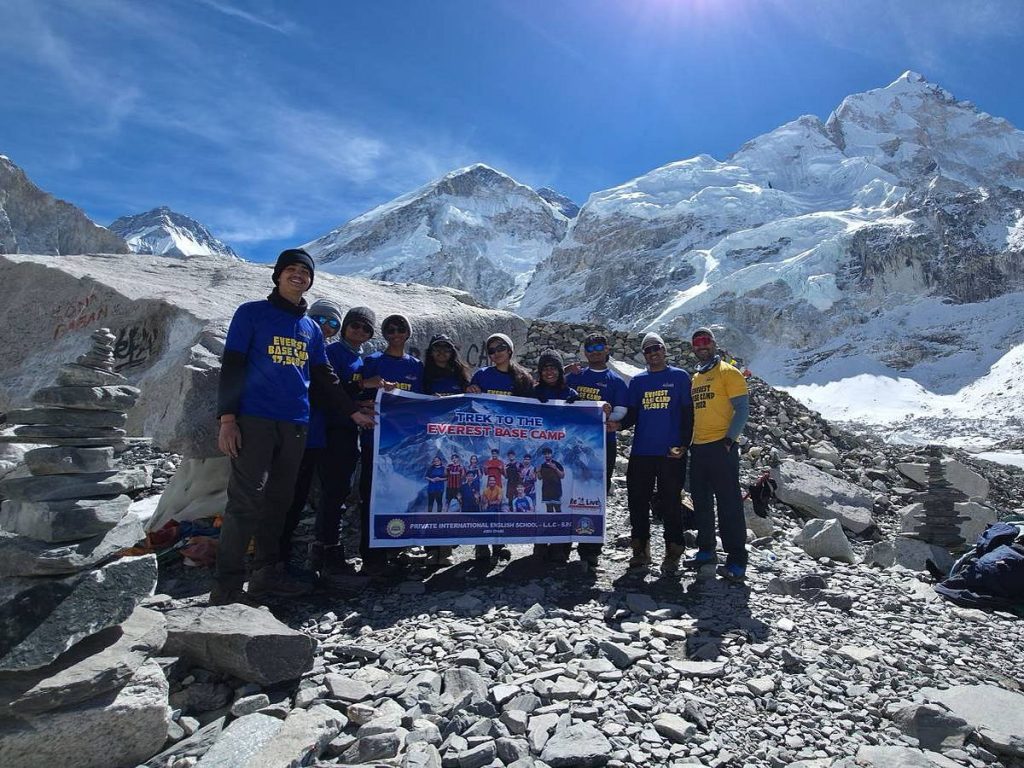
Training began months earlier
Preparation started at the end of November, with students undergoing daily training sessions focused on endurance and strength.
“It was like a very intense training for three complete months,” said Ganga Shaji, a teacher involved in the programme.
The training built up gradually. Students began with shorter runs before moving up to longer distances, along with strength exercises and conditioning.
One student said the change was noticeable within days.
“I was the kind of a person who never ran in my life. The first day, I could not run at all. But after few days, I was continuously running without any stop, and I was amazed.”
Even with preparation, the group knew the real challenge would only begin once they reached the mountains.
“No matter how much you train, it’s all about how your body gets adapted to that atmosphere,” Shaji said. “It’s about how well prepared you are mentally.”
Delays and a long road to Lukla
The journey started with a flight from Abu Dhabi to Kathmandu, followed by a connection to Lukla. Weather disruptions forced a change in plans.
Flights were delayed, and the group travelled by road to Ramechhap instead, turning the detour into an unexpected highlight.
“A memory I don’t think I’ll ever forget was the road trip we had from Kathmandu to Ramecha,” said 15-year-old Anam Haroub. “It was something that none of us expected. It was the best thing I’ve ever experienced.”
From there, the group flew to Lukla and began the trek.
Every stage brought a new challenge
The climb to Everest Base Camp was steady but demanding. Students covered between eight and 10 kilometres a day on the way up, with longer distances on the return.
“I don’t have a single day that I could say this was challenging,” Shaji said. “Every day was more challenging for us.”
Altitude, reduced oxygen levels and steep terrain made each stage tougher than the last.
Hitha Vippagunta, 14, said the experience required more than physical preparation.
“Definitely needed a lot of mental strength more than physical too,” she said.
Some students fell ill during the trek, and the descent proved equally difficult, with longer distances and added strain on the body.
Akshat Katke, 14, said the experience was tougher than expected.
“I thought it would be very easy, but in fact, it was very challenging. It was very tough.”
Reaching Everest Base Camp
The moment the group reached Everest Base Camp stood out for everyone involved.
“The day we reached EBC, I saw these kids crying,” Shaji said. “They ran to me hugging. That was very precious to see them so emotional at this young age.”
Students described the experience in their own words.
“The word would be peak,” Anam said.
Shyam Prabhash, 15, said the final stretch was the hardest but the most rewarding. “After that you get to reach the BC and then it’s very nice to see everything around you.”
Others described the journey as “marvellous”, “exciting” and “worth it”.
Nivetha Dayanand is Assistant Business Editor at Gulf News, where she spends her days unpacking money, markets, aviation, and the big shifts shaping life in the Gulf. Before returning to Gulf News, she launched Finance Middle East, complete with a podcast and video series.
Her reporting has taken her from breaking spot news to long-form features and high-profile interviews. Nivetha has interviewed Prince Khaled bin Alwaleed Al Saud, Indian ministers Hardeep Singh Puri and N. Chandrababu Naidu, IMF’s Jihad Azour, and a long list of CEOs, regulators, and founders who are reshaping the region’s economy.
An Erasmus Mundus journalism alum, Nivetha has shared classrooms and newsrooms with journalists from more than 40 countries, which probably explains her weakness for data, context, and a good follow-up question.
When she is away from her keyboard (AFK), you are most likely to find her at the gym with an Eminem playlist, bingeing One Piece, or exploring games on her PS5.