
Unlock the Editor’s Digest for free
Roula Khalaf, Editor of the FT, selects her favourite stories in this weekly newsletter.
The writer is head of thematic fixed income research at Barclays
Bond markets have discovered speed — and it’s changing the playbook. Volumes are up, the time needed to transact is way down, and the algos are flexing their market presence hard. US Treasuries now trade faster than you can blink — literally, in milliseconds.
Chunky blocks in corporate credit are being traded by algos like high-frequency equities. Even dealing in municipal bonds, historically regarded as akin to watching paint dry in excitement, has been transformed with pricing in minutes instead of the markets equivalent of geological epochs.
But here’s the twist: despite all the algorithmic swagger in bond markets, electronic trading volumes have been stuck at about 50 per cent for corporate bonds and about 60 per cent for Treasuries in recent years. Machines haven’t taken over bondland — they have just made more room for humans.
Paradoxically, the rise of the algos has unleashed fresh demand for the very thing they were supposed to replace: trading by talking to a broker and striking custom-made deals. It turns out, when you make the market faster, you also expose its limits.
Credit is where the “equitification” of fixed income — the trading of bonds like shares — is most visible. Back in 2015, nearly a third of US bonds didn’t trade at all on a given day. Fast forward to 2025, and that number’s down to just 10 per cent. Liquidity has improved to the point where trades can be done much more quickly — timeframes of “maybe next week” are now more like “right now”. The market’s reflexes have sharpened accordingly. In 2002, we at Barclays — an active broker and trader in fixed income — estimate it took more than 10 days for a price shock to work its way through credit. Today, it’s two days, tops.

Analysts are plugged into dashboards, data feeds and artificial intelligence tools that track every twitch in reaction to Federal Reserve shifts, credit downgrades and macro shocks. And if the market misses a beat, the algos are standing by — ready to pump liquidity into trading.
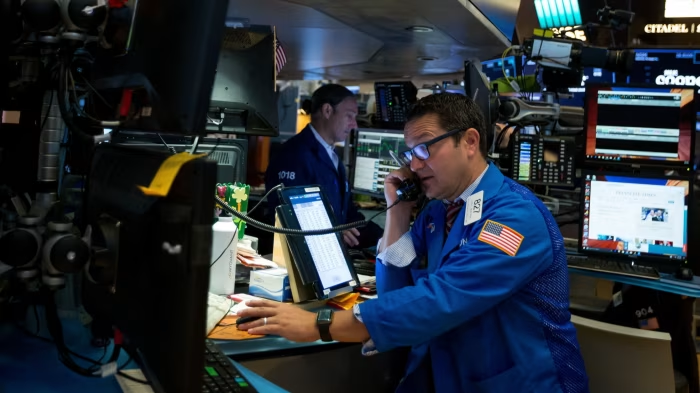
And yet, block trades in corporate credit — chunky, voice-brokered beasts of deals north of $5mn — are bigger than ever. The need for them never went away. Not because the market is nostalgic but because credit remains too idiosyncratic, too bespoke, too human. When things get choppy, traders want to hear a voice on the other end — not an algo quoting the midpoint of a bid/offer spread.
But the algos have created conditions that foster block trades. The balance sheets of dealers to support trading haven’t ballooned, but the market is moving like it has. The greater speed in transactions and flood of bite-sized trades courtesy of the algos are not a cure-all but they have given traders more confidence to warehouse chunky blocks — the kind that still change hands the old-fashioned way: with a phone call and a bit of trust.
As the big trades keep getting bigger and the small prints keep shrinking, the split between voice and electronic trading holds at 50 per cent. The machines didn’t push the humans out — they made more space for them. Now, they’re speeding side by side.

Speed is a mixed blessing for investors. It’s unlocked systematic strategies — old hat in equities, but a novelty in bonds until recently. But too many algos scanning the tape can make mispricings harder to spot.
Take trades in portfolios of various bonds together: they move bonds fast, but also flatten volatility and compress bid/offer spreads. Bonds stop being priced on their quirks and start moving with the herd. Our analysis shows higher portfolio trading activity cuts price volatility by 5 to 7 per cent.
And let’s be honest — it’s not obvious the equity trading model is always better with algos locked in a speed arms race and signals that evaporate faster than a trader’s conviction. Fast liquidity isn’t always better liquidity. In fact, some equity investors are starting to whisper the unthinkable: bilateral chats, off-venue trades, actual human interaction. The horror.
So maybe the next big thing isn’t bonds becoming more like equities — it’s equities quietly becoming more like bonds. Call it bondification.
Bonds will be mostly algo, sure — but humans aren’t going anywhere. Credit trading used to be voice versus machine. Now it’s voice with machine. Execution can’t be purely equity-style when the market isn’t. And in a bond market moving at machine speed, human judgment still has an edge.