
October 13, 2025
3 min read

Key takeaways:
- Options trading can offer flexibility, hedging opportunities and income potential.
- But for most physicians, the downsides — complexity, time demands and risk for large losses — often outweigh the benefits.
With rising market volatility and more physicians exploring side investments, options trading has become an increasingly common topic in financial discussions.
Although options can offer flexibility, leverage and income opportunities, they also carry significant risks. A clear understanding of the basics is essential before getting started.

Source: Chirag P. Shah, MD, MPH, and Jayanth Sridhar, MD
What are options?
Options are financial contracts that give the buyer the right — but not the obligation — to buy or sell an underlying asset (usually a stock) at a predetermined price within a set time frame. Unlike stocks, options do not represent ownership; they are derivatives, meaning their value is derived from another asset.
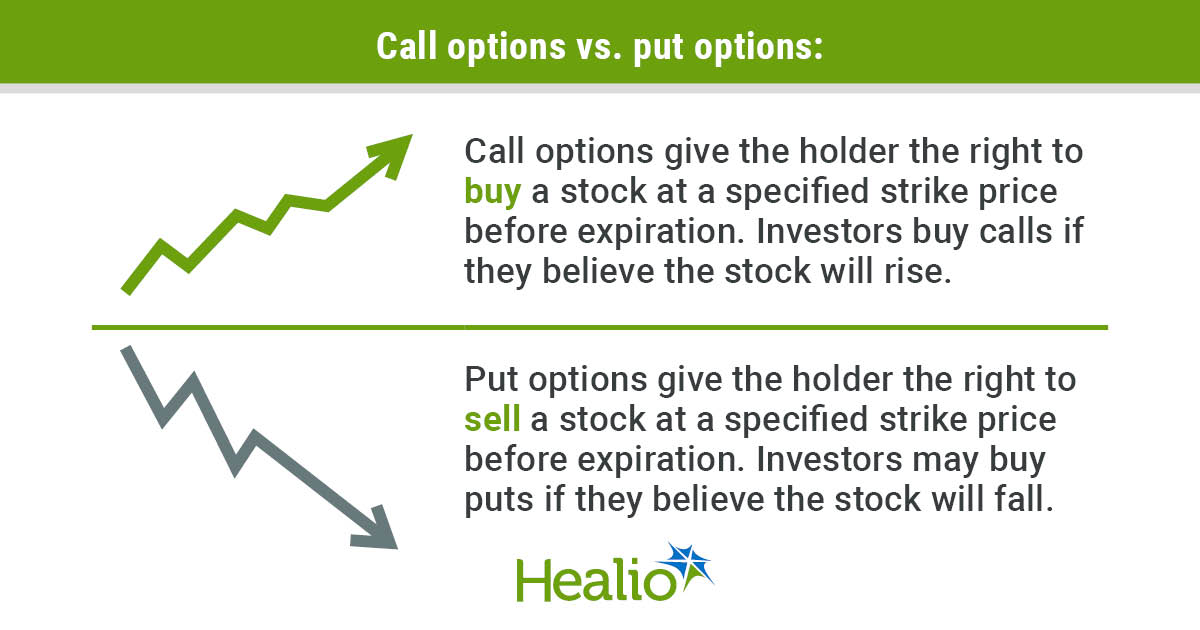
Two primary types of options exist:
- Call options give the holder the right to buy a stock at a specified “strike” price before expiration. Investors buy calls if they believe the stock will rise. Example: Suppose Stock X is trading at $100. You purchase a call option with a strike price of $105 that expires in 1 month. If Stock X rises to $120, you can exercise your option to buy at $105 and immediately own a stock worth $120 — capturing the difference (minus the cost of the option). If the stock stays at or below $105, the option expires worthless, and your loss is limited to the option premium.
- Put options give the holder the right to sell a stock at a specified strike price before expiration. Investors buy puts if they believe the stock will fall or if they want to protect gains. Example: Suppose you own Stock Y, currently trading at $80, and you buy a put option with a $75 strike price. If Stock Y drops to $60, you can sell your shares for $75, protecting yourself from further loss. If the stock stays above $75, you simply let the option expire, effectively treating it like an insurance premium.
Options can be purchased (long positions) or sold (short positions), and they can be combined into sophisticated strategies such as spreads, straddles or covered calls. Each strategy carries unique risk and reward profiles.
Upside potential: Flexibility, leverage and hedging
For physicians seeking to diversify investments, options can be used strategically to:
- Enhance returns through leverage without committing large amounts of capital.
- Generate income via selling covered calls on long-held stocks (selling a call option on a stock you already own).
- Hedge portfolio risks against market downturns through protective puts.
For example, a physician who owns a broad stock exchange traded fund, like SPY or QQQ, might purchase put options to protect against a market downturn. This can be a cost-effective way to limit downside risk without selling underlying holdings.
Major downsides: Complexity, volatility and time demands
Despite their appeal, options are not passive investments. Their value depends on multiple variables — including stock price, time to expiration, interest rates and, especially, volatility. Even modest stock movements can produce rapid gains or steep losses in option prices.
For busy medical professionals, the main drawbacks include:
- Steep learning curve. Misunderstanding contract terms or strategies can lead to unexpected losses.
- Time sensitivity. Options lose value as expiration approaches (time decay), demanding active monitoring.
- Amplified volatility. Leveraged positions can turn small market swings into large losses.
- Emotional strain. The pace of trading can heighten stress, compounding already demanding clinical schedules.
A particularly risky strategy is selling uncovered (naked) options — for example, selling a call without owning the underlying stock. If the stock price rises sharply, losses can be unlimited, far exceeding initial capital.
Special considerations for physicians

Chirag P. Shah
Physicians typically lack the time to monitor fast-moving markets throughout the day. Options trading also requires margin agreements, detailed tax reporting and meticulous record-keeping — often done outside clinical hours. These practical realities make high-frequency or speculative trading particularly challenging.
For most physicians, conservative options strategies — such as covered calls or protective puts — are more appropriate than speculative investments. Using complex or leveraged strategies without adequate preparation can expose portfolios to unnecessary risk and volatility.
Takeaway

Jayanth Sridhar
Options trading can be a powerful tool in skilled hands, offering flexibility, hedging opportunities and income potential. However, for most physicians, the downsides — complexity, volatility, time demands and the risk for large losses — often outweigh the benefits.
Before engaging, physicians should thoroughly understand option mechanics, consider practicing with paper trades or online trading simulators and consult experienced financial advisors. As in medicine, knowledge, preparation and experience are essential to avoid complications.
For more information:
Chirag P. Shah, MD, MPH, is a soccer and Nordic ski coach who also practices medicine and teaches in Boston. He can be reached at cshah@post.harvard.edu.
Jayanth Sridhar, MD, is an award-winning podcaster, physician and educator who is chief of ophthalmology at Olive View Medical Center in Los Angeles. He can be reached at jsridhar119@gmail.com.
Editor’s note: This article is for educational purposes only. Please consult a licensed financial advisor before making any investment decisions.
Sources/Disclosures
Source:
Expert Submission
Disclosures:
Shah and Sridhar report receiving and donating royalties as co-authors of Financial Freedom Rx: The Physician’s Guide to Achieving Financial Independence.