
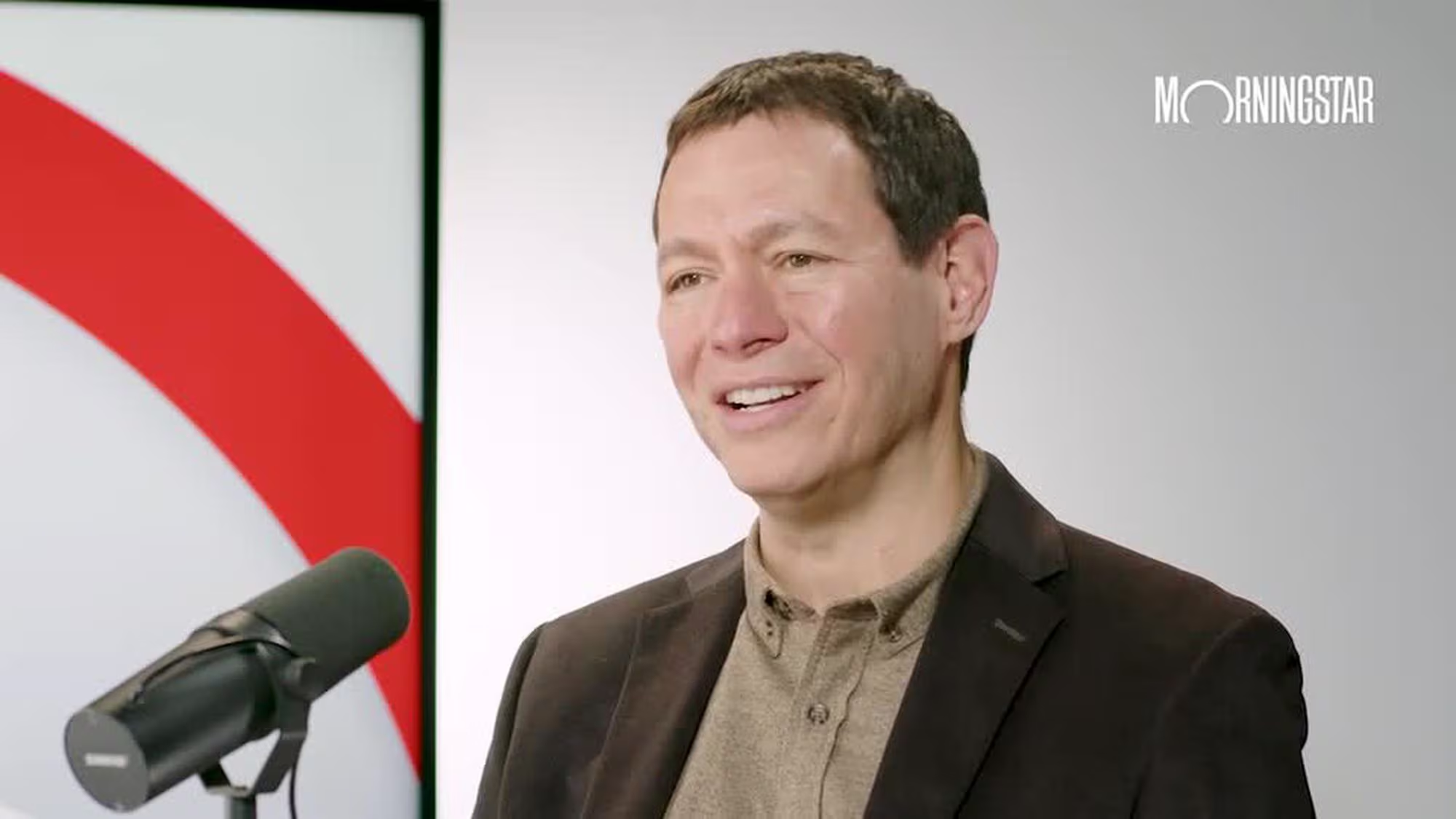
Hi. I’m Susan Dziubinski, co-host of The Morning Filter podcast. On a recent episode, I sat down with columnist and Morningstar Indexes strategist Dan Lefkovitz to talk about dividend stock investing. Here’s an excerpt from our conversation in late 2025.
Susan Dziubinski: So let’s pivot over to a related topic and that’s dividend-growth investing. You touched on that sort of at the beginning of our conversation. Seems it’s like sort of a betwixt between because it’s not, you’re not really, if you’re a dividend-growth investor, you’re not really looking for the highest dividends, but this isn’t purely the highest growth. These aren’t the highest-growth stocks you’re looking for either. Talk a little bit about what dividend-growth investing is and why it could be an attractive strategy to pursue for an investor.
What Are Dividend-Growth Stocks?
Dan Lefkovitz: Yeah. So dividend growth is about targeting companies that are increasing their payouts to shareholders. If you think about it, companies that are upping their dividends are strong and strengthening. So they’ve got maybe improving prospects. It’s a way to kind of zero in on high-quality companies, companies with strong competitive positioning, maybe even economic moats. And it’s a strategy that is known to have a defensive orientation, so less volatile than the broad equity market.
Dziubinski: So I think you said at the top of the show, Dan, that US dividend stocks have as a group lag this year. So is that true of dividend-growth stocks have also lagged the broader US market?
Lefkovitz: It is. They’ve performed decently in absolute terms, but a few percentage points—if you look at the Morningstar US Dividend Growth Index—it’s a few percentage points behind the broad US equity market.
Dziubinski: And we blame AI for that.
Lefkovitz: Absolutely.
Dziubinski: Just making sure we’re on the same page about that. OK.
Lefkovitz: Less volatile. Less volatile.
The Benefits of Dividend-Growth Investing
Dziubinski: Well, and that’s what I was going to ask next. So, have we seen dividend-growth stocks, so maybe they haven’t quite kept up this year, because we have seen some volatility, especially recently, as you and I are sitting here, with that AI trade. Have we seen a little bit more stability with dividend-growth stocks?
Lefkovitz: Yes. We’ve seen during selloffs this year, not just this year, but if you go back to 2022, 2018, those were down years for the broad stock market. And dividend growth has held up better during those selloffs.
Dziubinski: Now, you talked in your column about dividend-growth stocks earlier this year that you’re seeing an evolution, a bit of an evolution, in that dividend-growth stock universe. Tell us about that.
Lefkovitz: Yeah, we’re definitely seeing more technology stocks come into the dividend-growth universe. I mentioned earlier that the culture of Silicon Valley is not so warm on dividends, but that’s kind of a gross oversimplification. Apple AAPL pays a dividend, and they’re in the dividend-growth index. Microsoft MSFT is a technology stock that pays a dividend and is in there as well. Applied Materials AMAT is another company. I should also mention Broadcom AVGO, semiconductor maker. That’s in several, actually, of our dividend indexes, not just dividend growth. So it’s not necessarily the case that you get no technology exposure. Oracle ORCL is another one that is paying a dividend.
Dziubinski: But a lot of those tech companies aren’t sort of your big dividend-payers.
Lefkovitz: That’s right.
Dziubinski: They’re going to be more the dividend-growth stocks, really.
Lefkovitz: That’s right. That’s right. And the yields, in many cases, are really low.
Dziubinski: OK. So then what do these changes to this dividend-growth landscape mean for dividend stock investors in terms of maybe what they should be expecting? Let’s say they own a managed product of dividend growth, either an index ETF or an actively managed dividend growth, should they have different expectations moving forward for performance or?
Lefkovitz: I like to say that dividend growth tends to perform in between the market and the high-dividends-paying section of the market. So when high-dividend-paying stocks are outperforming, dividend growth tends to lag but perform better than the market. And then the inverse is also true. When the market’s doing really well, dividend growth tends to be behind the market, but not as far behind as high-yielding equities. And I expect that general performance pattern to continue.
Dziubinski: OK. All right.
Lefkovitz: It’s more marketlike.
Morningstar, Inc., licenses indexes to financial institutions as the tracking indexes for investable products, such as exchange-traded funds, sponsored by the financial institution. The license fee for such use is paid by the sponsoring financial institution based mainly on the total assets of the investable product. A list of ETFs that track a Morningstar index is available via the Capabilities section at indexes.morningstar.com. A list of other investable products linked to a Morningstar index is available upon request. Morningstar, Inc., does not market, sell, or make any representations regarding the advisability of investing in any investable product that tracks a Morningstar index.