

Issuance of common stock refers to the process by which a company sells its shares to investors to raise capital. Common stock represents ownership in the company, granting shareholders voting rights and a share of the profits through dividends or capital appreciation.
Companies issue common stock during initial public offerings (IPOs), follow-on public offerings (FPOs), or private placements. This method of raising funds is widely used to finance operations, invest in growth opportunities, or pay down debt.
To understand the financial impact of common stock issuance, you can calculate the proceeds raised by multiplying the number of shares issued by the price per share.
The formula for calculating it is:

Proceeds from Stock Issuance = Number of Shares Issued × Price Per Share
Additionally, companies report the total number of shares issued and outstanding on their balance sheets. This information is critical for evaluating dilution and shareholder equity.

Consider a company decides to issue 1,000,000 shares of common stock at $50 per share during a public offering.
Calculate Total Proceeds
Proceeds from Stock Issuance = 1,000,000 × 50 = 50,000,000
The company raises $50,000,000 from the issuance.
Update Shareholder Equity
If the company’s prior equity balance was $100,000,000, the new equity balance becomes:
New Equity Balance = 100,000,000 + 50,000,000 = 150,000,000
Adjust for Additional Costs
Issuance costs such as underwriting fees may reduce the net proceeds. If these costs total $2,000,000, the net proceeds are:
Net Proceeds = 50,000,000 − 2,000,000 = 48,000,000
Record on Financial Statements
The issuance affects two areas of the balance sheet:
- Cash (Assets): The cash account increases by the net proceeds from the issuance.
Net Proceeds: $48,000,000
- Shareholders’ Equity (Liabilities and Equity): The equity section will reflect the increase in Common Stock and Additional Paid-In Capital (APIC).
- Common Stock: If the par value of the stock is $1 per share:
Common Stock Value = Number of Shares Issued × Par Value
Common Stock Value = 1,000,000 × 1 = 1,000,000
- APIC: This represents the proceeds raised above the par value:
APIC = Net Proceeds − Common Stock Value
APIC = 48,000,000 − 1,000,000 = 47,000,000
Updated Balance Sheet Entries
Assets Section (Increase in Cash):
- Previous Cash Balance: $20,000,000
- Net Proceeds from Issuance: $48,000,000
- Updated Cash Balance:
New Cash Balance = 20,000,000 + 48,000,000 = 68,000,000
Shareholders’ Equity Section:
- Common Stock: $1,000,000
- APIC: $47,000,000
- Prior Equity Balance: $100,000,000
- New Equity Balance: 100,000,000 + 48,000,000 = 148,000,000
Evaluate Ownership Dilution
Assume the company had 5,000,000 shares outstanding prior to the issuance. After issuing 1,000,000 additional shares, the total outstanding shares increase to:
Total Shares Outstanding = 5,000,000 + 1,000,000 = 6,000,000
Ownership Dilution for Existing Shareholders:
Dilution Percentage = New Shares Issued / Total Shares Outstanding × 100
Dilution Percentage = 1,000,000 / 6,000,000 × 100 = 16.67%
Existing shareholders now own 83.33% of the company, compared to 100% before the issuance.
Impact on Financial Metrics (Earnings Per Share – EPS)
If the company’s net income remains constant at $15,000,000:
Before Issuance (EPS):
EPS = Net Income / Shares Outstanding (Before Issuance)
EPS = 15,000,000 / 5,000,000 = 3.00
After Issuance (EPS):
EPS = Net Income / Shares Outstanding (After Issuance)
EPS = 15,000,000 / 6,000,000 = 2.5
Final Summary of Calculations
- Total Proceeds Raised: $50,000,000
- Net Proceeds (After Costs): $48,000,000
- Cash Increase (Assets): $48,000,000
- Equity Increase: $48,000,000
- Common Stock: $1,000,000
- APIC: $47,000,000
- Ownership Dilution: 16.67%
- EPS Impact: Reduced from $3.00 to $2.50
This completed calculation highlights the financial effects of issuing common stock, including its benefits for raising capital and its implications for shareholder value.
The issuance of common stock is a critical financial tool that companies use to raise capital for growth, operations, or strategic initiatives. It plays a pivotal role in shaping a company’s financial health, ownership structure, and market presence.
Below are the key reasons why issuing common stock is important.
Capital Raising
The primary purpose of issuing common stock is to generate funds for operations, expansion, or debt repayment. This method is often preferred over borrowing, as it does not create financial liabilities.
Diversifying Ownership
Issuing shares allows companies to bring in new investors, spreading ownership and potentially improving corporate governance through diverse shareholder perspectives.
Enhancing Liquidity
Issuing stock enhances the liquidity of a company by bringing in more cash. This liquidity can be crucial during economic downturns, unexpected crises, or periods of high operational demand. For example, a retail chain uses proceeds from a stock issuance to maintain operations during a seasonal slump.
Building Market Credibility:
A well-executed stock issuance can boost a company’s public profile, attract institutional investors, and increase its market valuation.
Supporting Business Expansion
The proceeds from common stock issuance can finance growth initiatives, such as launching new products, expanding into new markets, acquiring other companies, or upgrading infrastructure.
A “good” issuance of common stock occurs when the benefits outweigh the drawbacks. Key indicators include:
- Minimal Dilution: The company issues a reasonable number of shares, maintaining a healthy balance between raising capital and preserving shareholder value.
- Strategic Use of Funds: Proceeds are invested in growth initiatives, debt reduction, or other value-adding activities.
- Favorable Market Conditions: Shares are issued when market sentiment is positive, ensuring higher pricing and stronger demand.
The issuance of common stock is a pivotal financial strategy for companies seeking to raise capital, expand operations, and solidify their market presence. While it offers numerous advantages, such as flexibility and growth opportunities, it is not without risks, including dilution and issuance costs. For investors, understanding the dynamics of stock issuance provides critical insights into a company’s financial health and future potential.
Some of its limitations include:
- Dilution of Ownership: Issuing additional shares dilutes the ownership percentage of existing shareholders, potentially reducing their control over decision-making.
- Costly Process: Issuing common stock involves underwriting fees, legal expenses, and regulatory compliance costs, which can reduce the net proceeds raised.
- Dividend Obligations: While not mandatory, companies may face shareholder pressure to pay dividends, which can impact cash flow.
- Market Volatility: Stock prices can be volatile, making it challenging to determine the optimal timing and pricing for issuance.
InvestingPro offers detailed insights into companies’ Issuance of Common Stock including sector benchmarks and competitor analysis.
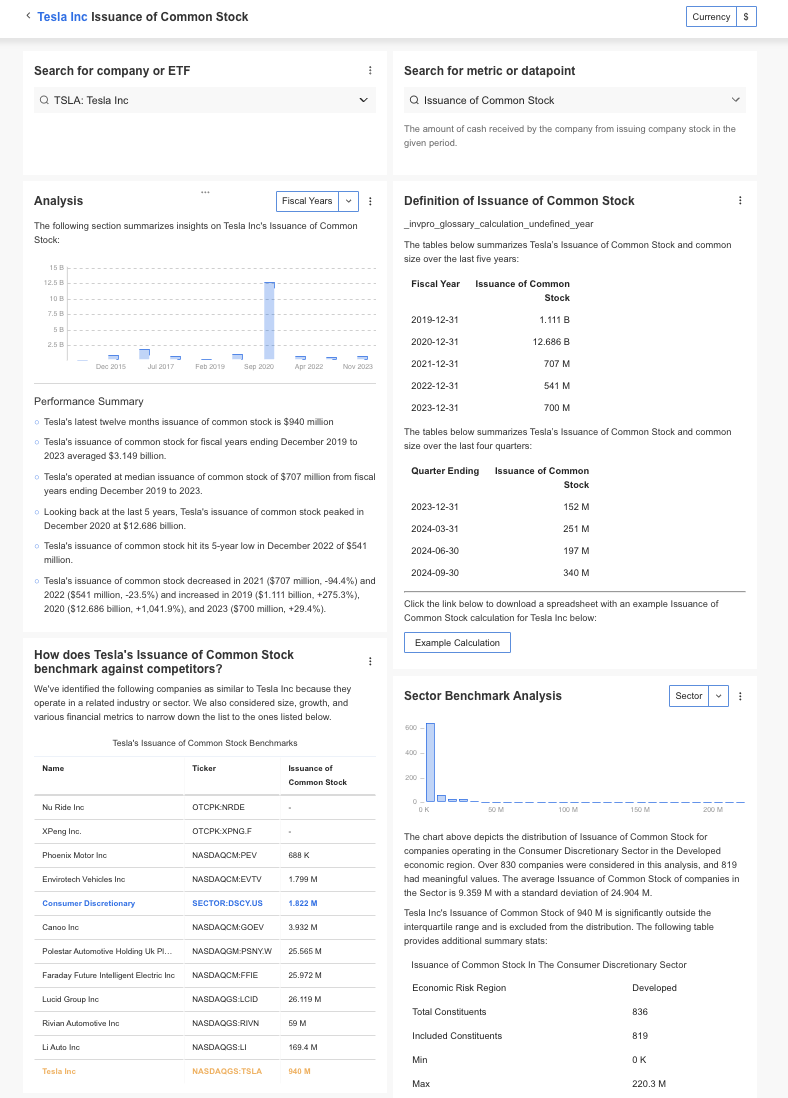
Unlock Premium Data With InvestingPro 📈💸
Gain instant access to Issuance of Common Stock data within the InvestingPro platform
🛠 Access to 1200+ additional fundamental metrics
🔍 Competitor comparison tools
📊 Evaluate stocks with 14+ proven financial models
What is the difference between common stock and preferred stock?
Common stock grants voting rights and potential dividends, while preferred stock typically offers fixed dividends without voting rights.
How does issuing common stock affect a company’s balance sheet?
Issuing common stock increases shareholders’ equity and cash assets, boosting the company’s financial flexibility.
Can private companies issue common stock?
Yes, private companies can issue common stock, often through private placements, to raise capital without going public.
What are the risks of issuing common stock?
Risks include dilution of existing shareholders’ equity, increased scrutiny from investors, and potential stock price volatility.
How do companies decide the price of common stock during issuance?
Stock prices are determined based on factors such as market conditions, demand from investors, and the company’s financial performance.
Is issuing common stock better than taking on debt?
It depends on the company’s financial health and goals. Stock issuance avoids interest payments but may dilute ownership, while debt retains equity but creates financial liabilities.