
Good morning. Yesterday’s letter noted that fund managers who have failed to embrace the AI hype have been all but doomed to trail the market. The Financial Times reported yesterday that Terry Smith is one of the sceptical underperformers. “We have yet to convince ourselves that [Nvidia’s] outlook is as predictable as we seek,” he wrote to his investors. Smith’s fund is up 9 per cent year to date, which should buy him some time. If you think Nvidia’s future results can be predicted, even roughly, more than a quarter or two in advance, by all means email me: robert.armstrong@ft.com.
Where’s the value?
In Monday’s letter we talked about the last report from (now former) JPMorgan strategist Marko Kolanovic, which was something of a cri de coeur arguing for sanity in the face of a market that seems to be in the grip of speculative frenzy. But, if we are not to buy Nvidia, what are we to buy? Here is what the report suggested:
Given robust investor sentiment and elevated positioning, we recommend diversifying away from momentum tail risk by adding allocation to anti-momentum Defensive Value plays (Utilities, Staples, Healthcare, Telecom, Dividend Aristocrats) and away from pro-cyclical exposures (Industrials, Consumer Discretionary, Financials, and unprofitable Small Caps).
This may be slightly easier said than done. “Defensive” non-cyclical stocks can of course be bought. But “defensive value” — stocks that are defensive and can be bought at fair prices — might be a little trickier. As we have written recently, the stocks that have rallied the most this year, after the AI gang, are the biggest, most stable consumer staples companies. Walmart, Costco, Colgate-Palmolive and Procter & Gamble all trade at meaty premiums to the market, for example.
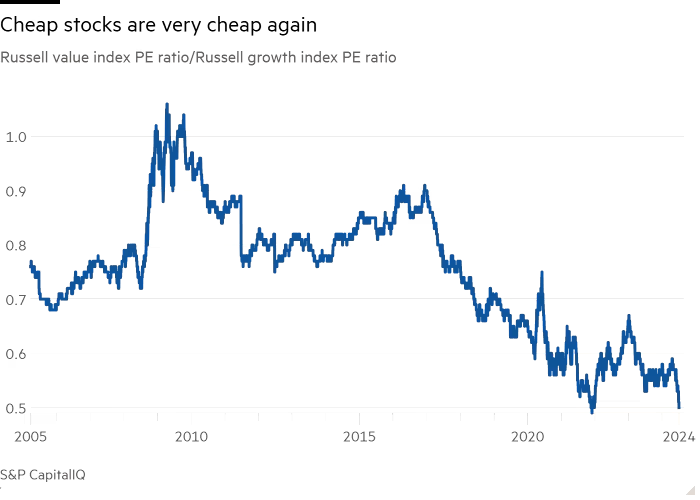
But there are clearly bargains out there, at least in relative terms. We’ve looked at the below chart before. It shows the forward price/earnings multiple of the Russell value index divided into the P/E ratio of the Russell growth index. It shows, roughly, how much cheaper cheap stocks are than growth stocks:

So where is the value in the market? I spoke to Kimball Brooker, a portfolio manager at First Eagle Investment Management, about this. He thinks many food companies have been unfairly beaten up because of the view that the new weight-loss drugs will reduce total calorie consumption. He points out that even if a significant portion of the population ends up on the drugs, those people will live for more years, during which they will keep eating. The hype around weight loss, he thinks, has even affected prices and valuations of healthcare companies like Medtronic (which makes pacemakers).
And indeed, among large consumer staples stocks, food companies that trade at biggish discounts to the markets and have performed poorly recently include Kraft Heinz, ConAgra, JM Smucker, Lamb Weston, General Mills, Kellanova, Hershey’s and Pepsi. The trick is sorting out which of these have been caught in the shadow of Ozempic and which are on the wrong side of changes in Americans’ eating habits.
Brooker also thinks that some companies that did well in the stuck-in-the house days of Covid, and have struggled since, have gotten too cheap. He uses the example of Comcast, where broadband internet subscriber growth has fallen. But Comcast still generates tons of cash, buys back stock, and trades at nine times earnings.
Value stocks, as a rule, do best in an economic recovery. The logic is that cheap stocks tend to be cheap because their earnings are economically sensitive. So value stocks take recessions hard, and then bounce hard when the economy begins to expand again. Right now, though, most people think the economy is either moving sideways or gently slowing down.
Bob Robotti of Robotti & Co is not deterred. He thinks the US industrial economy — one of the areas the JPMorgan report urges investors to avoid — has been under recession-like pressure for a while, and is now poised to grow. “In industrials, the economy that matters is China,” he says. China’s recent struggles have led industrial companies to cut prices for products in their export markets, particularly Europe, pinching American competitors. But this won’t last for ever. Furthermore, US industrials and materials have the advantage, after the shale revolution, of a permanent energy input cost advantage relative to peers. He likes energy, chemicals, fertiliser, steel and aluminium.
I did a quick screen of companies in the S&P 500 that have increased revenue and earnings at at least the rate of inflation over the past five years, that analysts expect to do the same over the next two, and that trade at a price/earnings ratio of no higher than 18 (that is, a 20 per cent discount to the market). This rendered a list of 58 companies, and on average, they had compounded earnings per share at 16 per cent annually over the past half-decade. There are solid, fairly priced businesses out there. The question is when more investors will want to buy them.
One good read
Where have the high-quality smaller companies gone?
FT Unhedged podcast

Can’t get enough of Unhedged? Listen to our new podcast, for a 15-minute dive into the latest markets news and financial headlines, twice a week. Catch up on past editions of the newsletter here.