
Unlock the Editor’s Digest for free
Roula Khalaf, Editor of the FT, selects her favourite stories in this weekly newsletter.
Chancellor Friedrich Merz has called for the establishment of a single European stock exchange, signalling German support for plans to unify the bloc’s capital markets.
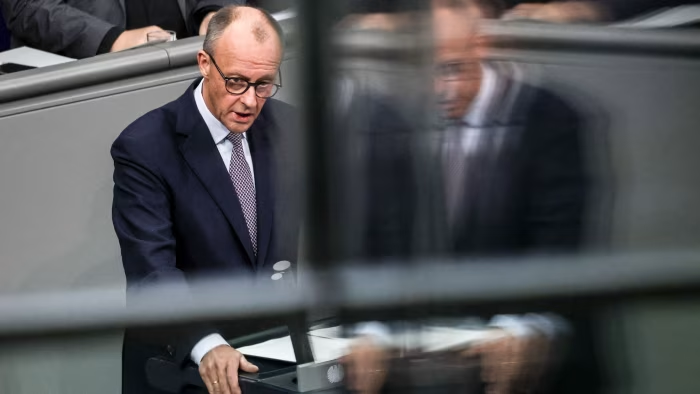
“We need a kind of European stock exchange so that successful companies such as biotech firms from Germany do not have to go to the New York Stock Exchange,” said Merz in a speech to the Bundestag on Thursday. “Our companies need a sufficiently broad and deep capital market so that they can finance themselves better and, above all, faster.”
Merz’s comments come as his government recently agreed to intensify collaboration with France to advance the EU’s capital markets union (CMU), including by handing over powers to a single European supervisor — abandoning Berlin’s previous reluctance to shifting regulatory powers to EU bodies.
EU plans for capital markets integration have stalled in large part due to Germany’s opposition to shifting supervision from the Bonn-based BaFin to the European Securities and Markets Authority (Esma), which is headquartered in Paris. Other countries, including Luxembourg and Cyprus, are also against centralised supervision.
The CMU — and a single watchdog mirroring the US Securities Exchange Commission — were among the priorities listed by former European Central Bank chief Mario Draghi in his report about how Europe can regain its competitive edge against global rivals, including China and the US.
Germany’s finance minister Lars Klingbeil has recently agreed to explore areas where centralised supervision is warranted as part of Franco-German preparatory work on the CMU, three people with knowledge of the matter previously told the Financial Times.
Merz, who advised US asset manager BlackRock and sat on the board of Deutsche Börse before returning to politics in 2018, is backing the CMU push as part of his efforts to revive the German economy after three years of stagnation.
Stéphane Boujnah, chief executive of Euronext, the stock exchange federating seven EU countries including France and the Netherlands, welcomed Merz’s proposal, saying Euronext was “ready to contribute to the next level of consolidation of markets in Europe”.
Boujnah said giving supervisory powers to Esma would address “the divergence in regulation and supervision”, adding: “we need a decisive move towards single supervision.”
Deutsche Börse did not comment on consolidation or supervision but said Europe’s financial system was suffering from “insufficient investor demand and a high degree of fragmentation”.
In his speech ahead of an EU summit next week, Merz outlined a plan for greater EU integration, less regulation and the implementation of recommendations made by Draghi and another former Italian PM, Enrico Letta, on how to eliminate remaining barriers on the bloc’s single market of goods, capital, labour and services.
“Mario Draghi’s report shows that much of the growth gap between the EU and the US is due to insufficient productivity growth in Europe,” Merz said. “Productivity is the most important prerequisite for competitiveness . . . Europe will only become more productive if it changes profoundly.”
Among EU members pushing for greater capital markets integration, France has argued that unified EU oversight of systemic financial infrastructure, such as stock exchanges and central counterparties, will set consistent standards across the bloc, reduce market fragmentation and cut compliance costs for cross-border operators.
The European Commission is working on proposals due this year on empowering Esma with additional supervisory powers of selected entities such as central counterparties, central securities depositories, trading venues, as well as cryptocurrency exchanges. Berlin, however, is for now opposed to Esma oversight on crypto.
Additional reporting by Paola Tamma in Brussels and Florian Müller in Frankfurt