

The new war in the Middle East is a reminder that global peace never seems to last. As tragic as these circumstances always are, it’s worth considering the defense companies that provide America with the machinery and technology it uses to defend itself and its interests.
Investors who are comfortable owning defense stocks could start with Lockheed Martin (LMT 1.27%) and RTX (RTX 1.33%), two prominent industry leaders worth adding to a long-term stock portfolio.
But is Lockheed Martin the better defense stock, or is it RTX?

Image source: Getty Images.
A direct defense play versus a more diversified alternative

Today’s Change
(-1.27%) $-8.21
Current Price
$636.99
Key Data Points
Market Cap
$148B
Day’s Range
$632.95 – $644.10
52wk Range
$410.11 – $692.00
Volume
79K
Avg Vol
1.8M
Gross Margin
10.15%
Dividend Yield
2.09%
Lockheed Martin is the largest U.S. defense contractor. The company’s broad portfolio spans aircraft, missiles and other weapons, space, and mission and technology systems. Most notably, Lockheed Martin sells the F-35 Lightning II to the U.S. and its allies and is a major long-term revenue driver as the most expensive weapons program in world history.
RTX’s Collins and Pratt & Whitney aerospace segments cater to both commercial and government customers. Its defense segment, Raytheon, is best known for missile technologies, including the PATRIOT Air & Missile Defense System, Tomahawk Cruise Missiles, and AMRAAM Air-to-Air Missiles, and it co-produces the interceptor missiles used in Israel’s Iron Dome defense system.
Hopefully, the war in Iran doesn’t last. But the longer it does, the more the U.S. will need to replenish and fortify its military capabilities, and these two companies will play a significant role in that.

Today’s Change
(-1.33%) $-2.75
Current Price
$203.31
Key Data Points
Market Cap
$277B
Day’s Range
$200.71 – $206.67
52wk Range
$112.27 – $214.50
Volume
2.6M
Avg Vol
6.1M
Gross Margin
20.08%
Dividend Yield
1.32%
But which is the better defense stock?
From a numbers standpoint, Lockheed Martin stands out for a few reasons.
First, Wall Street analysts expect much stronger long-term earnings growth from Lockheed Martin than RTX. Ironically, Lockheed Martin also trades at a lower valuation. The stock’s price-to-earnings ratio of 30 is well below RTX’s P/E of 41.
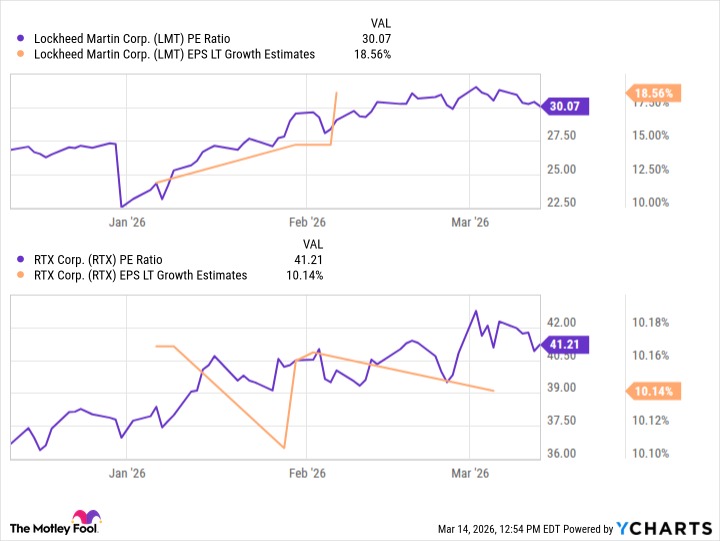
LMT PE Ratio data by YCharts
If you like dividends, Lockheed Martin wins again. The stock yields 2.1% versus RTX’s 1.3%, and Lockheed Martin has raised its dividend annually without fail for more than two decades.
Lastly, Lockheed Martin is on a stronger financial footing. The company is leveraged at 2.3 times its earnings before interest, taxes, depreciation, and amortization (EBITDA), while RTX’s leverage ratio is nearly 3.2. Both companies have investment-grade credit ratings from S&P Global, but Lockheed Martin has the edge with an A- rating versus RTX’s BBB+.
Don’t get me wrong; RTX is a fantastic company. It’s just that Lockheed Martin checks too many boxes not to be the better defense stock, and its lower valuation is just icing on that cake.