
I am the Lorax. I speak for the trees. For the trees have no tongues – Dr Zeuss
The national conversation about land, always simmering in South Africa, has come to the boil again. What’s often missing is a voice for the unrepresented party – the land. I’d like to be that voice.
The arguments are always over the land, but seldom about what it needs to remain healthy and productive. The state of the land – its capacity to deliver benefits to people, such as food, water, amenities, cultural meaning and protection from hazards – isn’t independent of how it’s managed.
Unlike inert resources such as ore bodies, the rate at which living, renewable natural resources like grass, forests, animal populations and soil are used, greatly influences the amount which is ultimately delivered. They can provide a sustained flow of benefits forever if treated right, or collapse irreversibly if abused.
How is this relevant to the political question of who owns the land? There are three points of connection: the tenure system which determines the rights under which the land is managed; the effective size of the properties; and use intensity.
The legal form under which the land is held has profound consequences for its ecology. Broadly there are four types of land property regimes worldwide: freehold (private), state owned, lease-hold and communal. In South Africa most land is freehold. The state owns about 21% in national parks, military training areas and through state-own enterprises.
Leasehold is not very common outside of urban areas, which make up less than 2% of the land surface. About 12% of South Africa is under communal ownership, where the land is used and managed collectively by a defined group, but a third of the population use this resource.
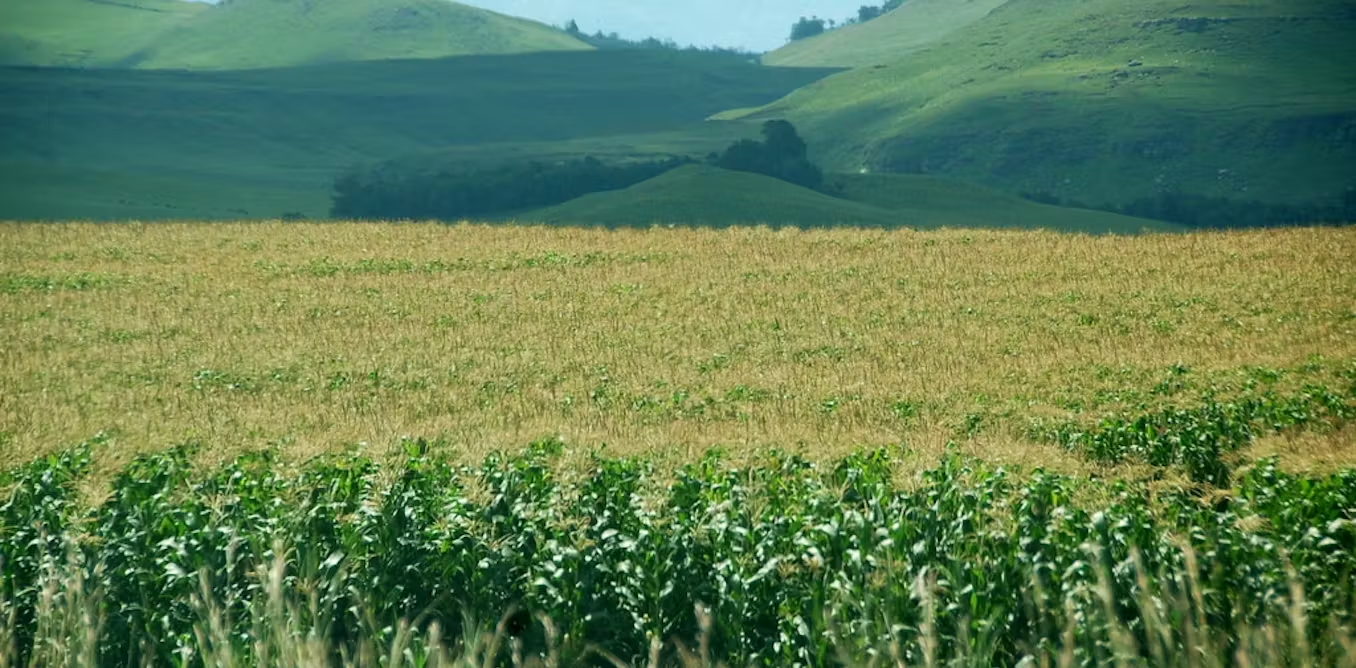
About three-quarters of South African land is used for agriculture, of which one fifth is cropland, and the rest is grazed. Close to a fifth of the land is currently under some form of wildlife-based use, mostly as private game farms, with a large area of state-owned conservation land, and a few examples of communally-owned wildlife areas.
The impact of ownership systems on ecology
An example of the ecological consequences of different legal forms of land use can be observed in Australia. In the middle of Australia – a notably homogenous environment – several states abut, each with different tenure systems: freehold, one-generation or multi-generation leasehold, state land under rental, and communal land. All have affected the condition of the land. Generally speaking, freehold and long-term leasehold perform similarly in terms of sustained productivity, and fare better than shorter-term leasehold or short-term rental of state land.
The logic is that when the land-user has confidence that he or she, or their descendants, will benefit from careful stewardship of the land, they are willing to forgo short-term gain in favour of long-term performance.
This shows that when land reform results in ownership transfer, it is important that it’s accompanied by long-term security of tenure. The worst outcome is where the land is used without a sense of long-term responsibility.
This also applies to communally owned land. The merits and demerits of communal land ownership is a much-debated issue. Historically, common ownership was the norm worldwide, and does not automatically lead to degradation provided that there’s a strong set of institutions to define and enforce fair and wise use.
Communal ownership isn’t the same as open-access, a system under which no use constraints apply. Under this system there’s little incentive for an individual to limit their use, a condition described as “the tragedy of the commons”.
South African Tourism/Flickr
The size of land parcels
The scale at which land is managed includes the question of the financial size of the enterprise. “Economies of scale” accrue to larger operations, which are also better equipped to survive climatic vagaries. But the main concern in this article is ecological scale. The processes which keep land healthy and productive work at characteristic scales in both time and space. When the scale of management is much smaller than the scale of ecological function, problems of land degradation often arise.
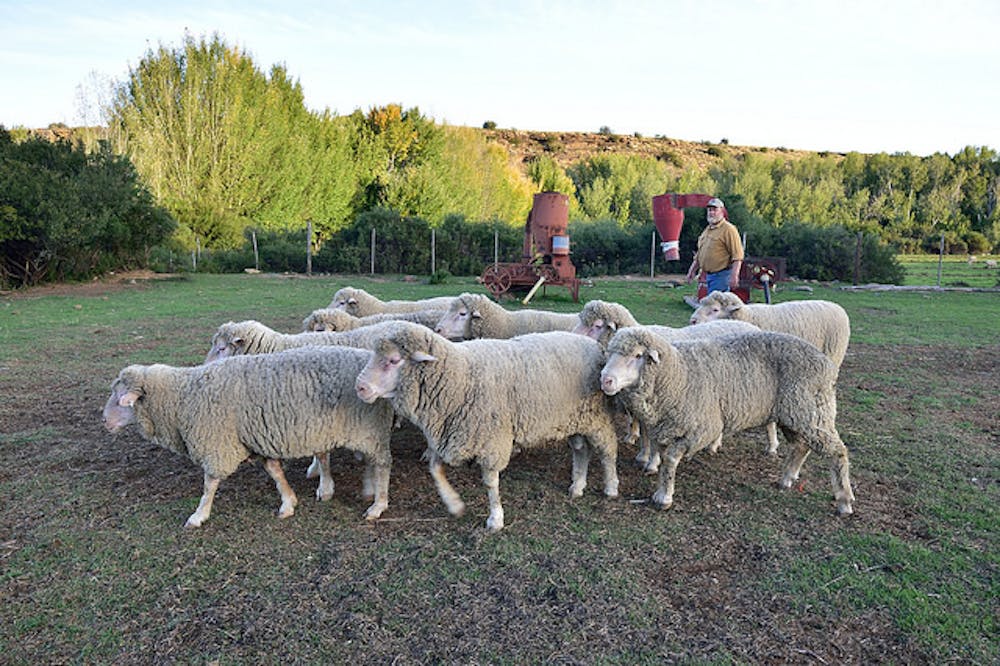
For instance, in the pre-colonial period, much of southern Africa supported migratory wildlife. The herds, numbering millions, ranged over hundreds of uninterrupted kilometres. In the past two centuries, the land has been subdivided into progressively smaller, individually-managed farms; each fenced, provided with permanent water from boreholes, and stocked with sedentary herds of cattle or sheep. Thus, the spatial scale of keeping animals changed to just a few kilometers, and the time scale from infrequent to continuous grazing.
Sometimes a landscape can be tricked into functioning ecologically at the scale under which it evolved, despite being owned and managed at smaller scales. Rotational grazing, and destocking at times of drought, are two such tricks.
Land reform programmes which divide large properties among a large number of claimants tend to lead to settlements being spread over the landscape in a way that fragments ecological processes. Since each parcel is too small to support a decent livelihood, the risk of overuse increases.
Use intensity, ownership and scale
How hard the land is used in relation to its inherent productive capacity – or “use intensity” – is important in its own right. But it also has links to ownership and scale.
It’s true of any renewable resource that there is an optimum use intensity for a given objective. For example, the question of overgrazing has been strenuously debated in Africa .
If land is persistently overstocked, the result is degradation – with adverse consequences for the land user and society as a whole.
Similarly, it’s possible to have under-intensive management regimes. For instance, crop agriculture where the inputs of seed, nutrients and cultivation are small may produce sufficient yield to support a family, but not enough surplus to feed the nation. South Africa is an agriculturally marginal land, where national food sovereignty requires most of the limited arable land to be under high input, high technology cropping. But there are also over-intensive cropping regimes which damage the soil, atmosphere and rivers.
The intensity applied by a given land user depends on the knowledge, expertise, capital and resources they have available to them, as well as the presence of perverse incentives to over-exploit the resource or positive incentives to conserve it. These are all affected by the support context in which land reform takes place.
The discussion of how best to use the South African landscape shouldn’t only include land owners and claimants. Society as a whole has expectations from its land: to grow affordable and healthy food, yield clean water, support tourism and recreation, sustain abundant biodiversity and provide a sense of place for all.
These objectives cannot be satisfied unless the ecological needs of the land are considered together with the social and political needs of its people.