
Matt McGrathEnvironment correspondent

 Getty Images
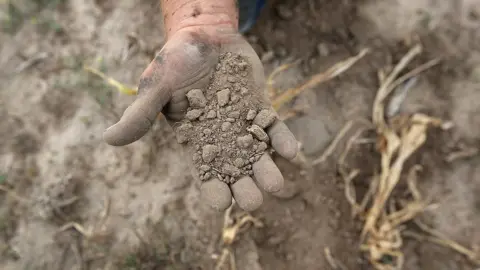
Human activities are damaging and degrading the lands of the Earth in an unsustainable fashion according to a new UN report.
Up to 40% of the global terrain has already been devalued, mainly through modern agriculture.
If nothing changes, then an additional area of land the size of South America will be damaged by 2050.
But if lands are restored and protected, they could help contain climate change and species loss.
This second edition of the Global Land Outlook has been five years in the making, and it examines how the world is managing land resources such as soil, water and biodiversity.
A major focus is the degradation of the lands of the Earth. This means the actions that are causing the land’s overall health to decline, become less fertile, store less carbon and be able to support fewer species.
The report outlines the damage that’s already been done but also offers hope that improvements in how we manage the land environment can offer a better future.
Right now, around half the world’s population is affected by the degradation of our lands.
- Just 1% of farms control 70% of the world’s agricultural land, while 80% of all farms are under 2 hectares.
- Around $700bn is paid in agricultural subsidies each year but only around 15% has a positive impact on natural capital or biodiversity.
- At least 70% of the clearing of forested areas for agriculture between 2013 and 2019 was done in violation of national laws.
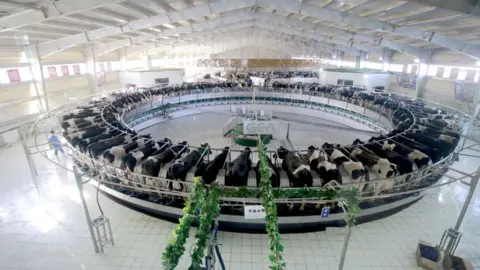
Food systems have been the single biggest cause of damage – being responsible for 80% of the deforestation and 70% of freshwater use.
If things continue as they are then an extra 16 million square kilometres will be degraded by 2050. That’s an area the size of South America.
Business as usual would also see a long-term decline in yield for 12-14% of agricultural, pasture and grazing land and natural areas – with sub-Saharan Africa worst affected.
“We cannot continue to just take land for granted,” said Ibrahim Thiaw, who is the executive secretary of the UN Convention to Combat Desertification (UNCCD).
 UNCCD
UNCCD“We cannot just continue to think that there is enough land out there, that there’s enough water and forest and wetlands to destroy, to respond to our insatiable greed, so to speak, for food and fibre and animal feed.”
While the Global Land Outlook report paints a challenging future if nothing changes, the picture is far more positive if governments take steps to restore and protect land.
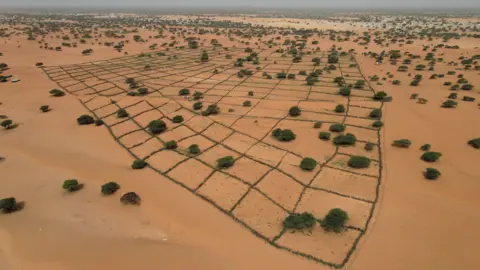
Restoration involves planting more trees, managing grazing more effectively and assisting the natural regeneration of some areas.
If governments go beyond restoration and actively protect lands as well, this would see crop yields increase in most developing countries, limiting food price rises.
It would also bolster the ability of the soil to store carbon and water. Biodiversity losses would continue but about a third of the projected losses would be prevented.
To achieve this will take political will, but cash will also be needed.
The UNCCD point out that around $700bn are given in what they term “perverse subsidies” to the fossil fuel and agriculture industries each year.
Repurposing about a third of this money would allow governments to restore 1 billion degraded hectares by 2030, an area the size of the US.
The UN says that many regenerative agriculture practices can boost crop yields while also drawing down more carbon from the atmosphere.

Small steps
The report is filled with examples of changes that can help farmers restore and protect their lands such as:
- Rewilding – allowing natural ecological processes to re-establish
- Forest landscape restoration with high value crops
- Terrace and contour farming to prevent soil loss
- Conserving and restoring watersheds and rainwater harvesting
Some $19bn has been committed to support regenerative agriculture from both public and private sources.
And it’s also a good investment – for every dollar invested in land restoration, the UN says the return can be up to $30 in benefits.
 VCG
VCGBut to really make a difference will require action from citizens as well as governments.
The UN says that consumers all over the world can have a major impact on the ways that land is managed.
“We all have to be, as consumers, conscious of the fact that yes, we can do something,” said Mr Thiaw.
“It’s not only about buying, but also about what we eat. When you are conscious of the fact that people in richer countries waste more than 100 kilos of food per capita, then you can change your habits.”
“It’s also about what we wear. And our daily decisions all have a bearing on land.”