
Commercial real estate is in the middle of one of its biggest transitions. For years, the challenge was finding data. Now the challenge is knowing what to do with it.

Lobby AI
Artificial intelligence (AI) is starting to change that. The conversation has shifted from if we should be using AI to how we can use it in a way that actually improves business outcomes.
REBusiness recently spoke with Rob Finlay, founder and CEO of Defease With Ease | Thirty Capital, and Trevor Albarran, VP of product at Lobby AI, about how AI is changing decision-making in commercial real estate (CRE), what early adopters have learned and what leaders should be focusing on next.
REBusinessOnline (REBO): What’s the biggest opportunity facing CRE executives today?
Rob Finlay: It depends on the context, but right now, AI is the most powerful tool a real estate executive can have in their arsenal. AI finally gives principals — the people paid to think — the space to actually do that.
When I started in real estate, I was paid to do. But as my role evolved, my value shifted to thinking — being strategic, motivating teams, and making high-level decisions. AI amplifies that ability. It takes care of the heavy lifting so leaders can focus on leadership, and can do so at a minimal cost.
REBO: Many firms have already experimented with AI. What did those early efforts reveal?
Finlay: A recent study found that nearly nine out of ten CRE firms have started testing AI, but only a small fraction have actually achieved their goals. That tells me the issue isn’t the technology. It’s the approach.
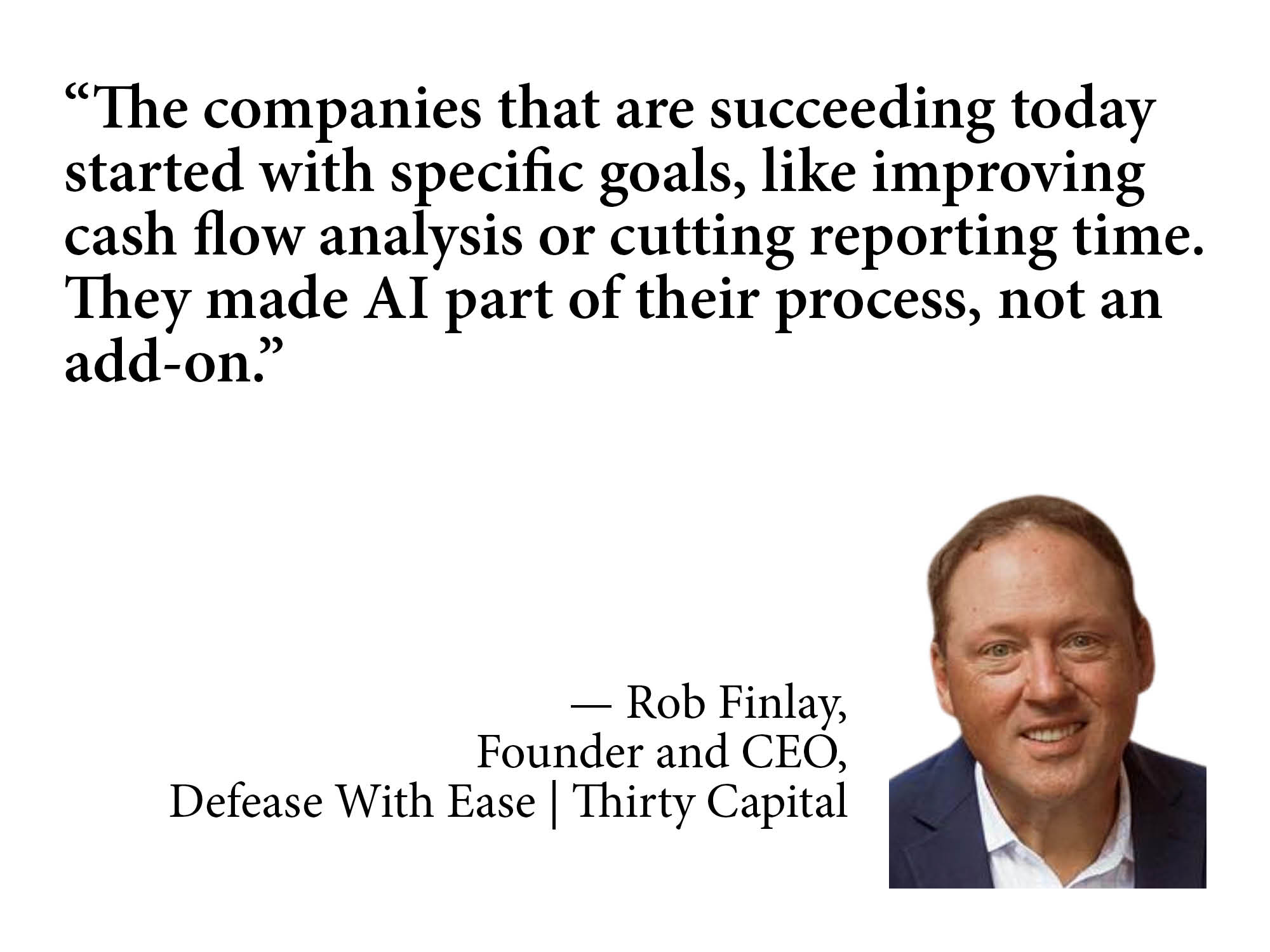
Too many teams treated AI like a side project. They wanted to experiment instead of solving a clear business problem. The companies that are succeeding today started with specific goals, like improving cash flow analysis or cutting reporting time. They made AI part of their process, not an add-on.
Also in many cases, executives delegate their AI initiatives to people who are understandably nervous about being replaced by it. And they’re right to be. You won’t be replaced by AI, but you will be replaced by someone who knows how to use it if you don’t.
Trevor Albarran: Right. What we saw in the first wave wasn’t a failure of the technology. AI is already capable of doing 80 percent of the analysis work most teams spend their week on. The failure was in execution. Most firms treated AI like a novelty: “Let’s try a few prompts, maybe it’ll spit out something interesting”. That’s not transformation.
The companies that actually made progress approached AI the same way they approach any real operational upgrade: define a measurable problem, attach it to revenue or risk and plug AI directly into the workflow that owns that outcome.
REBO: What’s the role of purpose-built AI in all of this?
Albarran: Generic AI gets you maybe 10 percent of the value. It’s helpful for surface-level tasks (summaries, explanations, rewriting something), but CRE isn’t a surface-level domain. Once you get past the chat interface and into real underwriting, debt sizing, rent roll normalization, entity structures, waterfall math or lender packages, you hit the wall immediately.
Purpose-built AI is what gets you past that wall. It combines your own rent rolls, loan docs, trailing 12 month reports (T12s), budgets, entity records and historical performance with specialized agents trained specifically on CRE workflows. That’s where AI stops being “a clever assistant” and becomes an actual part of your back office. It’s also what lets executives trust the output enough to make decisions and not just get summaries.
In other industries, generic AI is good enough. In CRE, it’s just the top 5 percent of the iceberg.
REBO: What does effective AI adoption look like in practice?
Finlay: It starts with utilization and small wins and just getting people to use AI. It will quickly become second nature. We’ve seen it on our own platform: adoption begins slowly, then suddenly takes off like a hockey stick. Once teams start using AI the way it’s meant to be used (i.e., engaging with it, strategizing with it, thinking through problems with it), there’s really no limit to what it can do.
Albarran: The first milestone is always the same: getting people to stop treating AI like a search bar and start treating it like a thinking partner. Once teams experience that shift, utilization jumps on its own. You can literally track the moment when someone stops pasting in a prompt and starts having a conversation with the model about what’s affecting their business; the capital stack, the DSCR constraints, the lease rollover, the budget variance, etc.
REBO: How is AI changing the relationships between lenders, investors and operators?
Finlay: AI gives executives the ability to walk into any conversation — with lenders, investors or their own teams — fully equipped with the answers, or at least the right questions. It levels the playing field and allows them to be the smartest person in the room.
Albarran: Rob is exactly right. The biggest shift is informational parity. AI gives operators and executives the same level of clarity and preparedness institutional players have historically had.
REBO: What new skills will CRE leaders need as AI becomes more integrated into business?
Finlay: The best part about AI is that it gives leaders the space to think strategically again. It’s less about learning new technical skills and more about sharpening your ability to ask the right questions, interpret insights and make smarter decisions faster.
Albarran: Exactly, it comes down to communication, both with people and with AI. Leaders don’t need to understand how large language model (LLMs) work; they need to know how to ask sharper questions in a way that improves response accuracy. They also need to translate AI-generated insights into clear direction their teams can act on. Data only matters when leaders can communicate it in a way that makes everyone better at their job.
REBO: What should executives keep in mind as AI adoption grows?
Albarran: The future of AI in CRE is about balance. It’s about combining human experience with machine precision. The people who thrive will be the ones who shift their time toward strategy, judgment and scenario analysis — the work CRE leaders wish they had more time for.
Finlay: The next generation of CRE leaders will succeed by turning information into intelligence. Winning won’t come from collecting more data or adding more tools, but from making smarter decisions with greater speed and confidence.
Defease With Ease | Thirty Capital is a content partner of REBusiness. To learn more about Defease With Ease | Thirty Capital, click here.