
Last Updated:
KGF wasn’t shut because it ran out of gold. It was shut because extracting that gold no longer made financial sense at the time. So what has changed now?




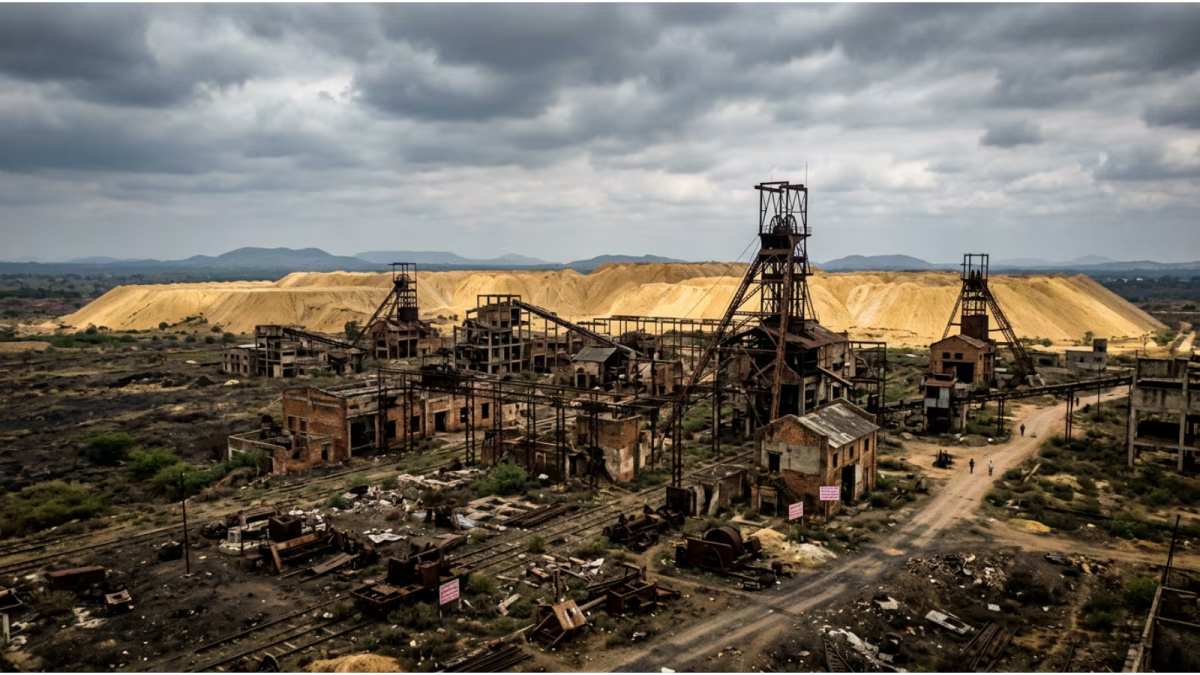
In simple terms, the KGF mines were still producing gold — but not enough to justify the cost of extracting it. (AI Generated)
India may soon revisit one of its oldest gold mining hubs — not to dig new mines, but to extract value from ‘gold waste‘.
A parliamentary panel has urged the mines ministry to expedite the monetisation of around 33 million tonnes of gold-rich tailings lying at Bharat Gold Mines Limited (BGML) in Kolar Gold Fields (KGF), Karnataka. These tailings — essentially mining “waste” — are believed to still contain recoverable quantities of gold and other precious metals, even as they pose environmental risks due to the presence of chemicals and heavy metals.
BGML, a public sector undertaking under the mines ministry, has remained shut since 2001 after operations became economically unviable. The government has continued to maintain the defunct entity — with Rs 8.75 crore allocated in the 2026-27 Budget — even as it explores options to revive value from its legacy assets.
This renewed focus raises a fundamental question: if gold still exists at KGF, why were the mines shut down in the first place?
A Mine That Became Too Expensive To Run
KGF, once among India’s most productive gold mining hubs, was operated by BGML, a public sector undertaking under the mines ministry. By the late 1990s, the mines were facing a harsh reality: the cost of extracting gold had far exceeded the value of the gold being recovered.
The easily accessible, high-grade gold had already been mined. What remained was lower-grade ore with very small quantities of gold. Moreover, KGF’s mines were among the deepest in the world, making operations more complex, risky, and expensive. Even labour, energy, and maintenance costs kept increasing over time.
In simple terms, the mines were still producing gold — but not enough to justify the cost of extracting it.
Why Gold Was Left Behind
Even as operations continued, a significant amount of gold was left in what is called ‘tailings’ — the leftover material after processing ore. Technology at that time was limited. Older extraction methods could not recover very fine gold particles. Plus low-grade material was ignored as processing it would have been too expensive for the returns it offered. So while gold technically remained, it was considered uneconomical to pursue.
The Environmental Cost Of ‘Gold Waste’
These tailings are not just leftover rock — they can also be environmentally hazardous. Gold mine tailings often contain processing chemicals and trace heavy metals. Over time, these can leach into groundwater, contaminate soil, and create toxic slurry ponds.
At KGF, these dumps have accumulated over decades, forming massive storage sites of crushed rock, water, and residue. This is why they are often seen as both a potential resource and an environmental liability.
Reprocessing them could lead to recovery of valuable metals, but also disturb existing deposits, potentially releasing contaminants if not handled carefully.
The Shutdown And What Followed
As losses mounted, BGML’s operations were officially shut down in 2001 after being deemed economically unviable. A few years later, in 2006, the Union Cabinet approved a plan to dispose of BGML’s assets through a global tender, with the first right of refusal offered to a society of former employees. However, that plan never fully materialised.
Since then, BGML has remained largely dormant, with only minimal maintenance. The 2026-27 Union Budget has allocated Rs 8.75 crore for its upkeep.
Why KGF Is Back In Focus Now
Two decades later, the same site is back in focus — not for fresh mining, but for what was earlier discarded.
A parliamentary panel — the Standing Committee on Coal, Mines and Steel — has urged the government to expedite the monetisation of around 33 million tonnes of gold-rich tailings lying at KGF.
These dumps are believed to still contain recoverable quantities of gold and other precious metals, prompting the government to explore viable options for BGML’s future.
Why It Makes Sense Today — And Why It’s Complicated
The same material that was once ignored is being reconsidered because better extraction technology can now recover gold that was earlier lost, higher gold prices make even low-grade recovery viable, and global push for resource efficiency favours reprocessing existing waste.
But the bigger question remains: can this gold be extracted without worsening existing environmental damage?
Karnataka, India, India
March 19, 2026, 13:21 IST
Read More