

Silver is a precious metal, so it falls into the same category as gold, except it is used extensively in industrial applications whereas its shiny yellow counterpart isn’t. In fact, over half the annual supply of silver is soaked up by manufacturers of electronics, alloys, solders, and more.
The price of an ounce of silver soared by 144% in 2025, partly because China announced new export restrictions which stoked fears of supply disruptions. The metal gained further ground in the early stages of 2026, but it’s actually down 28% from last year’s peak price of $121 per ounce.
The iShares Silver Trust (SLV 2.72%) is an exchange-traded fund (ETF) that directly tracks the price of silver. It can be purchased through any major stock trading platform, so it’s a popular alternative to buying physical silver, which carries storage and insurance costs.
Should investors buy the ETF following silver’s recent correction? Here’s what history says it could do next.

Image source: Getty Images.
Conditions favor more upside in silver
Investors typically buy precious metals during times of heightened political and economic uncertainty, because they are proven stores of value dating back thousands of years. Gold is the primary choice because of its scarcity, with just 219,890 tons of the yellow metal extracted from the ground throughout human history. Silver is more abundant with around 1.7 million tons mined to date.
Precious metals don’t produce any revenue or earnings, so they don’t grow in value organically. Instead, their perceived value tends to rise as the value of fiat currency declines. The U.S. dollar, for example, has lost around 90% of its purchasing power since 1971, which is the year the country abandoned the gold standard — a mechanism that prevented the government from printing more money unless it had an equal amount of physical gold to match.
Unsurprisingly, since the government has been able to print more dollars at its own discretion over the last five decades, money supply has exploded. The below chart shows the relationship between the rising money supply, the declining purchasing power of the U.S. dollar, and the rising value of gold in dollar terms:
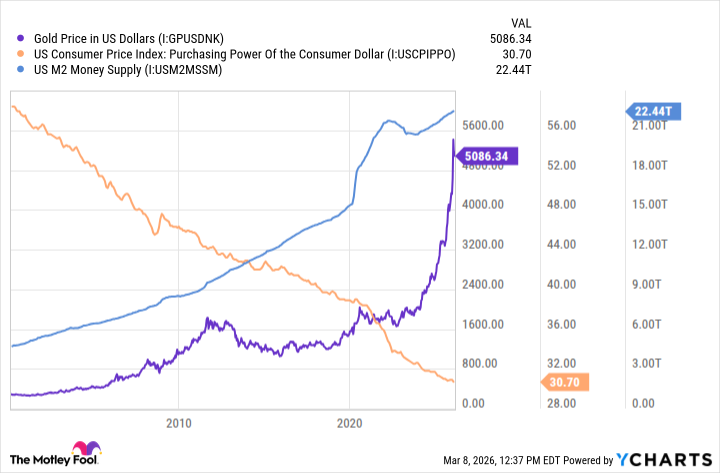
Gold Price in US Dollars data by YCharts
Political turmoil and economic uncertainty are rife right now, with the Trump administration levying tariffs on most of America’s trading partners, and also running substantial fiscal deficits which ballooned the national debt to a record high of $38.5 trillion last year. Investors fear the only way the government can sustain this fiscal trajectory is by devaluing the U.S. dollar through a further increase in money supply.
As a precious metal, this will benefit silver as well as gold, but silver’s value is more heavily influenced by supply-demand dynamics. In 2024, around 58% of its annual supply was absorbed by industrial manufacturers, and a further 18% was used by the jewelry industry. Investors, on the other hand, represented just 16% of the market for physical silver.
That’s why China’s restrictions triggered such a sharp rally last year. The country is the world’s second-largest exporter of silver behind Hong Kong, but it’s also one of the world’s top manufacturers of electronics. As a result, it’s trying to protect its domestic supply chains by limiting how much silver can be shipped overseas during 2026 and 2027 at least.
Investors should temper their expectations
Although conditions seem perfect for more upside in silver, it’s important to remember that gains of 144% in a single year are not normal. Over the last 50 years, the metal has generated a compound annual return of just 6.2%, which is a more realistic target going forward.

Today’s Change
(-2.72%) $-2.18
Current Price
$77.91
Key Data Points
Day’s Range
$76.45 – $78.06
52wk Range
$26.57 – $109.83
Volume
2.7M
Avg Vol
109M
Volatility is another important consideration. Prior to 2025, silver hadn’t set a fresh record high in 14 years, and its two most powerful rallies since 1980 were followed by sharp corrections of more than 70%. Since silver is already down 28% from last year’s peak, we can’t rule out even further downside.
With all of that said, it’s understandable if investors want to park some money in silver given the tailwinds we explored above. But before rushing out to buy physical metal, it’s worth considering the benefits of an ETF like the iShares Silver Trust. It can be bought and sold with a few clicks through any major investing platform, whereas disposing of physical silver is a much slower process, and carries risk because it has to be transported to a dealer.
The iShares Silver Trust isn’t free to own, because it has an expense ratio of 0.5% which is the proportion of the fund deducted each year to cover management costs. It means an investment of $50,000 will incur an annual fee of around $250, but that’s probably still less than the cost of storing and insuring an equivalent amount of physical silver.