
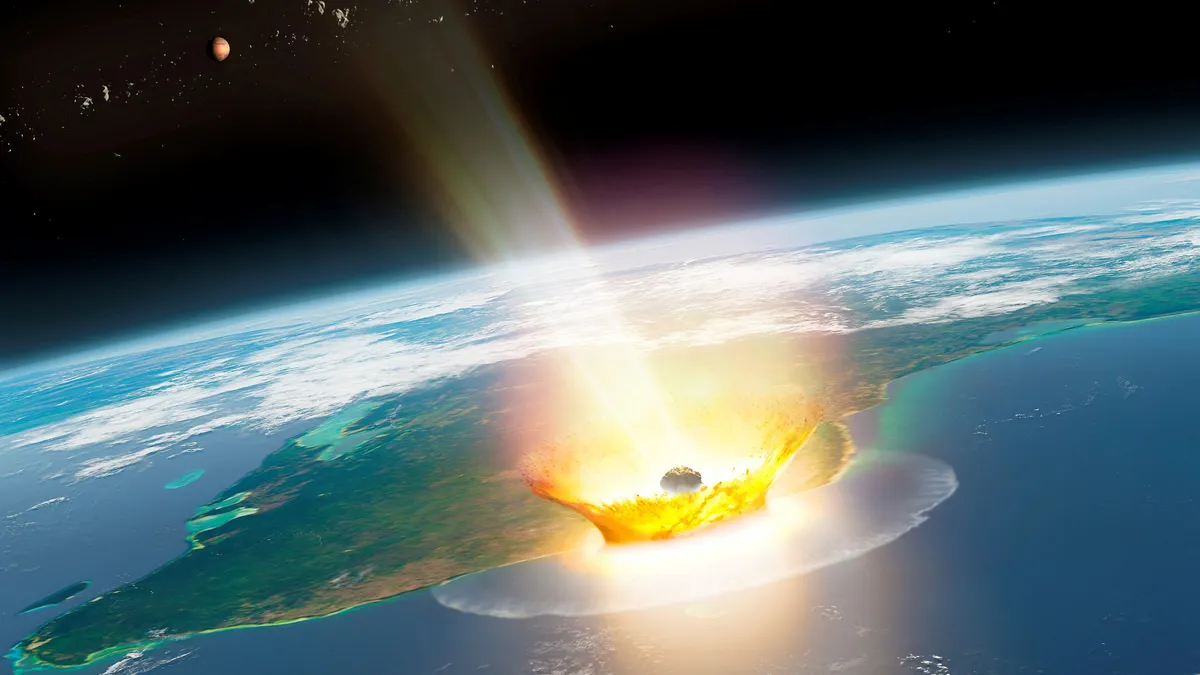
German scientists found evidence that the space rock came from the outer limits of our solar system, well beyond Jupiter, during its early development.


Stegosaurus dinosaur fossil sold for millions at auction
Believed to be the most complete Stegosaurus dinosaur fossil, the 70% complete, 11-foot-tall, 20-foot-wide “Apex” sold for millions at auction.
- The researchers are not the first to propose that the space rock belonged to a group of asteroids that formed beyond the orbit of Jupiter.
- Their findings, however, strengthen the case thanks to a rare element called ruthenium.
- Because ruthenium is abundant in asteroids and extremely rare in the rock forming Earth’s crust, traces of it are almost a surefire sign of space rocks.
German scientists think they’ve cracked the case on the origins of the giant asteroid that all but wiped out the dinosaurs 66 million years ago.
The huge space rock known as the Chicxulub impactor is widely believed to have ended the reign of non-avian dinosaurs, altering the planet’s climate and paving the way for mammals to rise from the proverbial ashes. But because we can’t exactly wind back time to watch the asteroid crash into what is now Mexico – creating the Chicxulub crater near the modern-day town of the same name – paleontologists have long debated the nature and origins of the dino-killing object.
Now, a team of geoscientists from the University of Cologne say they have found strong evidence to support the theory that the space rock came from the outer limits of our solar system during its early development. By studying remnants of the space rock collected in Europe, the researchers found signs of ruthenium – a rare element contained within asteroids from well beyond the orbit of Jupiter.
Here’s what to know about why the findings are important, as well as the drawn-out debate over exactly what caused the mass extinction of dinosaurs tens of millions of years ago.
Meet ‘Gnatalie:’ Dino skeleton to be displayed in LA is big, green and 150 million years old
What happened when the asteroid hit Earth?
Exactly what factors are to blame for wiping out 75% of life on Earth, including the dinosaurs, and ushering the end of the Cretaceous period have long been debated.
However, the most widely accepted theory for the mass extinction is that an asteroid (or, perhaps a comet) at least 10 kilometers in diameter crashed near modern-day Chicxulub on the Yucatán Peninsula in Mexico.
Evidence at the Chicxulub crater supports the notion that the crash would have been devastating enough to send deadly vaporized rock and gas into the atmosphere, filling the Earth with dust, debris and gas that drastically altered the climate. As fine dust particles obscured the sun, photosynthetic activity wound to a halt for several years, making life for many living creatures impossible.
Apophis 2029 flyby: Asteroids safely fly by Earth all the time. Here’s why scientists are watching Apophis.
Another theory? Volcanoes
But was the meteorite alone responsible for the mass extinction when it unleashed devastating tsunamis and ash that blotted out the sun? Or did massive volcanic eruptions at a site called the Deccan Traps in India doom life on Earth long before?
Reigniting the debate, an October study posited that volcanic eruptions may have already thrown the ecosystem into chaos and threatened the existence of non-bird dinosaurs before the asteroid crashing into Earth delivered the final blow.
The international team of researchers behind the study are the latest experts who claim that the world the dinosaurs roamed was one teeming with critical levels of sulfur that set the stage for their extinction. Such instability would have triggered a global drop in temperatures around the world, creating conditions inhospitable to life, according to the research.
Where do scientists think the asteroid originated?
Whether volcanic activity played a major role in the dinosaur extinction remains up for debate, but the German researchers did find evidence to rule out that the impactor could have been an icy comet.
So, whatever caused that giant six-mile-wide crater in Mexico was definitely an asteroid made up of metals and rocky material.
But where did it come from?
The researchers are not the first to propose that the space rock belonged to a group of asteroids that formed beyond the orbit of Jupiter. Their findings, however, strengthen the case thanks to a rare element called ruthenium.
Because ruthenium is abundant in asteroids and extremely rare in the rock forming Earth’s crust, traces of it are almost a surefire sign of space rocks.
Led by Mario Fischer-Gödde, a research scientist at the University of Cologne, the team searched for isotopes of ruthenium in the geological remnants of the Chicxulub impact. The impact was so powerful that it released dust particles that formed a layer of sediment around the entire globe, allowing the researchers to collect samples from European regions of Earth’s crust.
The sediment indeed was composed with ruthenium, allowing the scientists to conclude that the asteroid originally came from the outer solar system outside of Jupiter’s orbit.
“We found that the impact of an asteroid like the one at Chicxulub is a very rare and unique event in geological time,” said researcher Carsten Münker in a statement. “The fate of the dinosaurs and many other species was sealed by this projectile from the outer reaches of the solar system.”
The study was published Thursday in Science.
Eric Lagatta covers breaking and trending news for USA TODAY. Reach him at elagatta@gannett.com