
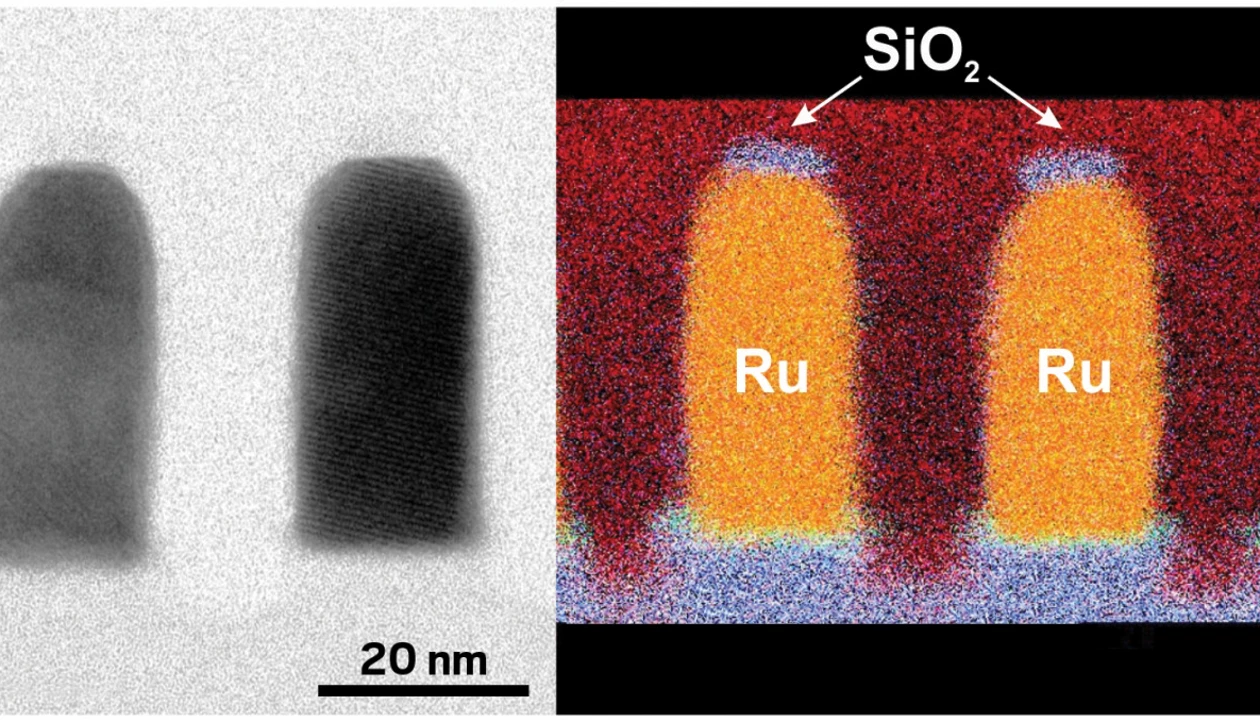
Ruthenium wires, shown here from above (left) and in cross section (center and right), are resilient and have good electrical resistance. Credit:
Imec

To continue improving computing performance, engineers must not only develop new transistors and memory cells but also reconsider the humble wire. The copper wires connecting components in today’s chips are being pushed to their limits, with increasingly narrower connectors carrying heavier currents. In a couple generations of chips, the smallest of these copper wires will be pushed literally to their breaking point.
Last week at the annual Imec Technology Forum in San Francisco, engineers made the case that the metal ruthenium has potential to replace put-upon copper in these wires. Such a replacement, these engineers argue, could prevent the semiconductor industry from tripping over a wiring problem in coming years.
A single computer chip contains kilometers of electrical wiring. These minuscule copper wires, some just 25 nm in diameter, carry electrical power and signals on and off chips and between transistors, memory cells, and other chip components. As transistors get smaller, so must the wires, called interconnects, that link them. “It’s getting increasingly difficult with copper,” says Zsolt Tőkei, who directs interconnect research at Imec, a nonprofit nanoelectronics research organization in Leuven, Belgium.
Resistance in any wire increases as its diameter shrinks. Copper has a lower electrical resistance than many alternative metals, but in the reality of an actual chip, things get complicated. The metal tends to leach into and damage the silicon surrounding it in a chip. So engineers have to line copper wires with barrier metals such as cobalt and tantalum. That means the actual copper wire is even narrower and more resistive as engineers miniaturize it.
Copper also has a reliability issue. Swift electrical currents create what engineers call an electron wind that can physically dislodge copper atoms from a wire, eventually causing electrical shorts. This problem is known as electromigration.
So researchers are on the hunt for interconnect materials that have the right balance of properties to replace copper. The material must have low resistivity with no need for barriers and be resistant to electromigration. Engineers also have to consider practical factors like how much the raw materials cost and whether these potential connectors can be integrated into computer chip fabrication using low-cost processes.
A combination of theoretical modeling and experiments pointed to ruthenium as a possible replacement, Tőkei says.
The Imec group evaluated different materials based on their resistivity and cohesive energy, an approximate stand-in for electromigration that measures how much energy it takes to break a bond and bump an atom out of its place. Many pure metals and compounds look promising by these metrics—particularly those in the platinum group. And metals in this group don’t require a wire barrier like copper does.
The team decided to perform experiments to confirm these predictions with ruthenium, a promising and reasonably priced platinum-group metal that’s already found some use as a copper-wire liner. The engineers couldn’t fabricate ruthenium wires using typical methods because the metal is hard to polish—a key step in fabrication. Instead, the Imec group coated silicon wafers with a layer of silicon dioxide, followed by a layer of ruthenium and then another layer of the oxide. They used lithography techniques to etch out thin ruthenium wires.
Ruthenium wires made by these methods and measuring 8 nm wide have half the electrical resistance as comparable lined copper wires. In another experiment, the group showed that they could use ruthenium to make bigger features such as long power rails that carry electrical power into all the layers of a computer chip.
Daniel Edelstein, a research fellow at IBM’s Thomas J. Watson Research Center, says demonstrating the effectiveness of one layer of ruthenium wires with this etching method is promising. But, he notes, that demonstration is not the same as building a fully connected multilayer chip. He says doing this with ruthenium and other noble metals will be challenging, especially with these methods. “You can do single wire levels but not integrate them,” he says.
Even if these issues are addressed, Edelstein expects that copper will continue to be used for parts of the chip where dimensions are not quite as small. But, he says, it’s unclear which material will replace copper in the finest interconnects.
Ruthenium is just one of many alternatives under consideration right now. Last year, Intel announced that they would use cobalt interconnects in the finest-featured layers of some chips. Chemists are also working on complex compounds, including graphene and titanium compounds like Ti4GeN3, that are further from production but have attractive resistivity or resilience.
Chemical & Engineering News
ISSN 0009-2347
Copyright ©
2026 American Chemical Society