
Look on my works, ye Mighty, and despair!
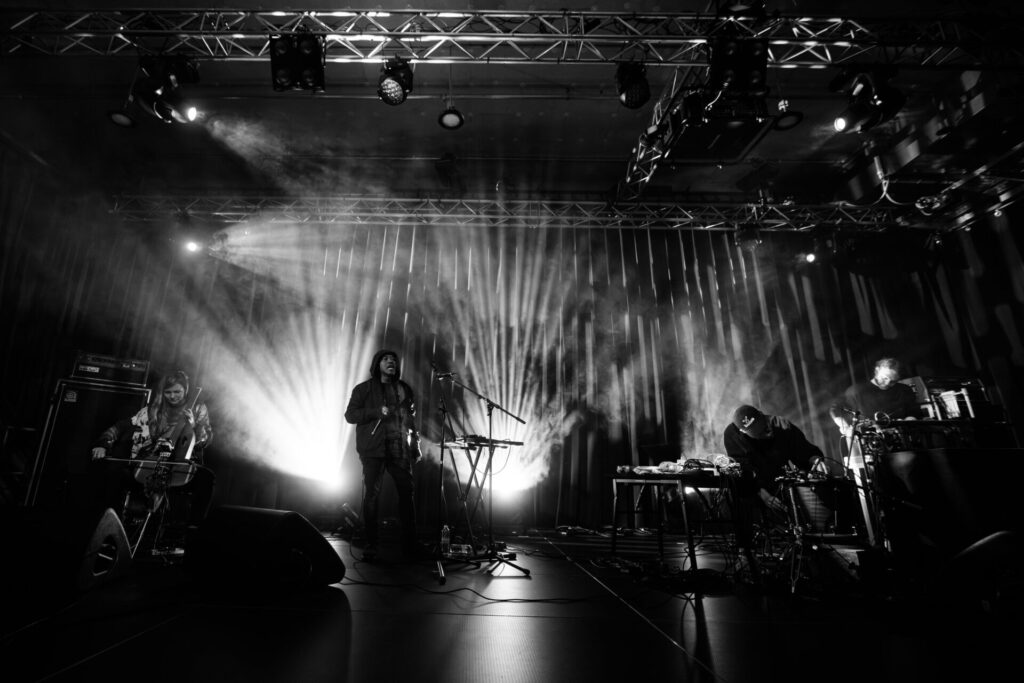
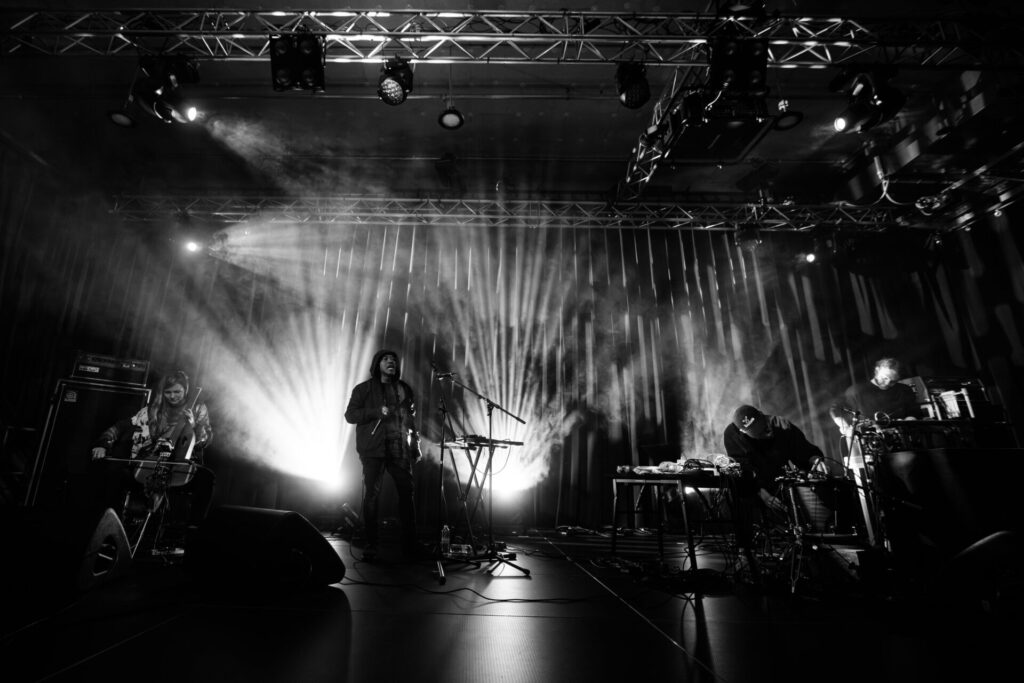
Words can, like Shelley’s, bring a certain irony to a situation. Written down, the bare facts about experimental supergroup Osmium and their self-titled debut look daunting. Oscar-winning composer and cellist Hildur Guðnadóttir, Emptyset and Subtext engineer and producer James Ginzburg, Rully Shabara from Indonesian experimental duo Senyawa and Grammy-winning sound designer and producer Sam Slater used an array of custom-built instruments, self-designed robotics and modulations of the voice to “explore the relationships between humans and technology, tradition and progression”. Osmium is, as Rully Shabara pointed out during our interview, “the heaviest metal”. How on earth are we mortals supposed to connect, let alone listen?
Pulling together the backstory sometimes felt like making a 1:1 scale, drivable kit of a submarine using instructions in a non-Latin language. Slater and Ginzburg sent in precise and detailed explanations of how they created their self-oscillating drum and monochord. Shabara rang in from a noise gig somewhere in Java, his answers now and then blotted out by background racket. Guðnadóttir chatted about the mysterious halldorophone she plays whilst stuck in a traffic jam, driving her son to football practice.
Still: learning the provenance of this tough-sounding record alongside repeated plays revealed its dark beauty. You could, I suppose, apply Linnaean-style descriptions of the various “kinds” of noise you hear, such as doom, metal, minimalist or industrial, but that process is a purely cerebral one. Osmium works best when (to use an unlovely modern term), the music is embodied. Tuning in to its stentorian roar whilst out on a walk led to elevated states of mind: its pieces are ritualistic and impactful. The strange instruments and Shabara’s unearthly vocals combine to make huge, pressing slabs of resonant noise.
The Unstoppable Force
After some time soaking up this record I wondered: could the Osmium project be seen as the ultimate Newtonian headfuck? Hildur Guðnadóttir noted that the rhythm section, with its feedback and robots, “had to be recorded together, because what we’re doing is so completely connected and intertwined, rhythmically and texturally”. You could be cheeky and argue Slater, Ginzburg and Guðnadóttir’s instruments represented a form of inductive and deductive reasoning based round definitions and axioms.
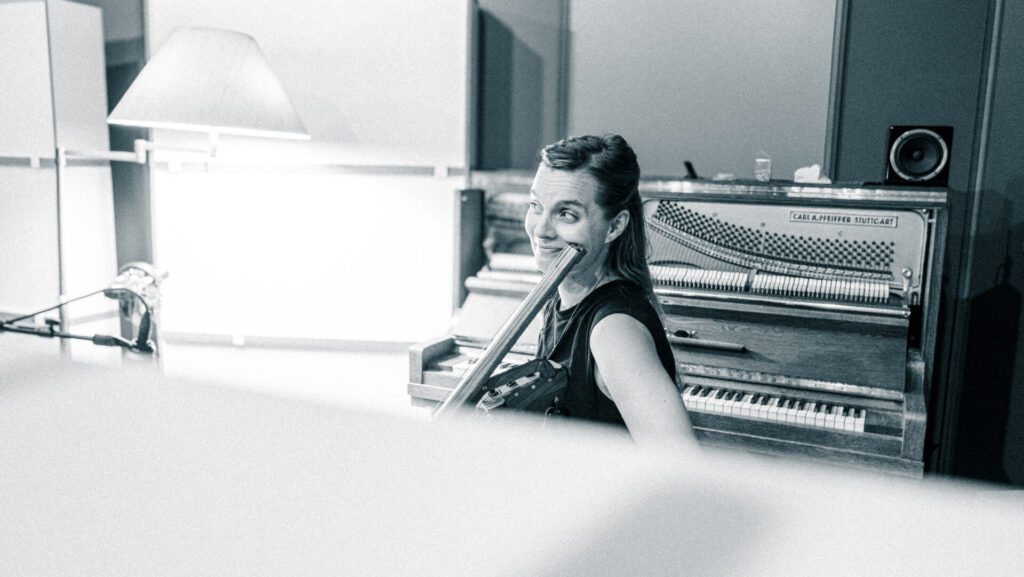
Ah yes, the instruments. They certainly need some explanation. We should turn first to Guðnadóttir’s halldorophone, a unique cello-like electroacoustic instrument designed by Halldór Úlfarsson, which allows the performer to harness unstable feedback loops. She explains: “With the halldorophone there are eight strings and every string has a pickup. There are two speakers in the back and then the feedback comes back at me.”
James Ginzburg built his monochord ten years ago for an Emptyset project called Borders. Designed to be a “simple way to create dense tones in the bass and sub bass octaves”, it was augmented with solenoids during the Osmium recording process, so that it could “hammer the strings in sync with Hildur’s halldorophone and Sam’s drum”. This setup allowed Ginzburg to “pick, hang plunk, bow, or mallet the strings around and amongst the rhythms that the solenoids are stamping into the strings”. For his part, Sam Slater built his feedback drum using membrane-based feedback with Christian Zollner at Koma Electronic. Slater wanted to create a system which would allow the signal to flow through the entire drum system, making use of both heads and the cavity in creating the feedback. The feedback ‘system’ in the drum used for Osmium “is a somewhat ruthless combination of pickups and distortions on both heads which, using filtering, can draw out resonances either in the lower harmonics, causing the drum to rattle and shake, or further up towards the screaming highs, where the drum creates an almost vocal like wailing.”
Guðnadóttir was quick to point out, “When you build instruments that work with feedback or chaos, you start out with an idea, but there is, inevitably, a large element of unpredictability. It’s a learning process: you learn by building and that is often the point.” Take the monochord: Ginzburg noted that it made “harmonically complex, tambura-like overtones”, an element that was “an emergent property of the instrument rather than something predicted”. Slater sees his drum as “a strange, wailing, wonderful instrument that is often completely out of control”. During the recording, the robotic hammers on the drum meant the feedback was broken each time the drum hit, creating a “very violent acoustic side-chaining sound”. This can be heard throughout the record. Slater: “We also added this strange field-drum style tuning system which means you can pitch bend by squeezing the wires.” Slater and Ginzburg both added that there were “a lot of complications” with the instruments “as they are all, in effect, experiments themselves”.
Blood in the Body
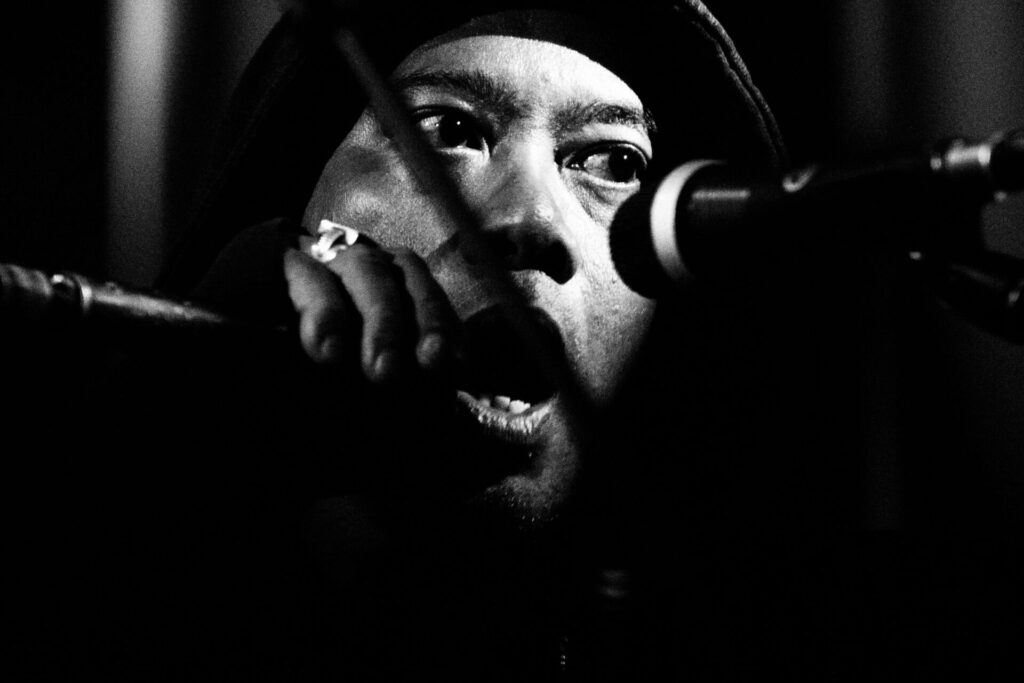
For their part, the extraordinary gymnastics of Rully Shabara’s voice could invoke Newton’s fevered candlelit experiments in alchemy. And, part-invoking another Shelley, Shabara’s vocals can also be imagined as blood, irrigating the monstrous body created by the rhythm section. He says: “I like that idea. It’s probably why they picked me, to offer something that is like blood fighting its way through a body: being the opposite of these handmade mechanical feedback machines, which can be very precise, and with sound programmed to have the maximum frequencies they want.”
Sam Slater and James Ginzburg trusted in Rully’s unique ability to create “entire landscapes of sound with his voice” whilst also invoking “demonic and animal experimentations with emerging technology and mysticism”. For her part, Hildur Guðnadóttir thinks Rully is “one of the best vocalists I have ever worked with”. Ironically, Slater and Ginzberg experienced the recording of Rully’s vocals as a “straightforward” process, “as he is an absolute machine”.
But Shabara’s work with Wukir Suryadi in Senyawa requires a certain, instinctive, physical mediation between the pair, normally at eye level. This is not present with Osmium: “It’s not like any of my other projects, where I bring my voice to the mix, but never with this kind of precision. And Osmium can be really, really loud live.”
So how did he bring a voice to this project? “Well I didn’t. There are voices in there but they are not complete. And anyway, I wasn’t there!” His absence was a logistical decision rather than an artistic one, as no-one could find the time for a full meet up. Guðnadóttir explains: “I think that [decision] was a good idea in the end. What Rully does is so otherworldly in Osmium. Because he could take a little bit more time.” For Shabara, it took a long time to work out how to adjust to the music and use his voices. “On other projects I react quickly, but with this there have been so many other considerations. What kind of singing, for example? What if I used more tonality, or what if I put more intensity in there? And how should I behave, should I go crazy, should I be deep? In all of my gigs I have to be sure I can add something. But now we have the record and I can hear it back, I can now think, yes!”
Come Together
Slater and Ginzburg found recording “challenging” but the results were “something that emerged out of us being in a room together. No one had to ask each other how to proceed”. Ginzburg adds: “When everything was finally working well enough to proceed, recording was fairly straightforward, and we only needed a few takes per piece.” Which prompts the question, why make a record that seems so headbangingly difficult to construct? Guðnadóttir’ laughs: “Well the answer to that is, ‘Why not?’ To be a little less facetious, all of us want to continue exploring something we haven’t done before. Curiosity is definitely a driving force for us in the band. Sam, James and I are all really interested in instrument building. And when you are working on instruments driven around feedback, their nature is very unpredictable and wild. That is exciting.”
What was interesting for them was to find a juxtaposition to this unruliness. Guðnadóttir continued: “I have always wanted to be in a drum circle – and this new band is like that. With Rully, the human element becomes another counterpoint to these precise rhythms and wild instruments.” Shabara concurs: “I think that was one of the most interesting things about this project, being confronted with a set of opposites.” Shabara listened in to how the rhythm trio balanced the precision of mechanical programming and the noise of the feedback and frequencies. It was “difficult and complex” to react to, but “at the same time that is the reason it was interesting”.
Hell is other People
Deeming studio work a success, or interesting, is one thing. Would other people be interested? Would they listen more than once? A substantial amount of production work was needed to translate the energy and the physicality of the sound through to smaller mediums such as home speakers and headphones. Hildur Guðnadóttir admitted to being sceptical about the results and unsure something would come out of the process that was “enjoyable to listen to”. She explains: “Listening live is one thing, when you hear all this energy and the movement of air. I did wonder if it would actually be possible to capture this in a way where anyone would sit down and listen to it!” James Ginzburg counters: “Honestly, I think the results surpassed our expectations. In experiments like this, there is a huge range of possible outcomes. There was a lot of work in the production stage but that was to make it sound like we experienced it in the live room, processing, editing and mixing the material so that it was both detailed and overwhelming.” All feel at peace with a record that doesn’t contain any compromises.
Ritual Alchemy
What can a listener grab on to, to find their bearings, in Osmium’s maelstrom of sound? One element which acts like the thread in the maze is the insistent tap of the monochord. Its sound somehow references older instruments built along similar lines such as the kologo or berimbau – instruments that lay down a basic tonal range that others can build on or react to.
Hildur Guðnadóttir agrees, but sees all the instruments used as taking old ideas and “blowing them up” into a new environment. She says: “The halldorophone is based on the idea of the cello. Taking something with hundreds of years of cultural connotations, how can you stretch it in new ways? Guðnadóttir sees this applying to the structure of Osmium’s music, which references ritual trance music, “where you have this drum circle-style idea of ‘ritual trancing’ into a rhythm or a sonic environment and staying with one thing long enough to get completely lost in it.” Osmium’s roadmap, it seems, is based round extreme contrasts: very old music and new, the very simple and complex, the mechanical, and the human. The unstoppable force and the immovable object, even?
Notebooks out, Geologists
Sam Slater claims the players “dissolved into the dynamic” of the project, creating an “unexpected alchemy”. The metal produced wasn’t gold, but the “heaviest metal”, Osmium. Guðnadóttir says: “Naming something is my least favourite thing to do: you are really defining something by giving it a name. We went through, how many millions, of terrible names. We did want the name to be weighty and metal-related because it is a kind of a metal band. So what is heavy and what is metal: that was the answer.” Rully adds, laughing: “You can tell people that we are serious geologists!”