
CNN Underscored reviews financial products based on their overall value. We may receive a commission through our affiliate partners and may earn compensation when a customer clicks on a link, when an application is approved, or when an account is opened, but our reporting is always independent and objective. This may impact how links appear on this site. This site does not include all financial companies or all available financial offers. Terms apply to American Express benefits and offers. Enrollment may be required for select American Express benefits and offers. Visit americanexpress.com to learn more.
The Delta SkyMiles® Platinum American Express Card occupies the number-two spot among co-branded Delta Air Lines credit cards, in terms of annual fee and benefits it provides. Sitting just below the Delta SkyMiles® Reserve American Express Card, the Delta SkyMiles Platinum comes with an annual fee of $350 (see rates & fees) but provides enough benefits to offset its cost, and then some. In fact, it may be a better choice for many Delta flyers than the Reserve card.
Besides the perks you’d expect from an airline card of its level — like free checked bags and priority boarding — the Delta SkyMiles Platinum has a benefit that can, all by itself, provide more value than the annual fee: a companion certificate that allows someone to fly with you for only the cost of taxes and fees on select Delta routes.
Just having the card can also provide you with a significant chunk of Delta’s Medallion Qualification Dollars — which count towards elite status — not to mention the best mileage earnings on common everyday expenses of all the Delta-branded credit cards. Then you have a spate of credits that can further offset the annual fee and discounts on flights booked with Delta miles.
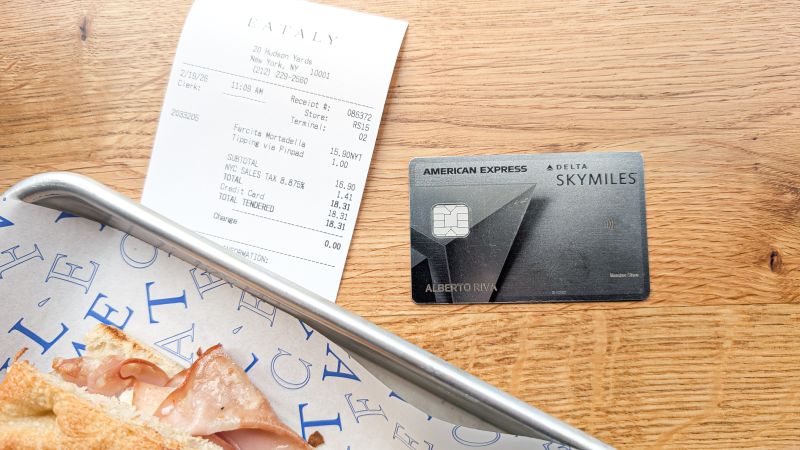
As a frequent Delta flyer, I’ve had the card since 2014, regularly use its perks and credits, and can recommend it to people who fly Delta more than a handful of times a year. If you’re a Delta loyalist and want only one credit card to use for all your expenses, this one should be at the top of your list, unless you truly value access to airline lounges. The only thing this card won’t do for you as a Delta devotee is get you into Sky Club lounges, but for everything else, it’s a top contender.
Learn more and apply for the Delta SkyMiles® Platinum American Express Card.
-
Welcome offer: Earn up to 100,000 miles — 80,000 bonus miles after you spend $4,000 or more in purchases with your new card within the first six months and an additional 20,000 bonus miles after you make an additional $2,000 in purchases within your first six months, starting from the date your account is opened. (Offer ends April 1, 2026.)
-
Annual fee: $350 (see rates & fees).
-
Intro APR: None.
-
Who it’s for: People who fly Delta often but don’t want to splurge for a credit card with lounge access.
First of all, we must make an important distinction: The Amex Delta Platinum is not the American Express Platinum® Card, which isn’t a Delta co-branded card, earns American Express Membership Rewards® and is currently our top travel card for luxury benefits, with an annual fee of $895 (see rates & fees). The Amex Delta Platinum charges an annual fee of $350 (see rates & fees) and earns Delta SkyMiles®, which makes it suitable only for people who fly or plan to fly Delta.
If you meet the criteria for the first tier of the Amex Delta Platinum’s bonus offer, which requires spending $4,000 in the first six months, you’ll earn 80,000 SkyMiles. Those are worth $1,000 toward travel, according to The Points Guy’s valuations. Just be aware that if you’ve had this card before, you’ll be ineligible for another bonus because Amex has a once-per-lifetime rule on welcome bonuses.
The Amex Delta Platinum has many strengths that appeal to Delta flyers — and one weakness.
-
Annual companion certificate
-
First checked bag free, including for up to eight companions
-
Priority boarding
-
Accelerated path to Delta elite status
-
No foreign transaction fees
-
No lounge access
-
High annual fee
The $350 annual fee, while high in absolute terms, can be offset with the companion certificate and with statement credits, both of which we’ll discuss below.
This is also is the best of the Delta co-branded cards at earning bonus miles on purchases. But since you can earn Delta miles with cheaper credit cards — and more valuable points with other cards entirely — the real value of the Amex Delta Platinum card lies in its perks.
Earning and using miles with the Amex Delta Platinum
The Amex Delta Platinum earns miles as follows:
-
3x SkyMiles on Delta purchases
-
3x on purchases made directly with hotels
-
2x at restaurants worldwide, including takeout and delivery
-
2x at supermarkets
-
1x on all other eligible purchases
Those earning rates mean that the Amex Delta Platinum could be a single do-everything card for people who fly primarily, and frequently, Delta. With 2 miles per dollar spent on supermarkets in the U.S., it can earn a lot of SkyMiles in this everyday shopping category, and it adds to that 2 miles per dollar on restaurants worldwide (plus delivery in the U.S.). Its best earning rates, 3 SkyMiles per dollar, are on flights booked directly from Delta and on hotel stays bought directly with the provider (third-party sites like Expedia don’t count.) This would be a good card for frequent travelers abroad too, since it doesn’t charge foreign fees.
Using the SkyMiles you’ve earned for maximum benefit can take some work, and you shouldn’t bank on them for award seats in long-haul premium classes, which Delta usually prices very high. Instead, SkyMiles can shine as a great value for domestic redemptions, where Delta often has relatively low prices in miles. There are also good limited-time deals on award seats for long-haul flights, but those tend to be in Main Cabin — Delta’s name for economy — although there are occasional gems in higher classes of service. As we’ll see below, holding the Amex Delta Platinum actually can make those award seats cheaper too.
That said, airline miles including Delta SkyMiles are generally less valuable than flexible credit card points such as Chase Ultimate Rewards® and American Express Membership Rewards. That’s largely because air miles can be used only on their given carrier and its partners.
Learn more and apply for the Delta SkyMiles® Platinum American Express Card.

The card has some Delta-specific benefits, including its companion certificate, but on top of those, it has some features that can help make travel smoother, including car rental insurance, or come in handy when travel does get disrupted.
Free checked bags and priority boarding
The card provides a free checked bag for the card member and up to eight others on the same reservation when flying Delta. Each first checked bag on Delta costs $35, so a couple flying two round-trips a year and checking one bag each would save $280 with the card — almost enough to offset the annual fee just through the checked-bag benefit alone. Card members and those on the same reservation also get boarding in Zone 5, out of Delta’s nine zones (including pre-boarding).
Using the card for inflight purchases, such as food, triggers a 20% discount (not including Wi-Fi, but nowadays free Wi-Fi is available for SkyMiles members on most domestic and international flights.)
This is the main perk of the Amex Delta Platinum. Every year upon renewal, card members get a companion certificate valid for a round-trip flight in Main Cabin, covering all but taxes and fees. The certificate is good for domestic trips, including Alaska and Hawaii, plus flights to Mexico, the Caribbean and Central America.
I use the Delta Platinum’s companion certificate every year, and find it beneficial even with the restriction that you can book only round trips — for example, if you want to fly from Atlanta to Los Angeles and then fly back from San Francisco, you can’t do that using the certificate. You’re allowed to return only from the airport where you landed. The certificate can’t be used on basic economy fares, both travelers must be booked at the same time and on the same reservation, and not all flights have availability, so booking as early as possible is generally better.
Note that the certificate doesn’t appear in your Delta account until the start of your second year of card membership.
The Delta Platinum helps you get to Medallion elite status faster with a feature called MQD Headstart.
Earning Delta elite status is based on only one metric: Medallion Qualification Dollars, also known as MQD. The basic Silver Medallion status requires racking up 5,000 MQDs in a calendar year; Gold requires 10,000 MQDs; Platinum requires 15,000 MQDs and the top Diamond Medallion level requires a hefty 28,000 MQDs. Those MQDs can be earned by flying Delta and its partners, by spending on the Delta Platinum or Reserve cards, or just by holding either or both. The Platinum gives card members a 2,500 MQD boost every February, at the beginning of the Medallion year. So, by simply holding the card, you’re already halfway to Silver status without making any purchases.
On top of earning SkyMiles, the Delta Platinum earns 1 MQD for every $20 you spend on the card in purchases, so a $100 expense will yield 5 MQDs.
Like the Delta Reserve card, the Delta Platinum comes with 15% off award redemptions for Delta flights. If you add the card to your SkyMiles account, you’ll see the discounted prices reflected in your search results on the Delta site and in the app. The discount doesn’t apply to partner-operated flights or to taxes and fees, but it’s easy to use.
Travel and purchase insurance
The Amex Delta Platinum provides some travel protections, although they aren’t the most robust in the industry. You’ll get trip delay insurance but not trip cancellation or interruption insurance.
If your round-trip is paid for entirely with the card (or if you use it to pay taxes and fees on an award booking) and it’s delayed more than 12 hours, the insurance can refund you for hotels, cars, meals and similar expenses if you pay with your card. You can get up to $300 per trip with a maximum of two claims per card every consecutive 12-month period.
When using the card for renting cars, you get damage and collision insurance, letting you skip the rental agency’s pricey insurance. Note that this doesn’t cover liabiity and that the card’s insurance is secondary, which applies only after your personal auto policy. (Terms apply to both trip delay and car rental insurance.)
Speaking of renting cars, the Amex Delta Platinum gives you Hertz Five Star status, which makes you eligible for upgrades if they are available as well as an extra 25% points earned on each rental, if you choose to collect Hertz points and not air miles. (Enrollment in the Hertz Gold Plus Rewards program is required; terms apply.)
If you’re not a Medallion elite member, having the card means you’ll be added to the complimentary upgrade list, including for upgrades to first class. Don’t count on getting bumped to a higher class based on this card alone, though, since you’ll come after all Medallion members and holders of the Delta Reserve card.
The card offers statement credits that, together, amount to $390, more than offsetting the annual fee.
To receive this credit, you must book prepaid hotels or vacation rentals through the Delta Stays site. Since this would be a third-party booking, it wouldn’t get you the benefits of any elite status you may have with the hotel or points in its loyalty program, but for such a large discount you may not mind. I do not, and I use the Amex Delta Platinum’s $150 credit every year, for example to book independent hotels without a loyalty program I care about.
You can get up to $10 in statement credits each month after you pay with the card at Resy restaurants. You don’t need to reserve a seat on the Resy site or app; you just have to pay with the card, and a statement credit will be applied automatically. Unfortunately, I can say from experience that this works only in the U.S. Using the card at restaurants abroad doesn’t trigger the credit, even if they are featured on Resy.
The ride-share credit is also automatic if you set up the Delta Platinum as your payment method for services like Uber or Lyft, and it also applies in $10 monthly installments.
Global Entry and TSA PreCheck
This is a $120 credit for a Global Entry application fee every four years, or up to an $85 credit for TSA PreCheck every four and a half years. We recommend going for Global Entry if you do any international travel, since it also includes TSA PreCheck.
If you love flying Delta or you live in a Delta hub like Atlanta or Minneapolis, earning miles in the Delta SkyMiles program makes a lot of sense. Whether you should do that with the Amex Delta Platinum or with a Delta co-branded card charging a smaller annual fee, or no fee at all, depends largely on two factors. If you want to earn qualifying dollars toward Delta elite status and/or you want the companion certificate, then the Delta Platinum wins.
Learn more and apply for the Delta SkyMiles® Platinum American Express Card.
If you want a Delta card but don’t want to pay the Delta Platinum’s annual fee, our clear recommendation is to apply for the Delta SkyMiles® Gold American Express Card. We consider it the best card for people who aren’t strong Delta loyalists but still use the airline a few times a year. The Amex Delta Gold has an introductory annual fee of $0 for the first year and then a $150 annual fee starting at your first renewal (see rates & fees).
With the Delta Gold Amex, you’ll earn 2 miles per dollar at restaurants, U.S. supermarkets and on Delta purchases, plus up to $200 in Delta flight credit after spending $10,000 in a calendar year. You’ll also get your first checked bag free on all Delta flights and 20% savings on in-flight purchases made while flying Delta. In short, it does a lot of what the Amex Delta Platinum card can do for you, minus the annual companion certificate.
If access to Delta lounges matters instead, the Amex Delta Reserve is the way to go among co-branded cards but at a cost: The Reserve has an annual fee of $650 (see rates & fees). It’s a powerful tool for hardcore frequent flyers on Delta, but for anybody who isn’t, there’s absolutely no need to shell out that kind of money.
Consider also that an airline-branded card isn’t the only way to earn miles that can be turned into award flights. Many travel cards earn points that have the advantage of being transferable to many airline and hotel partners. The only credit card points in the U.S. that can transfer to Delta SkyMiles are American Express Membership Rewards, which can also be transferred to JetBlue and Hawaiian, among several other airlines. That’s why people who may fly Delta a few times a year but don’t want to be locked into earning only Delta miles can look at American Express cards that earn Membership Rewards points as an alternative.
Among those, a direct alternative to the Delta Platinum is the American Express® Gold Card, with an annual fee of $325 (see rates & fees). It’s a great card for groceries and restaurants, and it has a solid earning rate on flights as well:
-
4x points per dollar spent on purchases at restaurants worldwide, up to $50,000 in purchases per calendar year, then 1x points for the rest of the year.
-
4x points per dollar spent at U.S. supermarkets, on up to $25,000 in purchases per calendar year, then 1x points for the rest of the year.
-
3x points per dollar spent on flights booked directly with airlines or on AmexTravel.com.
-
2x points per dollar spent on prepaid hotels and other eligible purchases booked on AmexTravel.com.
-
1x points per dollar spent on all other eligible purchases.
The Amex Gold also comes with several credits that can more than offset its annual fee. It won’t provide benefits tailored to Delta like free checked bags, but its points provide a flexibility that goes way beyond one single airline.
Learn more and apply for the Delta SkyMiles® Gold American Express Card.
Learn more and apply for the Delta SkyMiles® Reserve American Express Card.
Learn more and apply for the American Express® Gold Card.
According to CNN Underscored’s credit card methodology, we evaluate cards based on a variety of factors, gauging their utility for real-world users, not just card experts. The principal factors we consider are the following:
-
Earning rate vs. redemption value: A high earning rate is valuable, but only if the rewards are too. We balance both factors to assess a card’s overall value.
-
Weighing fees against benefits: We compare annual fees to the tangible value of a card’s perks. Travel benefits such as lounge access, statement credits and insurance protections are weighed relative to a card’s annual cost.
-
Welcome offer: A sizable welcome offer may make applying for a card worthwhile in itself, but only if the spending target is reasonably attainable.
-
Ease of redemption: We evaluate whether rewards can be easily redeemed and whether cards with transferable points and miles have strong airline and hotel partners.
-
Travel and purchase protections: Trip delay and interruption coverage, baggage protection and rental car insurance add significant value to travel-focused credit cards. Purchase protections like extended warranties and price protection can also make certain cards stand out.
-
Interest rates and balance transfer offers: While we advise avoiding interest charges, we evaluate 0% APR introductory offers for consumers looking to manage debt strategically.
The following FAQs have been answered by senior money editor and credit card expert Alberto Riva.
No, the American Express Delta Platinum doesn’t provide lounge access. The American Express Platinum® Card does, but that’s a different card with a far different cost and earning structure. The American Express Delta Reserve card also provides lounge access and has a much higher annual cost.
For people who fly Delta with some regularity, the Amex Delta Platinum card is a great tool, provided they want to earn Delta’s SkyMiles as reward for their spending. The card’s strong points are the perks it provides, not just the Delta miles it earns, and in particular its top selling point is an annual companion certificate that can be worth far more than the card’s annual fee.
The Amex Delta Platinum card provides benefits on Delta Air Lines, including a free checked bag for the card member and up to eight people on the same reservation, priority boarding, discounts on in-flight purchases and lower prices in miles for award tickets. Most of all, it comes with an annual companion ticket (starting in the second year of card ownership) that allows a companion to fly within the U.S. and to the Caribbean and Central America for simply the cost of taxes and fees.
CNN Underscored’s team of expert editors and contributors carefully reviews credit cards, travel rewards and loyalty programs to help readers navigate changes and make informed financial decisions. For this story, senior money editor and credit card expert Alberto Riva — who has top-level Diamond Medallion status with Delta Air Lines and has had the Amex Delta Platinum card since 2014 — applied his years of industry knowledge and personal experience to ensure every detail is accurate and actionable. Our recommendations are grounded in real-world value and backed by thorough analysis, expert insight and a commitment to clarity and transparency.
Click here for rates and fees of the Delta SkyMiles® Platinum American Express Card.
Click here for rates and fees of the Delta SkyMiles® Reserve American Express Card.
Click here for rates and fees of the Delta SkyMiles® Gold American Express Card.
Click here for rates and fees of the American Express® Gold Card.