
It’s been a constant of my working life for 25 years: exit the tube, dive into the nearest coffee shop and buy a hot drink to take to my desk, ready for a new day at work. It’s not a huge expense, though the price has risen through the years. At some places these days I’d get little change from a five-pound note – if I used cash, which I don’t. With Apple Pay, it’s just tap, tap, tap and my money flows out, friction-free and largely unnoticed.
Warren Buffett, a model of financial prudence and one of the world’s most successful investors, might pay more attention to that £5 coffee. He’d probably say: ‘Don’t be ridiculous! I’m not going to spend £100,000 on coffee!’ You see, if I’d saved my daily coffee money all those years and invested it instead, I might now have accumulated £100,000 – because of the power of compounding interest. Doh!
The value of our everyday financial choices is something that comes up a lot in my conversation, this week, with Morgan Housel. If you don’t recognise his name, you’ll likely recognise the cover of his bestselling book The Psychology Of Money, which explores the strange ways we all think about money and how to make better sense of it, and has sold more than eight million copies worldwide.
Now Housel, 42, has written a follow-up, The Art Of Spending Money: Simple Choices For A Richer Life. This one turns the spotlight on how to spend the money we do have. Asking big questions (such as ‘Can money buy happiness?’), the book has little to do with spreadsheets and everything to do with psychology, envy, social aspiration, identity and insecurity.
Steven Bartlett, of Dragons’ Den, is a Housel mega-fan. Hosting him as a guest on hit podcast Diary Of A CEO, Bartlett said The Psychology Of Money may be ‘the greatest book about money and finance ever written’.

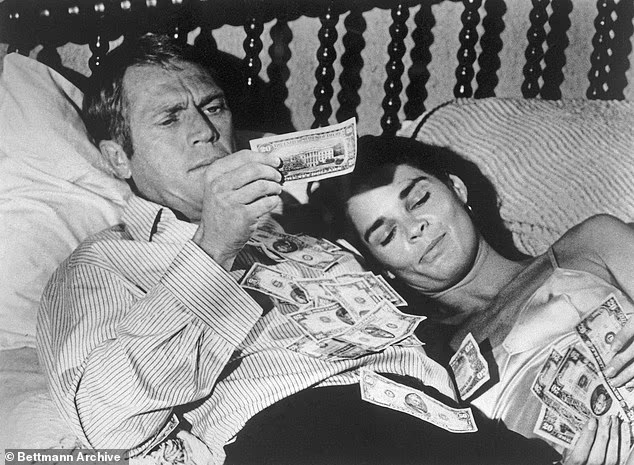
Steve McQueen and Ali MacGraw in The Getaway (1972)
Both books are crammed with digestible takeaways for the lay reader, which Housel rattles off fluently when we speak, with dizzying effect. We talk remotely: me in London, he in Seattle, where he lives with his wife and young children. He speaks fast, always smiling, which is a little disorientating when I’m confronting tough questions about my own spending habits.
To begin, I ask him why he says money can’t buy happiness. ‘Spending money can buy happiness,’ he writes in his book, ‘but it’s often an indirect path. Money itself doesn’t buy happiness, but it can help you find independence and purpose, both key ingredients for a happier life if you cultivate them. A big, nice house might make you happier, but mostly because it makes it easier to invite friends and family over. And the friends and family are actually what is making you happy.’
Now let’s have a reality check here. Housel is still in his early 40s and phenomenally successful – you don’t sell that many books without making a vast amount of money. Does he worry about sounding smug? Tin-eared? How are people likely to react to a book called The Art of Spending if they live on or below the poverty line and struggle to cover the basics? Housel accepts, with grace, that you first need to have the basics covered – food, shelter, adequate healthcare – before you can even begin to have these conversations.
‘My first response is empathy. It’s easy to discount the anxiety if you’re not financially struggling. It can be absolutely crippling. My second response is that every pound you save is a piece of your future that you control, that somebody else does not. So if you are able to save five pounds, ten pounds, 100 pounds, that makes a difference, particularly if you are to be laid off or have a medical emergency. Don’t be discouraged by the fact that you are only able to save what seems like a trivial amount. It absolutely is worth it.’
Once the basics are secure, Housel moves on to the bigger questions: how money relates to happiness and what really matters in life. ‘If you ask people, “How much money would you need to be happy?” the answer is usually about twice as much as you currently make.’ And that turns out to be true at almost every income level. In other words: most people want to spend more than they have.
One of his most striking exercises is this: ‘If I was on a deserted island with just me and my family, and nobody could see how we were living – nobody can see your house, your car, your clothes, your jewellery – how would I live? For me, and I think most people, you immediately gravitate away from status and towards utility.’
Of course, most of us don’t live on desert islands. We live in cities where comparison is everywhere and unavoidable: designer clothes, flashy cars, beautiful restaurants, dream houses. We are bombarded by images of perfection on social media. But Housel’s point isn’t that we should never buy anything nice. It’s that we should notice why it is we want to.
His ‘desert island’ thought experiment lingers with me for days. It may seem banal, unless you try it, as I did. I found it unexpectedly helpful as a way to frame what’s truly important for me.
It’s hard to avoid, as I read Housel’s book, a sinking feeling of regret. I remember all those times in my 20s and 30s when I frittered away money thoughtlessly – on clothes I wore only once, taxis, eating out, Pret lunches. What would be different if, instead, I’d made myself a sandwich and stuck the cash in an ISA? It simply didn’t occur to me. Perhaps I was never exposed to the powerful life lessons Housel had.

Morgan Housel wrote the bestselling book The Psychology Of Money, which explores the strange ways we all think about money and how to make better sense of it
Everyone is different, he says. Saving was hardwired into him. His father, an ER doctor, lived well below his means so that when the stress finally became too much, he could stop. ‘Having saved, he could do that. A lot of his peers couldn’t.’
But everything has its pros and cons. ‘Sometimes I have the opposite thoughts to yours,’ he says. ‘Did I save too much in my 20s? Should I have lived a little bit more, lived a bigger life?’
Saving is not a moral virtue, he says, or a joyless habit. It’s a long-term strategy. When you have financial independence, you have wealth: ‘What you want is to get to a point where you can wake up every morning and say, I can do whatever I want today – even if what you actually want to do is go to work. You need some sense of independence and you [also] need a purpose that you’re living for, striving for, working towards every day.’
How to achieve that? His main principle is simple: regardless of your income, live below your means. ‘The person who makes $50,000 but only needs $40,000 to be happy is richer than the person who makes $150,000 but needs $151,000 to be happy.’
Simple. And obvious. But so many people fail to live by it. What to do? Question every purchase, he says. Why are you buying this? Is it for status? For a dopamine hit? Or will it genuinely make you happy?
To be clear: this doesn’t mean luxury is inherently bad. Buy a Dior handbag! Buy a daily coffee! But awareness is key. When you understand what drives your spending – status, convenience, comfort or joy – you can make more deliberate choices.
He understands why young people make status-driven choices. Older people, not so much. ‘Desire for material status when you’re young is because you have nothing else to offer. You don’t have marketable job skills. You don’t know how to be a good partner, a good spouse. So the only lever you have to get people’s admiration may be, “Look at my stuff”.’
Again and again, he comes back to the idea that money can only buy happiness indirectly. It’s independence, purpose and the ability to cultivate relationships that matter.
Bad things can happen to upset even the most prudent savers: war, 9/11, the credit crunch, Covid and so on. ‘I do the absolute best that I can to prepare for the downside. But you can’t live your life preparing for those nuclear Armageddon-style catastrophes. It’s not sensible and I’m not going to let that keep me up at night!’ Housel says, smiling. ‘What you can do is live in a way that gives you some margin of safety, some flexibility, so that when life turns upside down, you can absorb it.’
It’s a pragmatic philosophy, neither romantic nor cynical. In the end, Housel’s argument isn’t really about money at all – it’s about agency; about living in a way that gives you a buffer when things go wrong, and to enjoy what you have when they go right.
‘Don’t let anyone tell you what you should or shouldn’t spend money on,’ he says. ‘There is no right way. You have to figure out what makes you happy and fulfilled. Everyone’s different. My own desire to live a relatively simple life is not because I don’t enjoy nice things.’
Even Housel isn’t immune to the occasional craving for shiny new toys that ultimately disappoint. ‘I just got the new Apple iPhone. The allure is so tempting, the siren song of telling yourself, “Oh, this is gonna change my life”. And a day later, you’re, like, it’s just absolutely nothing.’ The lesson is not to resist that dopamine hit altogether but to remember how fleeting it is.
So what have I learnt? That it’s never too late to start. I will live a little more carefully and build some margin to help me absorb the shocks. I’ll make sure my child – and any other young person I meet – hears this message, too. I’ll grab them in a slightly deranged manner and not let them go until they promise to save, even just a few pounds a week.
The Art Of Spending Money by Morgan Housel is published by Harriman House, £16.99. To order a copy for £14.44 until 30 November go to mailshop.co.uk/books or call 020 3176 2937. Free UK delivery on orders over £25.