Close Menu
Simply Invest Asia
  • Home
  • Industries
  • Investment
  • Money
  • Precious Metals
  • Property
  • Stock & Shares
  • Trading
What's Hot

High-Frequency Trading: HFT in Modern Crypto Trading

March 7, 2026

Martin Lewis explains how to get much better return on savings

March 7, 2026

Costco’s Strong Growth Continues. But Is the Stock Too Expensive?

March 7, 2026
Facebook X (Twitter) Instagram
Trending
  • High-Frequency Trading: HFT in Modern Crypto Trading
  • Martin Lewis explains how to get much better return on savings
  • Costco’s Strong Growth Continues. But Is the Stock Too Expensive?
  • Platinum deficit set to continue for 4th yr; shortage may shrink 75%
  • Boost tax-free Personal Allowance for savings with HMRC pension rule | Personal Finance | Finance
  • Best savings accounts as lenders cut rates
  • Arbitrage Trading: Profiting from Crypto Price Differences
  • Why Grocery Outlet Stock Dived by 33% This Week
Facebook X (Twitter) Instagram YouTube
Simply Invest Asia
  • Home
  • Industries
  • Investment
  • Money
  • Precious Metals
  • Property
  • Stock & Shares
  • Trading
Simply Invest Asia
Home»Money»South Africa and Nigeria removed from money laundering ‘grey list’
Money

South Africa and Nigeria removed from money laundering ‘grey list’

By LucasOctober 24, 20253 Mins Read
Share
Facebook Twitter LinkedIn Pinterest Email


Unlock the Editor’s Digest for free

Roula Khalaf, Editor of the FT, selects her favourite stories in this weekly newsletter.

South Africa and Nigeria have been removed from a global financial crime watchdog’s “grey list”, a relief for banks and investors in Africa’s two biggest economies.

The Financial Action Task Force on Friday said South Africa and Nigeria are no longer subject to “increased monitoring”, more than two years after the Paris-based body flagged them for illicit finance risks.

Grey-listing triggers greater international bank scrutiny of transactions going through affected countries, in what the IMF has said amounts to a “large and statistically significant” chilling effect on capital flows.

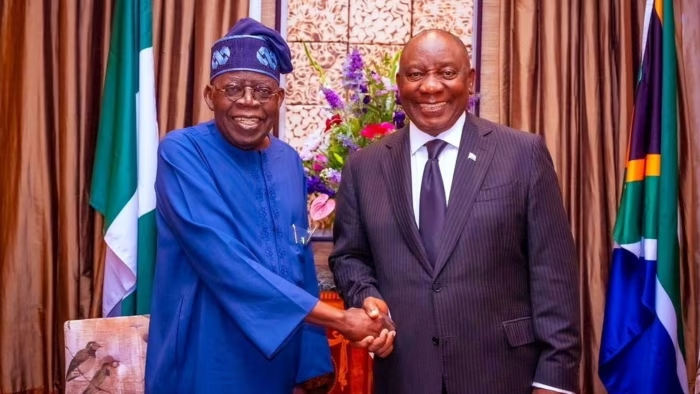
The FATF first grey-listed South Africa and Nigeria, led by Bola Ahmed Tinubu, early in 2023 over failures to collect and co-ordinate intelligence on financial crimes and investigate and prosecute cases.

As a result, South Africa’s government led by President Cyril Ramaphosa in particular mounted a national effort to align regulations and speed up money-laundering case verdicts.

Years of decay under former president Jacob Zuma gutted law enforcement and the country’s ability to fight corruption.

“This is a watershed moment for South Africa’s financial sector and economy,” said Leila Fourie, chief executive of the Johannesburg Stock Exchange and chair of Operation Phumelela, a South African financial industry task force.

“Exiting the FATF grey list restores confidence in our financial system, strengthens our position as a leading African financial hub, and reaffirms our commitment to global standards of financial integrity,” she added.

Hafsat Abubakar Bakari, the head of the Nigerian Financial Intelligence Unit, said: his country’s removal “is a clear signal to the world that Nigeria can meet and exceed global standards in financial integrity”.

Mozambique and Burkina Faso were also removed from the FATF’s grey list on Friday after several years.

The G20-backed FATF can ultimately “blacklist” countries if they fail to heed its warnings, a penalty levied only on Iran, North Korea and Myanmar. A FATF blacklisting de facto cuts domestic banks off from international payment systems.

Iran ratified a UN convention against terrorist financing this month as part of efforts to overturn FATF blacklisting, which was imposed in 2020.

The country also sent delegates to the FATF’s plenary meeting in Paris this month for the first time in six years, according to state media.

The South African rand rose roughly 0.6 per cent to about 17.23 to the US dollar on Friday after the FATF decision.

The FATF announced changes to its grey-list criteria last year “to relieve pressures on least-developed countries and focus on those countries posing greater risks to the international financial system”.

Countries are now prioritised for so-called “active review” if their financial sectors are more than $10bn in size.


Source link

Share. Facebook Twitter Pinterest LinkedIn WhatsApp Reddit Tumblr Email

Related Posts

Martin Lewis explains how to get much better return on savings

March 7, 2026

Boost tax-free Personal Allowance for savings with HMRC pension rule | Personal Finance | Finance

March 7, 2026

Best savings accounts as lenders cut rates

March 7, 2026
Leave A Reply Cancel Reply

Our Picks

Gibraltar Stock Exchange on track to become crypto trading hub

January 25, 2026

Why Zscaler (ZS) Stock Is Falling Today

February 25, 2026

Demand for commercial property in Scotland rises amid signs of budget anxiety

October 30, 2025

Bitget Lists Momentum (MMT) for Spot Trading

November 4, 2025
Don't Miss
Trading

High-Frequency Trading: HFT in Modern Crypto Trading

By LucasMarch 7, 2026

In today’s dynamic financial environment, time is of the essence. A matter of a fraction…

Martin Lewis explains how to get much better return on savings

March 7, 2026

Costco’s Strong Growth Continues. But Is the Stock Too Expensive?

March 7, 2026

Platinum deficit set to continue for 4th yr; shortage may shrink 75%

March 7, 2026
Our Picks

Precious Metals Royalties Firm to Offer Dividends in Tether’s Tokenized Gold

February 17, 2026

Clocks go back this weekend – but should daylight savings be scrapped? | Science, Climate & Tech News

October 21, 2025

Insights From Forbes’ 2025 Best Employers

October 21, 2025
Weekly Pick's

There’s a growing number of Britons moving into abandoned properties – but they’re not squatters… | Money News

January 31, 2026

Nigeria’s Dangote plots refinery expansion part financed by stake sale

October 26, 2025

Bond Funds vs Individual Bonds Explained

March 1, 2026
Monthly Featured

Businesses trading in gold see boom as Kiwis capatalise on record-high prices

October 29, 2025

Stock recommendations for 30 January from MarketSmith India

January 30, 2026

Crude supply limits Nigeria’s refining capacity

November 30, 2025
Facebook X (Twitter) Instagram Pinterest
  • Contact Us
  • Privacy Policy
  • Terms and Conditions
© 2026 Simply Invest Asia.

Type above and press Enter to search. Press Esc to cancel.