
Payday isn’t just about the moment when money hits our accounts – it’s about the cascade of bills, obligations, opportunities and emotions that come in the days that follow: the sudden whoosh of direct debit outgoings, the quick mental calculation of what’s left over and, for some, the worry about how to stretch until next payday. It’s the time when we can feel most confident about our finances or, conversely, realise how unconfident we really are.
The decisions we make, the systems we build and the conversations we have about our finances all contribute to our overall “money mindset” – and how we feel about our money confidence. Our money mindset affects not just our bank balances, but also our sense of security, our ability to plan for the future and, ultimately, our ambitions for our life.
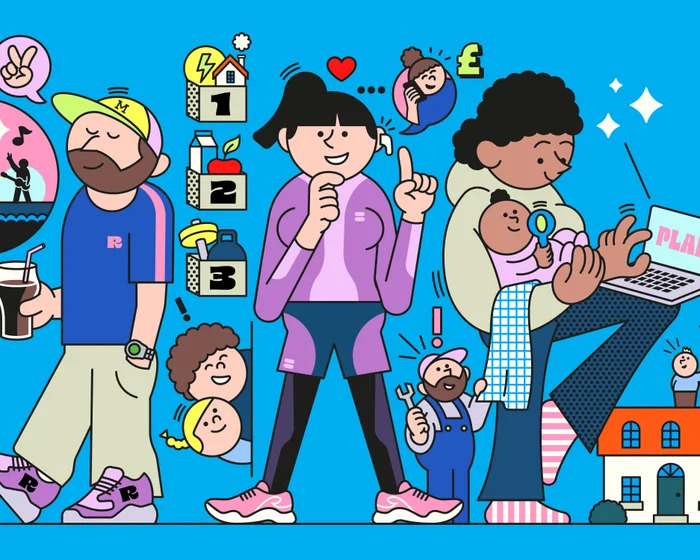
But what influences our money mindset and most affects our money confidence? Three people told us their stories – from a divorce-driven transformation to freelance uncertainty to civil service stability, their stories reveal the complex, often unspoken relationship we all have with money – and how learning and thinking more about our money improves not just our confidence but also our lives.
Mel, 36, freelance developer, engaged new mum
For Mel, there’s no such thing as a traditional payday. As a freelance developer, she invoices at the beginning of each month, but doesn’t typically receive payments all at once. “It tends to span over two weeks and occasionally people are late,” she says. “I’m always thinking a month in advance. I have a spreadsheet I’ve been updating for the past 10 years to budget every single month.”
That decade-long journey has transformed her relationship with money. “When I grew up, I was always told that you don’t talk about money,” she says. She admits not always being good at managing it either, although: “I was very proud to be completely debt-free about six years ago, which was a lovely feeling. My confidence has only grown since then.”
She now puts 10% of her earnings into a managed pension – a decision she made after her daughter was born a year ago. “I thought, actually, I’m now 36. I need to start thinking seriously about my pension.”
The uncertainty of freelance work means Mel’s money confidence has its wobbles. “For the most part it runs like clockwork, but then you might be hit by a five-week month, with five weeks of childcare to pay for, or you might be off with every nursery bug for four weeks so you don’t have four weeks of pay.” She and her fiance, who has a salaried job, maintain a joint account for household bills, splitting expenses such as childcare and food between them, with careful planning, using separate pots for direct debits.

Currently, the savings pot is depleted – “I had a baby, bought a house and had no maternity allowance.” Now she’s working to replenish it.
“We’re very fortunate that we do own our house, which is fantastic. But things like the boiler going or needing new gutters … I suppose you don’t appreciate until you have a house how much that stuff costs. And it’s always there at the back of my mind that we need to save for that. I suppose it’s when I remember things like that, it affects my financial confidence.”
When spending on essentials or treats, the couple consider their values as a family – eating at local child-friendly cafes rather than chains, using sustainable refillable shampoo rather than grabbing a new bottle at the chemist.
It’s a choice that does hit the bottom line. “It’s interesting how mindfully spending your money can make you feel really good,” she says, “but you do spend more of it. Which is too bad.”
Stay in control of your money with the Barclays app1 – from spend insights to savings goals2
Max, 32, local government official
Max’s pay journey is out of sync with most of his mates. He gets paid on the 20th of each month – which means he’s flush when everyone else is skint. After taking care of rent and bills, he puts away £200 a month for savings, to be able to afford holidays, gigs and festivals. “It’s out of my pocket before I start spending on other things” – and then “I’ve got just about enough to cover the month.”
Max feels “knowledgeable enough” about his finances: “I’d probably say my mindset is ‘short-term planning’.” But he’d like to learn more about money and saving.
“ I had a few lessons about it in school, which were helpful-ish,” he says. He believes those lessons aren’t nearly informative enough if students don’t have someone else also providing financial information. In Max’s case, this was his dad. “He was always quite keen on making sure I knew stuff about finance,” he says. Now he shares ownership of his flat with his father and pays rent on his dad’s half.
He has a local government pension offering defined benefits and a stocks and shares ISA with market-tracking funds. He’s comfortable with this pension and says he doesn’t feel the need to be putting any extra into it now.
While he doesn’t consider himself a financial optimist – “I don’t really know if my salary’s going to go up enough to meet needs in the future,” he says – he feels comfortable at the moment. “I know my income and I know how much I need to spend within my means without having to think too hard, basically.”
Learn more about saving with Barclays
Jess, 43, single parent of two and entrepreneur
Jess’s money mindset underwent a huge transformation while finalising her four-and-a-half-year divorce. “Money was very much my husband’s domain,” she says. “When I found out I was getting divorced, I was in the early days of building my consulting and speaking business, we were in lockdown, and I’d had to pause everything. It was in a really financially vulnerable position.”
Now she’s prioritised her finances. Jess is paid for her work – helping companies with gender gaps and neurodiversity – through her limited company via PAYE and dividends, and she has an intricate system. On payday week, she manually divides her income between three separate accounts to keep track of spending. After the lump sum arrives into the main account for fixed monthly outgoings – mortgage, insurance, bills, and some savings – she manually transfers smaller amounts into two others. One is for variable family expenses, with different pots for food, fuel and emergency savings. “I even put money aside every month for birthdays and Christmas, so I don’t get caught out.”
The other is purely personal, for known costs such as dentist appointments and therapy, but also fun. Health is a core value, and she prioritises activities such as yoga, pilates, run clubs and strength training. “Instead of going to a bar, I’ll meet a friend at a sauna,” she says. She also earmarks some of this pot for “mini-adventures”, such as her recent trip to Marrakech to rest, run a 10k, and rave.
“It’s about differentiating myself from the household and my family. It’s really vital to my family and my business’s wellbeing and success, and I feel like I’ve earned that.”
Her growing money confidence didn’t come overnight. The experience of opening her finances for divorce lawyers spurred her on. She enlisted the advice of financially savvy friends, used free online education programmes and began talking more about money in general. She even started a monthly “money date” with a friend where they share updates, gently challenge each other and hold each other accountable. “ I feel more in control of my money now than any time since my early twenties.”
Now, “every time I pay myself, even now, I feel a great sense of pride and excitement. It fuels my ambition.” She’s financially stable enough to contribute to her pension and invest, and she’s made it her mission to get “outspoken about the unspoken”. For Jess, money confidence goes beyond spreadsheets and savings pots (although she’s mastering those too): “Financial confidence comes from understanding money, not being afraid to talk about it, and learning about it.”
Jess proactively brings up money in friendships, with her children, in her communities. “There’s a lot of shame around money. Fundamentally, we just need more money in the hands of great people,” she says.
“My long-term goal, once my kids’ needs are met, is to become an angel investor and support other social entrepreneurs,” she says. “I see money as an enabler.” It’s certainly done that for her. “I get to design the life that I want now,” she says. “It feels very empowering and exciting.”
Feel money confident with Barclays – learn more
1 You need to be 11 or over to use the app. T&Cs apply.
2 You must have a Barclays or Barclaycard account, have a mobile number and be aged 16 or over to use the Barclays app. Terms and conditions apply.