
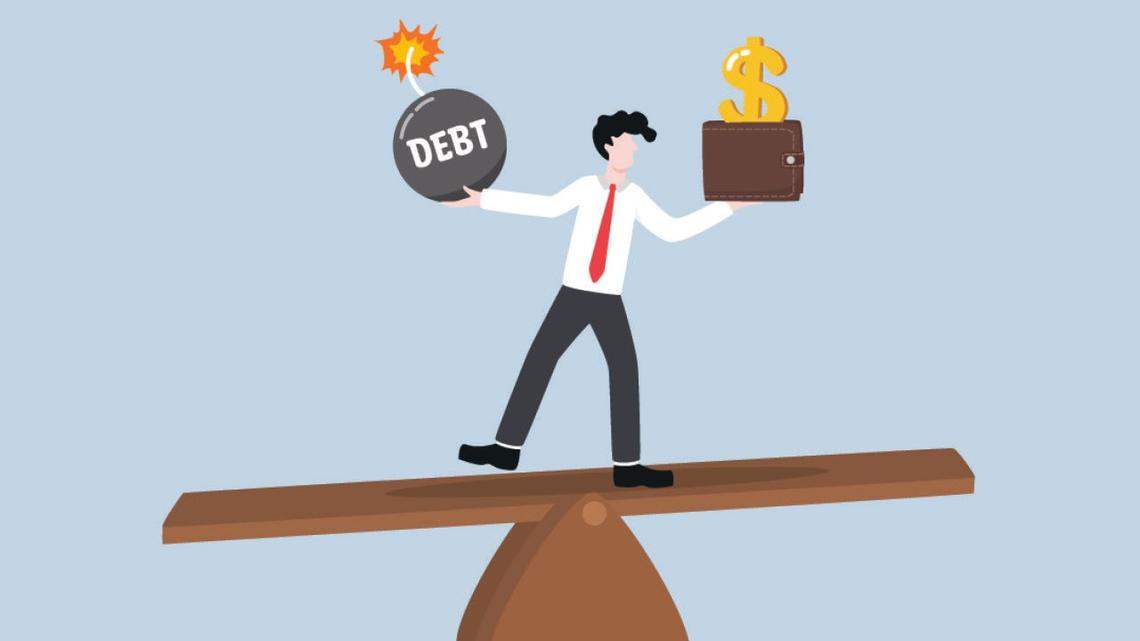
If you had to choose, which would you rather have: $100,000 in debt or $0 in savings?
Most people instinctively say debt. But when you actually play out both scenarios over time, the answer is more nuanced. To find out which situation is truly worse, CreditNinja follows one person into four different financial futures and sees how their net worth and financial security change over 10 years.
Key Takeaways
- The type of debt you have matters more than the amount. High-interest debt carries greater financial risk than lower-interest debt.
- Focusing only on paying off debt while ignoring savings can leave you financially vulnerable.
- Building an emergency fund helps protect you from falling back into high-interest borrowing.
- Investing early, especially when employer retirement matching is available, can significantly increase long-term net worth.
- A balanced strategy that addresses high-interest debt while saving and investing often leads to stronger financial security over time.
Meet Alex: The Starting Point
Alex’s starting financial snapshot
Age: 25
Salary: $80,000
Take home pay: approximately $4600 a month
Monthly expenses: $3800
Left to spend: $800 a month
Savings: $0
Retirement: $0
Debt: $100,000
Two Types of Debt: Bad vs. Good
Before exploring Alex’s four futures, it’s important to understand the difference between bad debt and good debt.
Bad debt includes high-interest obligations like credit cards, payday-style loans, and expensive auto loans. These debts tend to lose value and slow wealth-building.
Good debt, such as lower-interest student loans, may support long-term earning potential and is often more manageable.
Four Financial Futures: Same Income, Different Choices
In every scenario, Alex has the same $800 each month. The only difference is how it is used.
Alex can either put all of it toward debt or split it between debt, savings, and investing. That creates four distinct financial paths.
Future 1: Aggressive Bad Debt Payoff with No Savings
Alex puts the full $800 toward high-interest debt every month. After two years, a significant portion of the debt is gone, and the credit score improves. However, there is still no emergency fund or retirement savings. One unexpected expense could push Alex back into high-interest borrowing.
Future 2: Bad Debt With Some Savings and Investing
Alex splits the $800 between debt payments, savings, and retirement contributions. Debt decreases more slowly, but Alex builds a small emergency fund and starts investing early. Financial stress is lower, and progress is more balanced.
Future 3: Good Debt With Aggressive Payoff
Alex focuses entirely on paying down student loan debt. The balance drops steadily, but there are no savings or investments. Even with lower-risk debt, this version of Alex remains financially fragile.
Future 4: Good Debt With Savings and Investing
Alex treats student loan debt as long-term and prioritizes building savings and investing. Retirement savings grow early, an emergency fund is established, and overall financial stability improves despite remaining debt.
Fast Forward 10 Years
At age 35, the differences between these choices are clear.
- Alex, with bad debt and aggressive payoff, has eliminated most debt but has no savings or investments, leaving net worth near zero.
- Alex, with bad debt and some savings, has built a solid retirement account and emergency fund, resulting in positive net worth.
- Alex, with good debt and aggressive payoff, has little debt left but is far behind on investing.
- Alex, with good debt and consistent saving and investing, has the highest net worth, substantial retirement savings, and strong financial flexibility, even with some debt remaining.
So, What’s Worse: Debt or No Savings?
Being one emergency away from financial trouble is the biggest risk. Having manageable debt while building savings and investing often leads to better long-term outcomes than focusing on debt alone.
High-interest debt should be addressed strategically, but eliminating savings entirely creates vulnerability.
Final Thoughts
Debt is not automatically the problem. Lack of savings is what creates instability. The strongest financial plans focus on balance: reducing harmful debt while building emergency savings and investing early.
Your financial situation is not your identity. It is your starting point. The earlier you take control, the more options you create for yourself.
This story was produced by CreditNinja and reviewed and distributed by Stacker.
Copyright 2026 Stacker Media, LLC
This story was originally published March 19, 2026 at 5:30 AM.