
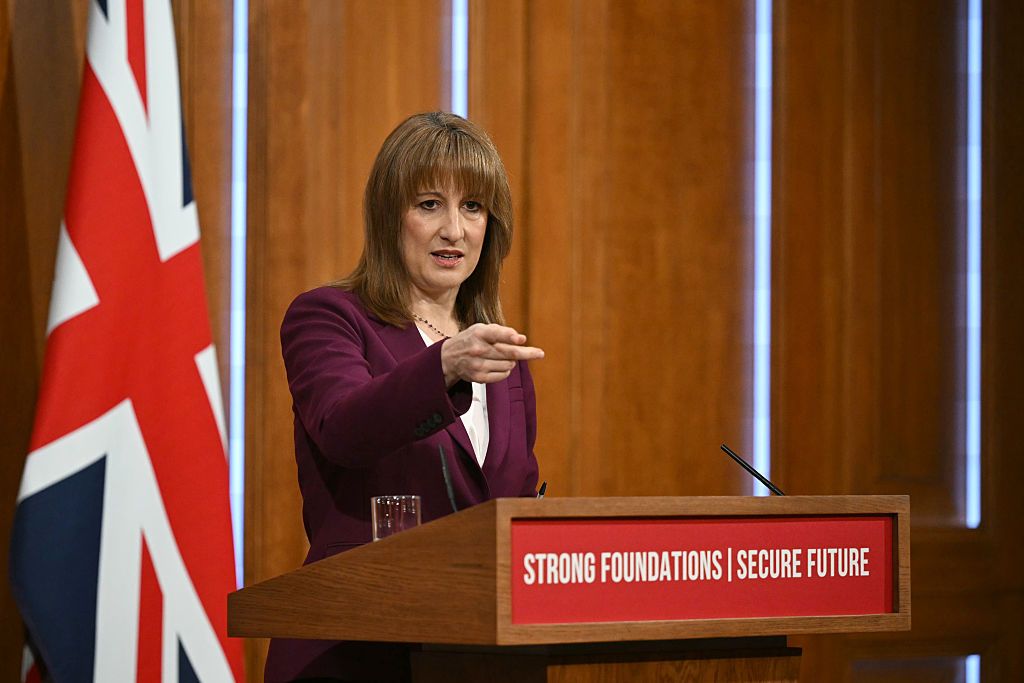
Rachel Reeves has given her strongest indication yet that income tax rises could be on the cards in the Budget, refusing to repeat her manifesto pledge not to increase income tax, National Insurance, or VAT.
In a speech, delivered on Tuesday (4 November), the chancellor seemed to set the stage for tax rises in the Autumn Budget, saying: “If we are to build the future of Britain together, we will all have to contribute to that effort. Each of us must do our bit.”
She added that despite the bleak economic outlook for the UK, “austerity, reckless borrowing, [and] made-up numbers” were “the problem, not the solution”.
Sign up to Money Morning
Don’t miss the latest investment and personal finances news, market analysis, plus money-saving tips with our free twice-daily newsletter
Don’t miss the latest investment and personal finances news, market analysis, plus money-saving tips with our free twice-daily newsletter
Not raising income tax ‘risks doing more harm than good’, says Labour-linked think tank
Commentators and economists have expected taxes to rise in the Budget for some time now, with the possibility seemingly becoming likelier by the day.
Now an influential think tank with close links to Labour has called for the chancellor to “take decisive steps in her Budget in order and aim to double her level of headroom, while focusing on reducing prices, poverty and protecting payslips”.
The Resolution Foundation, which until 2024 was led by Pensions Minister Torsten Bell, says to achieve this, around £26 billion worth of tax rises are likely to be needed as a U-turn on welfare reform and a downgrade to productivity growth estimates are expected to cost the government billions.
The scale of the required cash injection means that avoiding the three big taxes (VAT, income tax, and National Insurance) “risks doing more harm than good”, the think tank estimates.
It ruled out a VAT rise as doing this will cause upwards pressures for inflation, which has remained stubbornly high in 2025. Instead, the think tank has suggested a 2p rise in income tax, offset by a 2p cut in employee National Insurance.
Such a policy would raise around £6 billion a year, according to the analysis, and would target people who pay income tax but not employee National Insurance. This includes landlords, pensioners, and the self-employed.
Beyond this policy, the remaining cash needed could be raised through “sensible reforms”, the think tank said, such as taxing partnership income, raising dividend tax, and closing capital gains tax loopholes, while also boosting growth by reducing the VAT threshold and reforming Vehicle Excise Duty.
James Smith, research director at the Resolution Foundation, said: “The chancellor should look to make sensible tax reforms to car taxes, dividends and capital gains. Switching 2p of employee National Insurance onto income tax would raise £6 billion [per year] while protecting workers’ wages.
“Together, this will help to deliver a decisive Budget centred around prices, payslips and poverty reduction, and that shifts the focus away from black holes and back onto boosting growth.”
However, Sarah Coles, head of personal finance at Hargreaves Lansdown, warned that while such a policy would technically avoid hitting ‘working people’, it would still impact several other types of income that are currently subject to income tax but not National Insurance.
“This includes pension income, earned income from people over the state pension age, savings interest outside cash ISAs, and income for landlords and self-employed people. Someone on a total pension income of £35,000, for example, currently pays £4,486 in income tax at 20%. A rise to 22% would mean they pay £449 extra a year.”
How you could protect yourself from potential income tax hikes
With income tax hikes potentially on the horizon, it could be a good idea to start looking into ways to combat a potential rise and keep hold of more of your money.
One of the best ways to do this is by reducing your total taxable income as much as possible so any increases to the rate of income tax will affect you far less.
This can be done in a number of ways.
Higher pension contributions
One method is to increase your pension contributions, either through your workplace pension scheme, or by putting more into your Self-Invested Personal Pension (SIPP).
As your taxable income is calculated after your pension contributions, putting more into a pension means you can reduce the amount of monthly pay which is subject to income tax.
“It won’t give you more money in your pocket today, but it will help you build a more resilient retirement, “Coles at Hargreaves Lansdown says. “Assuming that tax relief remains at your highest marginal rate, it would also raise the rate of tax relief, so you get more out of every penny you put into your pension.”
Depending on how much you earn, you may be able to reduce your taxable income enough to keep you below a tax threshold, cutting your highest rate of tax.
Utilise ISAs
Coles adds that if you are aiming for a retirement income that could exceed future tax thresholds, “you can consider using cash and stocks and shares ISAs alongside your pension”.
Any money that you save in an ISA can be taken tax free, meaning you are awarded more flexibility when managing your finances in retirement, and helping you pay less tax on your income.
For example, if you have built up a large ISA balance, you can top up your retirement income by taking money out of your ISA savings without having to pay extra income tax.
Currently, the maximum you can put into an ISA each year is £20,000, and you have full control over how much of that allowance you put in each type of ISA.
However, rumours have circulated all year that the amount of this ISA allowance that you can save in cash may be reduced – possibly even halved to £10,000.
Gifts and spousal transfers
Meanwhile, if you are married or in a civil partnership with a partner that pays a lower rate of tax, you can transfer income-producing assets into their name.
“It means you can both take advantage of your tax allowances. You can also use all the tax-efficient vehicles at your disposal, including your ISAs and pensions, as well as the Junior ISAs and Junior SIPPs of any qualifying children,” says Coles.
Defer your income
You may be able to defer your income if you expect to be paying a lower rate of tax at a later date.
“Business owners can manage their dividend payments, but employed people can also take steps,” Coles said.
For example, savers could use fixed-term savings accounts that pay interest annually, rather than an account which pays interest monthly.
“This often makes sense just before retirement,” Coles said. “If this money is currently sitting in accounts paying interest, then from a tax perspective, the sooner you move, the better.”
Explore More