
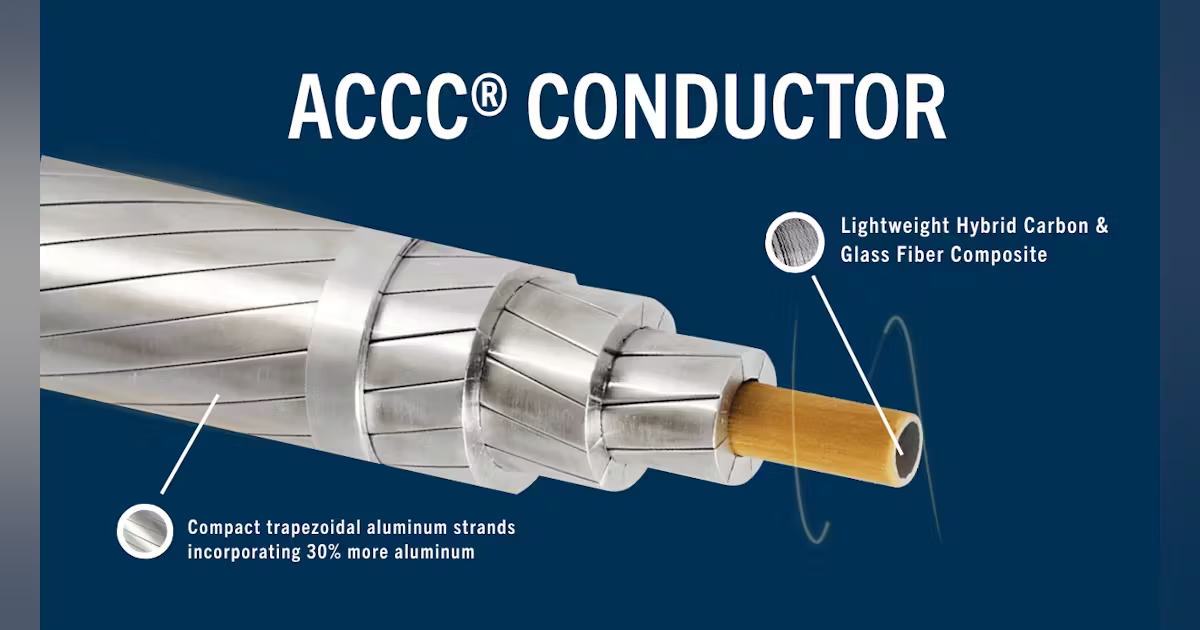
From Steel to Composite: Why Materials Matter
Traditional conductors such as ACSR and ACSS use steel cores to provide tensile strength. However, steel expands when heated, causing line sag at higher operating temperatures. That sag often becomes the limiting factor in system performance – and it constrains utilities from operating lines at higher capacities, even when thermal limits are well below safety margins.
The ACCC® Conductor replaces that steel with a carbon fiber composite core that has roughly one-third the weight and one-tenth the thermal expansion. Surrounding the core are fully annealed (or aluminum-zirconium alloy), trapezoidal aluminum strands that pack more conductive metal into the same diameter.
The benefits compound quickly:
- Higher Ampacity: Up to twice the power flow on existing structures
- Reduced Line Losses: Typically 25–40% lower electrical losses at equivalent load, translating into fuel savings, emission reductions and freed-up generation capacity.
- Lower Sag: Reduced thermal expansion maintains ground clearance and safety margins at higher temperatures – thereby improving reliability and reducing wildfire risk.
- Extended Asset Life: Lower operating temperatures and mechanical stress reduce long-term degradation.
In practice, reconductoring with ACCC® Conductor can turn an overloaded corridor into a modern high-capacity highway – without new towers, foundations, or rights-of-way. That capability is transforming how planners and regulators think about transmission upgrades.
Policy Alignment: The Push Toward Grid Efficiency
Policy support for Advanced Conductors has accelerated significantly in recent years. The DOE’s Grid Resilience and Innovation Partnership (GRIP) program, FERC’s transmission reform initiatives, and funding mechanisms within the Inflation Reduction Act (IRA) and Bipartisan Infrastructure Law (BIL) all point to a central theme: increasing grid capacity faster and smarter.
According to Peter Brehm, Vice President of Policy & Grid Strategy at CTC Global, the policy landscape is catching up to the technical capability. “Federal and state agencies are aligning around a ‘Speed to Power’ approach,” he says. “We now see language in federal and state guidance that explicitly prioritizes Advanced Conductors and Advanced Reconductoring as priority grid investments.”
This marks a significant shift. For decades, grid expansion focused primarily on adding new corridors. Today, the focus is turning toward optimization – extracting more value from the existing network. Advanced Conductors fit this model perfectly: they deliver measurable performance gains at a fraction of the time and cost of building new lines.
Integrating Advanced Conductors into Transmission Planning
Still, unlocking the full potential of Advanced Conductors requires changes in how transmission planners assess options. Traditional planning tools were built to evaluate new infrastructure, not technology upgrades.
“Planning models tend to undervalue time-to-benefit and non-capacity advantages like reduced losses or improved reliability,” explains Jay Caspary, Principal at TransGrid Advisors and former Director of Transmission Planning at Southwest Power Pool (SPP). “But when you quantify avoided congestion costs, reduced losses, and resiliency improvements, Advanced Conductors often become the least-cost, highest-impact investment available.”
Caspary points to examples in the Midwest and California where reconductoring existing corridors provided years of relief while major new transmission projects advanced through permitting. “It’s not an either/or,” he adds. “It’s about using Advanced Conductors as a bridge to meet near-term demand while long-term infrastructure comes online.”
Beyond Reconductoring: Advanced Conductors for New & Rebuilt Transmission
For utilities already deploying Advanced Conductors in reconductoring projects, the benefits are well established: operating capacity can double—or more—while line sag is reduced by 50%, total project costs fall to roughly half that of full rebuilds, commissioning timelines accelerate, and line losses drop by up to 40%.
Christian Bilcheck, Principal at Breakthrough Innovations LLC and former Vice President of System Planning at AVANGRID, highlights a persistent misconception among utility planners and engineers—that Advanced Conductors are relevant only for reconductoring or exceptional long-span applications, such as river crossings.
“The benefits of applying the ACCC® Advanced Conductor extend far beyond reconductoring,” Bilcheck explains. “When integrated into the design of new or rebuilt transmission lines, ACCC® can reduce total project costs by 10–15% or more compared to conventional ACSR or ACSS conductors.”
He emphasizes that realizing these savings requires utilities to leverage the conductor’s characteristics from the outset of the design process. “Too often, line designs begin with traditional steel-core conductors, and ACCC® is considered only later as an alternative. By that point, the design—and the (lost) opportunity for real savings—has already been locked in.”
The lower weight and reduced sag of ACCC® enable longer spans, fewer or shorter structures, and smaller foundations—all contributing to meaningful cost savings. “Fewer and shorter structures also translate to improved siting and permitting outcomes,” Bilcheck adds. “They deliver not only economic benefits but also tangible environmental advantages—demonstrating a commitment to minimizing visual impact and respecting local communities.”
Delivering Economic and Environmental Benefits
The efficiency gains from Advanced Conductors also carry systemic benefits. Reduced line losses mean less generation is needed to deliver the same power, lowering both operational costs and emissions. For large utilities, this can translate into tens of millions of dollars in avoided losses annually.
Moreover, because reconductoring projects can often be completed in months rather than years, utilities can respond to new industrial loads or renewable integration needs far more quickly. That agility supports economic growth – by enabling new factories, data centers, and housing developments to connect to reliable power without long delays.
From a ratepayer perspective, the story is equally positive. By upgrading existing assets rather than building new lines, utilities can mitigate rate pressure even as demand grows. The result is a more efficient, resilient, and affordable grid.
A Proven Path Forward
As the energy transition accelerates, utilities must move beyond incremental change. The scale of electrification now demands proven, scalable solutions that can be deployed today. Advanced Conductors like the ACCC® Conductor provide exactly that – a practical bridge between the aging grid of the past and the high-performance, high-capacity network of the future.
“Every transmission owner can take steps right now,” says Bryant. “Survey existing corridors, identify congested paths, and evaluate what reconductoring could deliver. The technology is highly tested and proven, the policy support is here, and the need has never been greater.”
The U.S. grid stands at an inflection point – and as this new generation of conductors demonstrates, the fastest path to the future may well run along the lines we already have.