
On the hunt for cheap and fast strategies to prevent deadly wildfires, utilities across the U.S. and Europe are contracting with a handful of artificial intelligence startups to map wildfire risk along thousands of miles of power lines, picking out individual trees to cut and poles to replace.
The most obvious way to prevent power equipment from sparking a blaze is to bury lines underground. But at a cost of upwards of $3 million a mile, many investor-owned utilities are limiting themselves to just a few hundred miles of buried lines per year. That’s proved to be a major business opportunity for several tech companies that use machine learning to deliver custom recommendations for targeted, relatively low-cost fixes — including some that can be paid for from maintenance budgets.
Take Massachusetts-based Overstory, which analyzes high-definition satellite images to spot trees most likely to topple or drop a limb onto power distribution lines — those most in need of trimming. The company started out making tools to find and discourage deforestation, said Chief Executive Fiona Spruill. Overstory pivoted after a realization: “We could have a huge impact from a climate standpoint, in that we could help prevent wildfires,” she said. The company recently closed an oversubscribed Series B funding round that pulled in more than $43 million.
Overstory’s clients now include American Electric Power Co.’s Texas utility and California’s Pacific Gas & Electric Co., along with other major U.S. utilities, Spruill said. U.K.-based National Grid Plc, meanwhile, has signed a deal with Rhizome, a San Francisco-based climate tech firm, for custom modeling to suggest investments in fire safety.
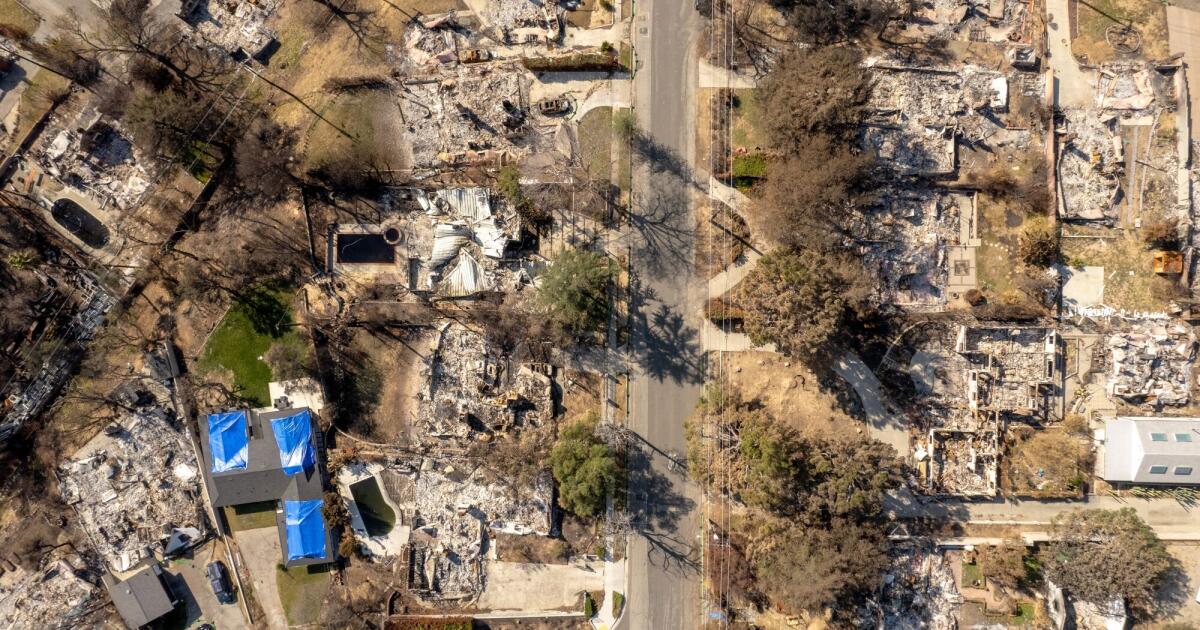
The stakes for utilities are high: Edison International’s Southern California utility is facing lawsuits for its possible link to the Eaton fire in Altadena, which killed 19 people in January. Wildfire liability from deadly blazes in Northern California pushed PG&E to declare bankruptcy in 2019.
In the years since, PG&E has worked with Overstory’s staff to map the precise location and health of individual trees across its vast service area, which stretches for more than 500 miles in California. The premise is that it’s cheaper and more comprehensive than sending utility workers to inspect trees from the ground — or deploying helicopters to spot problem areas from the air.
To train its AI, Overstory relied on a large team of arborists who contributed on-the-ground measurements and observations of diseased or dying trees. The company’s data and risk predictions are loaded into a custom web platform, with suggestions for what to trim and how often.
Rhizome co-founder and CEO Mishal Thadani said his company set out to help utilities decide which fire risk interventions — from cutting trees to replacing flammable wooden poles and installing new safety equipment — will deliver the most benefit for the cost. Rhizome’s gridFIRM model can parse an array of site-specific information about a given grid, including local weather trends and maintenance records, and factor in information about nearby properties and populations that would be impacted in a fire.
National Grid plans to start using the model soon in the UK and already employs it on grids in New York and Massachusetts. Those states may not traditionally be thought of as fire prone, but the amount of land area burned within their borders more than tripled from 2023 to 2024, according to data from the U.S. National Interagency Coordination Center, a federal hub for tracking and managing wildfire response.
Rhizome’s technology has already rewired some of the utility’s assumptions about its fire risk, according to Casey Kirkpatrick, National Grid’s director of group strategic engineering. Previously, National Grid assumed it was worse in areas near bigger cities with more fire-ignition sources, along with sections of the grid near overgrown forests. Some of the biggest risks, however, lurked in suburbs.
Human-caused climate change is driving more volatile and extreme weather events. Heavy winter rains allow grasses and brush to flourish and are followed by summer heat domes and flash droughts that kill off plants and weaken trees. Researchers have found that drought stress can also lead to an outgrowth of disease in forested areas.
“Because of climate change, trees are dying in new and different ways than they have in the past,” said Spruill of Overstory, meaning a maintenance plan that “may have worked 10 years ago is not necessarily going to work anymore.”
Periodically trimming trees near power lines has been a mainstay of utility maintenance programs. Some companies have experimented with more aggressive cutting, but it may not be the most cost-effective way to control fire risk across an entire system, said power systems researcher Duncan Callaway, who leads UC Berkeley’s Energy and Resources Group.
Callaway was part of a team that recently examined PG&E’s fire-mitigation programs. Fast-trip safety settings that quickly shut off the power when equipment begins to fail delivered the most benefits for the money, according to the team’s analysis in the journal Nature Climate Change, preventing about 80% of potential fire starts. More targeted trimming in known problem areas could help reduce the remaining risk of sparking a blaze, Callaway said, but can’t eliminate it entirely.
“There’s always going to be some risk of ignition unless we spend just extraordinary amounts of money” to bury all distribution lines, Callaway said. “If that cost is making it difficult for people to pay their bills, which is certainly already front of mind, at some point you have to live with the discomfort of some residual risk.”
But as utilities confront potentially ruinous financial fallout from wildfire-related lawsuits, fines and insurance premiums, the demand for any tool that can drive down residual risk is increasing. Overstory recently rolled out a model to help determine the presence of dry grasses and brush at the base of high-powered transmission lines, which were tied to two devastating fires sparked by PG&E in 2018 and 2019.
The Kincade blaze and the deadly Camp fire — which helped push the company toward bankruptcy — “happened basically at the transmission tower,” said Andy Abranches, PG&E’s vice president of wildfire mitigation. Both could have been prevented by clearing out the dry brush that lay beneath the towers, ready to burn. “Even if the equipment failed, the sparks that it threw would have landed on bare earth,” he said. “There would have been no fire.”
Rosenthal and Wertz write for Bloomberg.