
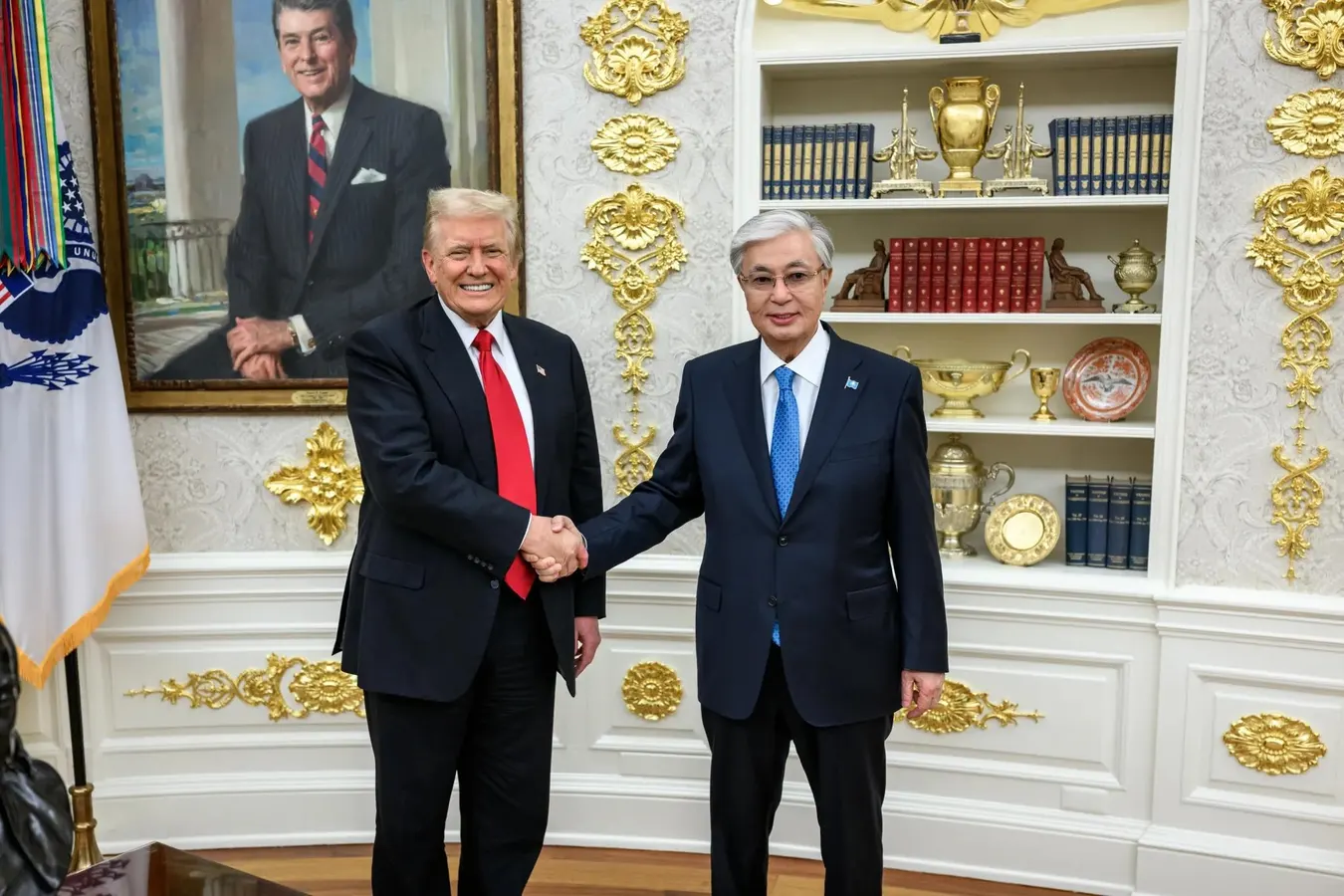

The expansion of the Abraham Accords to include Kazakhstan during the C5+1 Summit on November 6th sets the stage for stronger ties between the U.S. and Central Asia.
The White House
When Kazakhstan’s president Kassym Jomart Tokayev announced, during a meeting with President Trump in the Oval Office, that Kazakhstan would join the Abraham Accords, markets rejoiced, and the decision was lauded in boardrooms and policy chanceries from Washington to Beijing and from New York to Shanghai. Kazakhstan’s joining transformed the process initiated by President Donald J. Trump in his first term from Arab-Israeli diplomatic normalization to a historic rapprochement between Islam and Judaism. If a Christian country such as Armenia or Cyprus joins, it will become truly Abrahamic.
The implications of this diplomatic move have already had reverberations. The Caspian Pipeline Consortium, which transports Kazakh oil to Europe through Southern Russia and has sometimes been a diplomatic flash point, was exempted from U.S. sanctions against Russia. Meanwhile, the Central Asia Five group (Kazakhstan, Kyrgyzstan, Tajikistan, Turkmenistan, and Uzbekistan) decided to admit Azerbaijan to the group to build a westward logistics corridor. Azerbaijan, too, is likely to join the Abraham Accords. This creates the conditions for a unified Central Asian-Caucasian investment market that is far less beholden to geographic externalities than ever before.
Over the past three decades, Kazakhstan has built a reputation as a reliable and mature partner for American investment. Since the 1993 Kazakh-Chevron “Deal of the Century,” Kazakhstan embraced market reforms, pursued multi-vector diplomacy, predictability, and punched above its weight in multi-lateral organizations such as the U.N., Organization for Security and Cooperation in Europe, Conference on Interaction and Confidence-Building Measures in Asia, and Organization of Islamic Cooperation. This allows Astana a balancing act vis-a-vis the political challenges from Russia and China, while attracting Western economic investment.
Despite the earlier structural advantages, Western trade and investment in Kazakh energy and its broader economy have lagged since the late 2000s. It was in Kazakhstan that China’s Belt and Road was launched and retooled after a decade, after all. What Kazakhstan’s accession to the Abraham Accords represents then is not just an embrace of a diplomatic framework for peace in the Middle East, but also a well-coordinated attempt to court American investment and engagement.
A Market Matures
Since establishing diplomatic ties in the early 1990s, Kazakhstan and the United States have cultivated a relationship marked by pragmatism and shared interests. This relationship began with nuclear disarmament before shifting more to counterterrorism and regional security. Trade took a second fiddle to Washington’s immediate energy and strategic interests. Washington came to view Astana as a stabilizing force in a region often defined by volatility and as a reliable partner that prefers long-term cooperation over short-term gain.
This relationship took on greater weight in 2018, when the two countries elevated their engagement to an “enhanced strategic partnership,” signaling a more comprehensive approach to diplomacy, energy, and commerce. In the years since, that partnership has quietly matured into one of the most robust bilateral relationships involving any Central Asian state.
Today, Kazakhstan serves as the focus of U.S. economic presence in the region. More than 630 American companies operate there, ranging from industrial giants like Chevron and ExxonMobil to technology innovators and financial firms. It is the leading destination for U.S. investment in Central Asia, capturing nearly 80 percent of all American capital directed into the region. Since independence, U.S. foreign direct investment has exceeded $60 billion, accounting for more than 13 percent of Kazakhstan’s total FDI stock.
That figure continues to grow. In 2024 alone, the country attracted over $15 billion in American investment, and in the first quarter of 2025, the flow reached $362 million. Beyond the raw numbers, these figures reflect renewed confidence in Kazakhstan’s reform-driven economic model, which privileges transparency, private enterprise, and openness to international partnerships.
Investment further expanded during President Kassym-Jomart Tokayev’s September visit to the UN General Assembly in New York, where he met with more than 150 American business leaders, including executives from over 30 Fortune 100 companies. The deals inked totaled over $17 billion and included tech leaders like Nvidia, transport giants like Boeing, and critical minerals mining companies such as Cove Capital. Most important of all was the 4.2-billion-dollar investment deal between the railway company Wabtec and Kazakhstan, which will significantly boost Kazakhstan’s transportation infrastructure capacity and thus incentivize further investment.
Rare earth mining is a key vector of cooperation between the United States and Kazakhstan as public and private American interests look to diversify mineral supply chains to reduce dependence on China.
The Jamestown Foundation
Together with President Tokayev’s meeting with Trump at the White House at the C5+1 in November, these high-level engagements reaffirmed what investors have increasingly recognized: Kazakhstan is not a traditional frontier market. It is an emerging market in transition, a place where risks are balanced by institutional sophistication and a commitment to modernization. It demands a different view of risk and reward.
Eurasia’s Changing Investment Climate
Kazakhstan’s economic appeal lies not just in its resource wealth but in its institutional infrastructure. The government has worked to create a business climate where foreign investors can operate with confidence. Legal reforms, tax incentives, and a steady improvement in governance have propelled the country to the top tier of global ease-of-doing-business rankings.
The heart of this institutional architecture is the Astana International Financial Centre (AIFC), an independent jurisdiction within Kazakhstan that operates under English common law, a rarity in the post-Soviet space. The AIFC offers tax exemptions until 2066, streamlined visa and labor regimes, and a modern digital dispute-resolution system. It is now home to more than 4,200 registered companies from over 80 countries, including more than 60 from the United States. Its rise mirrors Kazakhstan’s broader ambition to become a recognized middle power and a regional hub for finance, green innovation, and digital enterprise. Ten major projects with U.S. investors, worth roughly $538 million, have already been completed, while another nine, totaling nearly $6 billion, are being completed.
Legal certainty has been another pillar of Kazakhstan’s appeal. The country maintains double taxation avoidance agreements with 55 nations and has ratified 51 bilateral investment protection treaties, ensuring that investors’ rights are safeguarded under international law. Recent hearings in the U.S. Senate have reinforced that confidence: Secretary of State Marco Rubio confirmed that Washington now formally recognizes Kazakhstan as a market economy and is working toward establishing Permanent Normal Trade Relations (PNTR). Once complete, that move will effectively remove outdated trade restrictions under the 1974 Jackson-Vanik Amendment currently under consideration by US Congress, and give U.S. businesses full access to Kazakhstan’s market.
For American investors, this signals a new era. The combination of geopolitical stability, legal transparency, and a government eager to attract global capital makes Kazakhstan an attractive emerging market.
The Actual Frontier: Beyond Oil In Eurasia
Nowhere is the U.S.–Kazakhstan partnership more visible, or more strategically significant, than in energy. Since 1993, Chevron and ExxonMobil have collectively invested about $60 billion in the oil and gas sector, with roughly a quarter of their global production now tied to Kazakhstan’s fields. The hydrocarbons extracted from Kazakh soil play a vital role in Europe’s energy security.
But the next phase of cooperation goes beyond oil. As the global economy pivots toward decarbonization, Kazakhstan’s vast reserves of uranium, lithium, tungsten, and rare earth elements are emerging as critical assets. The country is now positioning itself as a key supplier of the minerals essential to clean-energy industries, IT, and high tech, an ambition strongly aligned with U.S. strategic interests in diversifying supply chains away from China and Russia.
Kazakhstan’s entry into the Abraham Accords accelerates that process. By joining this U.S.-backed framework, Astana not only gains access to new sources of investment from Gulf and Israeli partners but also embeds itself more deeply into global technology and logistics networks. For Washington, it represents an opportunity to strengthen a trusted ally in the heart of Eurasia while securing vital resources for the next generation of energy systems.
Deals like Cove Capital’s tungsten mining agreement, announced in tandem with broader U.S. efforts to source rare earths outside East Asia, show how policy alignment is rapidly translating into deal flow. Investors are now eyeing not just extraction, but the full value chain: refining, processing, and manufacturing.
At the same time, Kazakhstan is investing heavily in its Middle Corridor transport route, a trans-Caspian trade artery connecting Central Asia to Europe via the South Caucasus, bypassing Russian territory. That corridor, connecting to the Trump Route for International Peace and Prosperity in South Caucasus, coupled with satellite and digital infrastructure projects like Amazon Kuiper, positions Kazakhstan as a linchpin in the 21st-century global supply chain.
Kazakhstan is a lynchpin in trade through the Middle Corridor, a trade route bolstered by the Trump Route for International Peace and Prosperity, also known as the Zangezur Corridor.
GIS Reports Online
For American investors, frontier markets are usually perceived as either developing countries where they can get in on the ground floor or cutting-edge high-tech startups in Shenzhen or Silicon Valley. Kazakhstan offers a different model: an economy in transition to a developed market that, with an educated workforce and significant potential to play from critical minerals to AI to uranium fuel enrichment. Joining the Abraham Accords can be a catalyst for the country to become a 21st-century dynamo middle power in the heart of Eurasia, and a model of global diplomatic engagement and economic cooperation.