
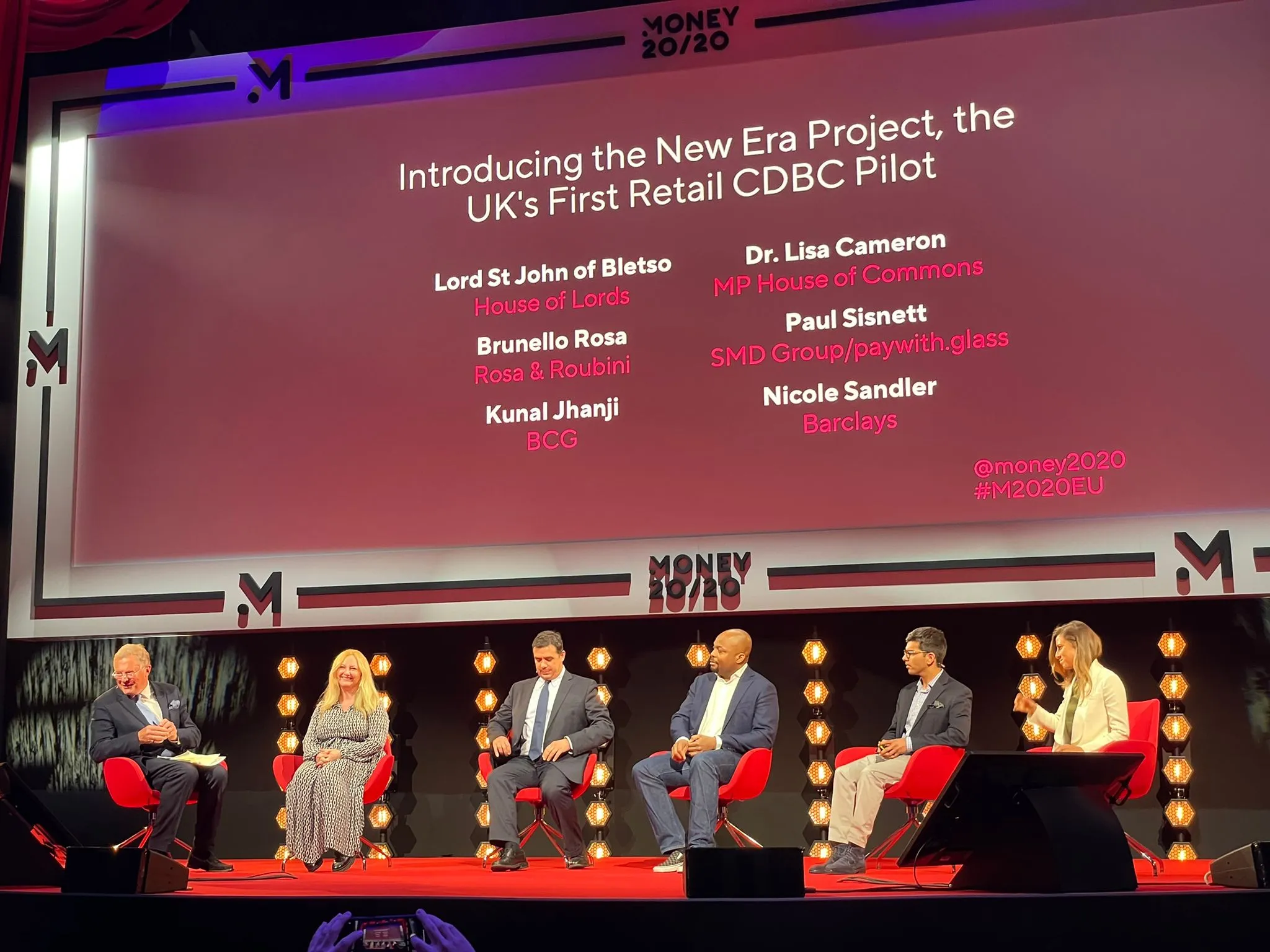

Project New Era is a privately-led, cross-industry initiative that will evaluate a future digital currency ecosystem in the UK that could include stablecoins and a Central Bank Digital Currency (CBDC).
Differing from other initiatives which seek to promote policy theories for digital currencies, New Era is about testing them in practice through a private sector pilot, using a live digital Sterling (‘dSterling’) asset.
The pilot, set to launch in September, will be run by the private consortium but aims to engage with The Bank of England, the Financial Conduct Authority and the Payments Systems Regulator to update them around the progress and learnings in order to help them make informed decisions on implementing a CBDC in the future. These authorities are not, however, directly involved in the pilot itself.
Elements being investigated include evaluating the risks, both from macroeconomic and technical aspects, looking at cybersecurity, resilience, and ease of integration in order to generate a fully simulated environment for digital currencies and perhaps eventually a CBDC for the UK.
The project is led by SMD Group, the technology company whose ‘paywith.glass’ fintech platform provides the pilot’s underlying infrastructure, and already has broad support across the industry. It is officially advised by Boston Consulting Group and supported by The Payments Association trade body. Other global advisors to the project include Rosa & Roubini Associates as Macroeconomic Advisors, Simmons & Simmons as legal counsel and Farrant Group providing strategic communications.
Phase one was completed with the publication of a Green Paper in February 2022, outlining the possible paths to CBDC adoption in the UK and challenges along the way. Phase two is now underway, which involves building a consortium to conduct the pilot which will last 18-24 months from September. The aim is to explore best practice when it comes to ‘Digital Financial Market Infrastructure’, or ‘dFMI’. The consortium conducting the project goes by the same name – the Digital FMI Consortium.
The pilot will create a technical infrastructure, validate use cases, and provide empirical evidence in support of the proposed implementation.
Project New Era is very focused on the practical, hands-on approach and that according to SMD Group’s CEO Paul Sisnett is one of the key differentiators from other projects in this space.
“There are a number of think-tanks currently in place across the UK and that is very helpful, but we wanted to move beyond theory. Unless you actually put these ideas into operation, it’s very hard to know what works or conversely what can go wrong,” says Sisnett.
“We are creating a real environment – as close as possible to a CBDC environment without actually issuing a CBDC. But it’s different from a stablecoin simulation as we will hold the assets backing the coin in either a central bank reserve account or a commercial bank account. So for all intents and purposes it will behave in the same way as a true CDBC.”
Sisnett believes that by creating a blueprint for a retail CBDC, the project can give the UK an opportunity to lead the way in the retail CBDC space. He also sees the pilot as providing access to data for the UK regulators so that they can make informed decisions especially when looking at interoperability with legacy solutions and other existing currencies.
The core objective of the pilot is to provide design principles and to build from learnings of the Green Paper, according to Kunal Jhanji, a Managing Director and Partner at BCG and advisor to the project.
“Elements such as bank disintermediation risk, data privacy and consumer data protection must be enshrined in retail CBDC and future digital currencies. We also need to establish cybersecurity and resilience of the future digital currency infrastructure,” says Jhanji.
“And the issue of programmability of money needs to be addressed because that is where future innovation will be realised.”
Recent high-profile collapses in the cryptocurrency market and most notably the collapse of the algorithmic stablecoin UST, make the kind of sandbox testing undertaken by Project New Era even more important and timely.
“The collapse of UST raises some critical questions on how to implement a digital currency,” says Jhanji. “Asset backing, consumer protection, and regulatory requirements are more important than ever. Digital currencies need to be governed properly with liquidity held by either a central bank or other trusted entities which are well governed.”
Sisnett, with his background in payments and telecommunications, stresses the importance of infrastructure.
“We were able to apply our learnings from the telecommunications industry where cloud and data centre infrastructure design are key. We approached the project to see how a CBDC can sit on this platform, but we also wanted to incorporate the flexibility to support other digital currencies or digital assets in the future.
“The idea is that we are creating a new highway or a new internet for money which has compliance and regulation baked into the infrastructure layer,” says Sisnett.
Sisnett points out that when the World Wide Web was first invented and used in the early 90s there was no way anyone could have predicted applications such as YouTube or TikTok.
“What we are aiming for here is to create a foundation that can support future currency apps; we’re laying down those rails for the foundation of new money, for digital money. We see digital money as a human right,” says Sisnett.
He points to the world where currently 1.7 billion people have no access to formal financial services.
“If we don’t take into consideration the unbanked populations today, they will be excluded from the future digital currency ecosystem and that would be a socio-economic disaster of epic proportions. Our aim is to ensure every single human being has access to financial services in the future.”
Around the world there are 90 countries actively looking at CBDCs, there are 17 live projects and three full implementations. Both Sisnett and Jhanji believe that the UK has an opportunity to make a difference.
Jhanji views Project New Era as being very different from other implementations due in part to the UK’s engagement with the private sector.
“The Bank of England has been actively engaging with the private sector, setting up a task force and openly looking to gain input on what a CBDC might look like,’ says Jhanji referring to the discussion documents issued by the Bank of England in 2019, 2020 and again last year.
Sisnett is one mind with Jhanji.
“From the beginning the Bank of England reached out to the public for feedback, opinions and advice on a CBDC strategy which was a bold and unique move. One entity is unlikely to be able navigate the complexity of a CBDC all by itself. By seeking consultation, the UK not only has access to deep experience, it also is acting in a very transparent fashion.”
“I truly believe by taking this approach the UK has an opportunity to showcase to the world a CBDC strategy that works and meets all regulatory and retail needs,” concludes Sisnett.