
Charlotte EdwardsBusiness reporter

 Getty Images
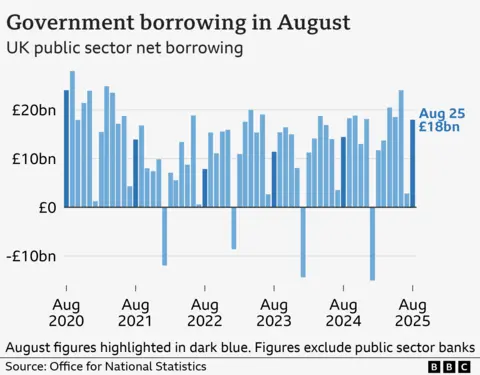
UK government borrowing in August hit the highest level for the month in five years, latest figures show, adding to the pressure on the chancellor ahead of the Budget.
Borrowing – the difference between public spending and tax income – was £18bn in August, the Office for National Statistics (ONS) said, which was higher than analysts had expected.
Despite tax and National Insurance receipts increasing, they were outstripped by higher spending on public services, benefits and debt interest, the UK statistics body said.
One analyst said Rachel Reeves faced “tough choices” in the Budget to meet her tax and spending rules, with speculation building that taxes will rise.
The latest borrowing figure for August is the highest for the month since the height of the Covid pandemic, when government spending was ramped up to support the economy.
Borrowing over the first five months of the financial year has now reached £83.8bn, which is £16.2bn higher than the same period last year.
It is also above the prediction of £72.4bn that the government’s official forecaster, the Office for Budget Responsibility, had made in March.
Paul Dales, chief UK economist at Capital Economics, said the latest figures, “highlight the deteriorating nature of the public finances even though the economy hasn’t been terribly weak”.
He added that this would contribute to the chancellor having to find money in November’s Budget, “mostly through higher taxes”.
Nabil Taleb, an economist at PwC UK, said Reeves now faced “tough choices, and the test will be whether she can make them palatable to voters and markets”.
The expectation is Reeves will need to raise extra money or cut spending to meet her self-imposed rules for government finances.
Reeves has two main rules, which she has said are “non-negotiable”:
- Not to borrow to fund day-to-day public spending by the end of this parliament
- To get government debt falling as a share of national income by the end of this parliament in 2029/30.
There has been a wide range of forecasts for how much money Reeves might raise in the Budget to meet her rules.
One factor that will influence this is the latest growth forecast from the Office for Budget Responsibility (OBR). Small changes to the forecaster’s outlook can make a big difference to its projections for tax income over the years ahead.
The cost to the government through its U-turns on benefit cuts – which had aimed to save billions of pounds – will also be a factor, as will the interest rates on government borrowing.
Mr Dales at Capital Economics said the chancellor would have “to raise £28bn, mostly through higher taxes, if she wants to keep her buffer against her rule of £10bn”.
Elliott Jordan-Doak, senior UK economist at Pantheon Macroeconomics, said the latest figures suggested “the chancellor will need to raise taxes by more than the £20bn we had previously estimated”.
“We still expect the chancellor to fill the fiscal hole with a smorgasbord of stealth and sin tax increases, along with some smaller spending cuts.”
On the financial markets, the value of the pound fell 0.5% against the dollar to $1.349, while government bond yields – which indicate government borrowing costs – rose on Friday.
The latest ONS figures showed interest payments on government debt rose by £1.9bn to £8.4bn, partly due to inflation pushing up costs.
Welfare spending increased by £1.1bn to £27.3bn, largely driven by inflation-linked benefit rises and higher state pension payments.
James Murray, Chief Secretary to the Treasury, said the government had “a plan to bring down borrowing because taxpayer money should be spent on the country’s priorities, not on debt interest”.
“Our focus is on economic stability, fiscal responsibility, ripping up needless red tape, tearing out waste from our public services, driving forward reforms, and putting more money in working people’s pockets,” he added.
But shadow chancellor Sir Mel Stride, wrote on X: “Keir Starmer and Rachel Reeves are too weak and distracted to take the action needed to reduce the deficit.
“The chancellor has lost control of the public finances, and Labour’s weakness means much needed welfare reforms have been abandoned.”
Warm weather boosts stores
Separate data from the ONS showed that good weather brought a boost to the High Street in August.
Retail sales rose by 0.5% during the month, slightly higher than analysts had expected, with butchers, bakers, clothing stores and online shopping all reporting growth.
The figures come despite warnings from some retailers in recent days of cost pressures and price rises.
However, the monthly shop sales data from the ONS can be volatile.
Over the three months to August sales declined by 0.1%, the ONS said, compared with the three months to May.
“Overall, August caps off a better-than-expected summer, particularly for non-food retailers, with sales of seasonal lines boosted by the hottest summer temperatures on record,” said Jacqueline Windsor, head of retail at PwC.
“However, overall sales volumes remain below pre-pandemic levels, so the high street is far from being out of the woods.”
Alice Cowley, managing director in Accenture’s retail practice, said retailers were “facing fresh headwinds as we head into the autumn”.
She said factors such as uncertainty over possible Budget measures, and ongoing energy and labour cost pressures, would continue to put profit margins “under greater strain”.