Close Menu
Simply Invest Asia
  • Home
  • Industries
  • Investment
  • Money
  • Precious Metals
  • Property
  • Stock & Shares
  • Trading
What's Hot

Municipal bonds offer a rare opportunity as yields climb, says Nuveen’s Dan Close

March 7, 2026

Better Stock to Buy Right Now: Royal Caribbean vs. Viking Holdings

March 7, 2026

Building society launches new ‘competitive’ savings account with 4% interest | Personal Finance | Finance

March 7, 2026
Facebook X (Twitter) Instagram
Trending
  • Municipal bonds offer a rare opportunity as yields climb, says Nuveen’s Dan Close
  • Better Stock to Buy Right Now: Royal Caribbean vs. Viking Holdings
  • Building society launches new ‘competitive’ savings account with 4% interest | Personal Finance | Finance
  • Income Tax Impact of Selling Precious Metals and Numismatics
  • High-Frequency Trading: HFT in Modern Crypto Trading
  • Martin Lewis explains how to get much better return on savings
  • Costco’s Strong Growth Continues. But Is the Stock Too Expensive?
  • Platinum deficit set to continue for 4th yr; shortage may shrink 75%
Facebook X (Twitter) Instagram YouTube
Simply Invest Asia
  • Home
  • Industries
  • Investment
  • Money
  • Precious Metals
  • Property
  • Stock & Shares
  • Trading
Simply Invest Asia
Home»Investment»Government borrowing, bonds and yields explained
Investment

Government borrowing, bonds and yields explained

By LucasOctober 15, 20253 Mins Read
Share
Facebook Twitter LinkedIn Pinterest Email


Government borrowing, bonds and yields explained


You may have heard politicians and economists talking about government borrowing costs going up and then down again. Here’s a handy guide explaining what government borrowing, bonds, and yields all mean.

Governments borrow to cover the gap between their spending and income

Governments get most of their income from taxes, but often they will want to spend more money than taxes raise.

To cover that gap, they borrow money. They also borrow to pay for big projects, like new railways and roads.

A bond is an IOU from the government to investors, and a gilt is just another word for a bond

When a government wants to borrow money from investors, it sells them something called a bond, which is a loan the government promises to pay back at the end of an agreed time – say five, ten, or 30 years. The government will also make regular payments – which can be once every three months, six months, or year – to the investor.

In the UK, a government bond is called a gilt. It has other names in other countries.

Maturity is the date the government pays the investor back

On that day, the bond has matured and the investor gets the original value of the bond back. So, if someone buys a £100 bond from the government, they will get the £100 back if they hold the bond to maturity.

Yield is a way of figuring out return-on-investment

It is a percentage figure which tells you the amount of money someone would get each year if they bought a bond and held it until it matures.

You figure out the current yield by dividing the annual payment from the bond, which is the money the government gives the person who owns the bond over a year, by the full price paid for the bond.

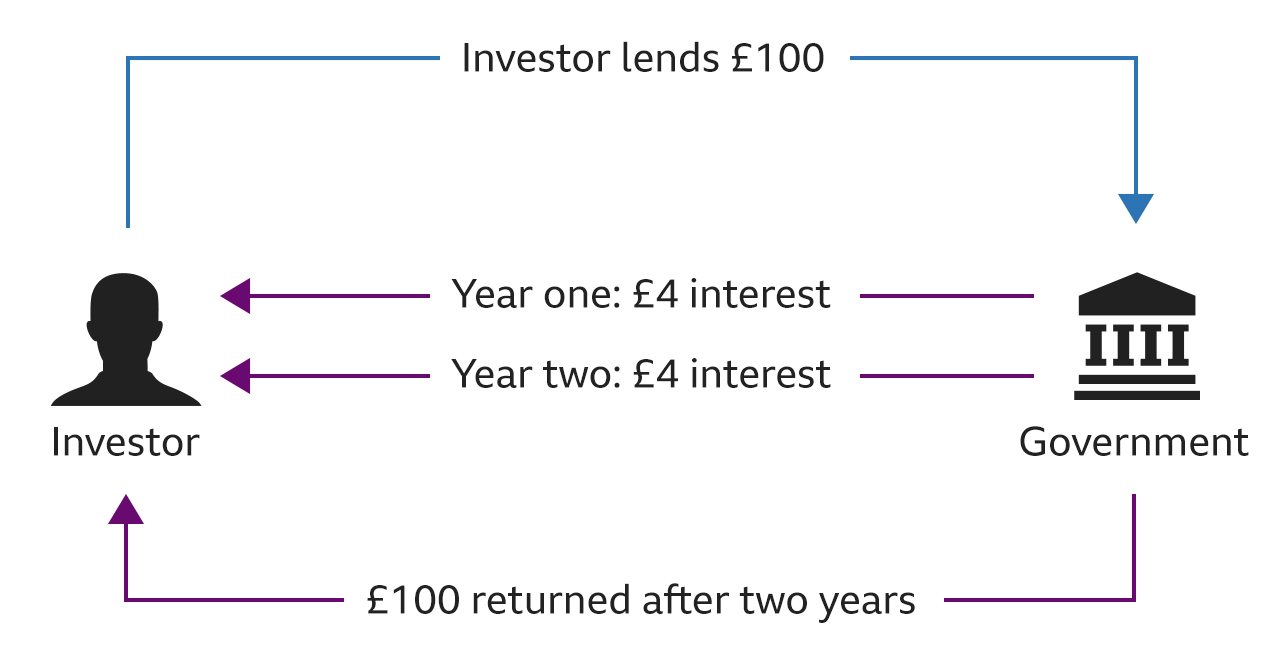
For example, if someone pays the government £100 for a two-year bond which pays £4 a year, that means the yield is 4%.

Example: Two year bond with a 4% yield

Source: House of Commons Library

Bond prices can rise or fall based on demand, which then changes the yield

Higher interest rates and lower trust in a government’s ability to pay back a bond can drive down bond prices, as investors may sell their bonds if they feel they can get better deals elsewhere.

Lower prices mean higher yields. For example, paying the government £100 for a bond that pays £10 a year means a yield of 10%. But if that bond price drops to £80 and it still pays £10 a year, then the yield has gone up to 12.5%. And if the bond price goes up to £125 and it pays £10 a year, then the yield has gone down to 8%. When bond prices go up, yields go down and vice versa.

Government bonds are bought by lots of people, including funds and individual investors

Pension funds are some of the biggest buyers of government bonds because they are considered a safe investment. So some of your pension investment is very likely to be in bonds.

Banks – including central banks like the Bank of England – other governments, and investment funds are buyers too. You can also buy bonds yourself.


Source link

Share. Facebook Twitter Pinterest LinkedIn WhatsApp Reddit Tumblr Email

Related Posts

Municipal bonds offer a rare opportunity as yields climb, says Nuveen’s Dan Close

March 7, 2026

Southampton Premium Bonds winners revealed for March 2026

March 7, 2026

SoftBank could raise up to $40Bn loan to fund OpenAI investment

March 7, 2026
Leave A Reply Cancel Reply

Our Picks

Build Nigerian industries, not buy Rolls-Royce

December 7, 2025

Kazakhstan Plans to Double Oil Refining Capacity by 2040

December 2, 2025

Safest and Most Advanced Crypto Trading App in India (2026)

February 9, 2026

Foreign investment in GCC countries reaches $523.4bn

November 25, 2025
Don't Miss
Investment

Municipal bonds offer a rare opportunity as yields climb, says Nuveen’s Dan Close

By LucasMarch 7, 2026

The firm’s head of municipals says attractive valuations and improving flows point to further upside…

Better Stock to Buy Right Now: Royal Caribbean vs. Viking Holdings

March 7, 2026

Building society launches new ‘competitive’ savings account with 4% interest | Personal Finance | Finance

March 7, 2026

Income Tax Impact of Selling Precious Metals and Numismatics

March 7, 2026
Our Picks

2 Top Growth Stocks to Buy, And 1 to Sell Right Away

March 5, 2026

Is It Too Late to Buy This Surging Silver ETF?

February 1, 2026

Meloni’s party pushes to declare Italy’s gold ‘property of the people’

December 2, 2025
Weekly Pick's

Bigger Land Rover Experience moves closer at Eastnor Castle

March 3, 2026

Digital currencies are reshaping everyday finance across Australia | The Canberra Times

October 24, 2025

Japan’s Mitsubishi Heavy to freeze development of SpaceJet regional jet -sources

October 11, 2025
Monthly Featured

China to unveil plans to integrate AI with manufacturing

November 4, 2025

Saudi signs MoU to explore vehicle manufacturing project

November 21, 2025

Cash-Rich Stock Poised For A Breakout

October 17, 2025
Facebook X (Twitter) Instagram Pinterest
  • Contact Us
  • Privacy Policy
  • Terms and Conditions
© 2026 Simply Invest Asia.

Type above and press Enter to search. Press Esc to cancel.