
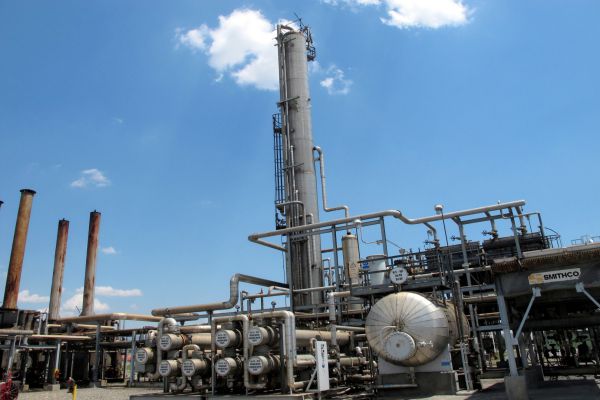
Oil refineries are industrial facilities that transform crude oil into everyday fuels and petroleum products such as petrol (gasoline), diesel, kerosene, and lubricants. While the global energy sector is often dominated by massive refining complexes capable of processing hundreds of thousands of barrels of crude each day, a number of countries also operate small or micro-scale refineries.
These compact facilities are typically designed to serve remote regions, small economies, or isolated oil fields where transporting crude oil to large refineries is costly or impractical. Despite their modest size, such refineries play an important role in strengthening local energy security, lowering transportation costs, and ensuring steady fuel supplies for nearby communities.
Below are seven of the smallest oil refineries in the world, ranked largely by their processing capacity:
Capacity: Approximately 66–100 barrels per day (bpd)
Operator: Oil and Natural Gas Corporation
The Tatipaka refinery in India is widely considered one of the smallest operational refineries in the world. Located in Andhra Pradesh, the facility processes limited quantities of crude oil and condensate from nearby fields. It was built as a compact refining unit to handle local production that would otherwise be uneconomical to transport to larger refining hubs.
2. C & H Refinery
Capacity: Micro-scale historic refinery
The C & H Refinery is notable for its place in refining history as one of the smallest functioning refineries ever documented. Using a simple thermal distillation system, the facility once processed crude oil from the Lance Creek field, showcasing an early example of small-scale refining technology.
3. Douglas County / Superior Micro-Refinery – United States
Location: Wisconsin, USA
Capacity: About 3,800–5,000 bpd
Operating far below the scale of major industrial refineries, this micro-refinery focuses on specialized petroleum products rather than mass fuel output. Its production is largely dedicated to regional needs such as asphalt and heating oil.
4. Pangkalan Brandan Refinery
Capacity: Around 5,000 bpd
One of Indonesia’s historic refining sites, the Pangkalan Brandan facility now operates as a smaller processing plant. It supplies fuel to surrounding island communities where transporting petroleum products from larger refineries can be difficult and expensive.
5. SOMIR Nouadhibou Refinery
Capacity: About 10,000 bpd
The Nouadhibou refinery was developed primarily to serve Mauritania’s coastal economy. Its output supports the fishing industry and local transportation sector, helping reduce the country’s dependence on imported petroleum products.
6. SOCIR Muanda Refinery
Capacity: Around 15,000 bpd (often operating below this level)
Located in Muanda, this facility remains the only refinery in the Democratic Republic of Congo. Though relatively small by global standards, it plays a critical role in providing domestic fuel supplies and limiting the country’s reliance on imports.
7. Small Modular Micro-Refineries (Various Countries)
Capacity: Typically 1,000–10,000 bpd
In recent years, the energy sector has increasingly turned to modular micro-refineries—compact, prefabricated plants that can be installed quickly near oil fields. These units are significantly cheaper to build than traditional refineries and are becoming popular in developing regions seeking to refine crude locally and improve fuel availability.