
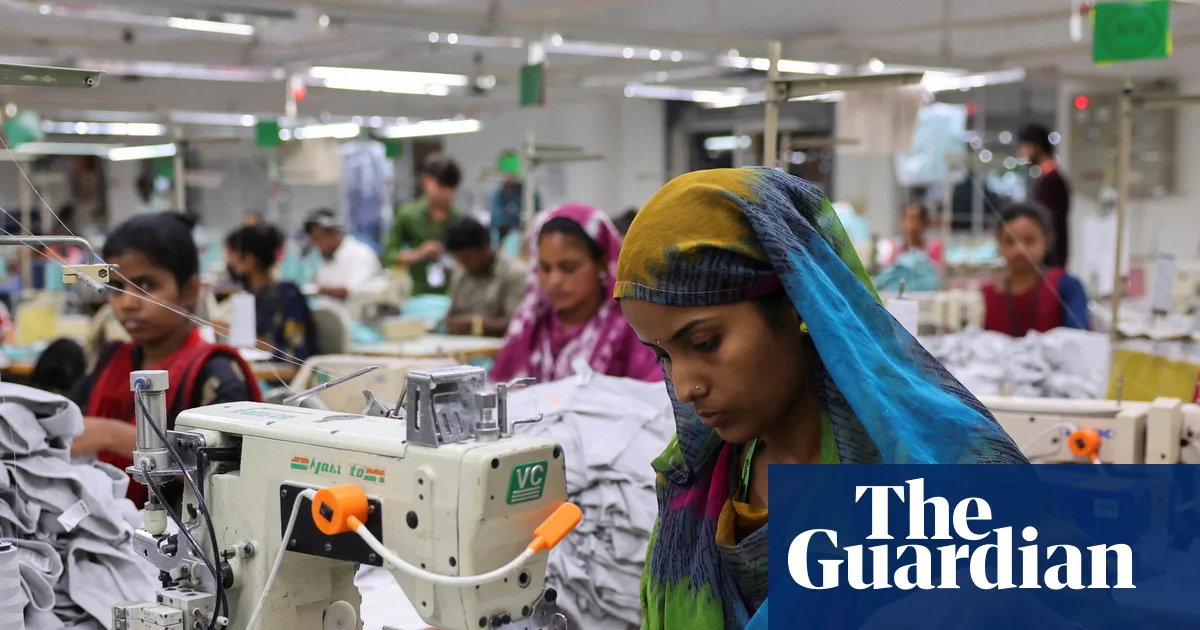
India has long been one of the world’s great garment houses, turning out everything from cheap T-shirts to intricate embroidery. Last year, textile and garment exports to the US alone fetched £21bn, riding a wave of strong consumer demand.
Now the trade is in jeopardy. With the stroke of a pen, the US president, Donald Trump, last week slapped a 50% tariff on more than half of India’s £65bn worth of merchandise exports to the country’s largest market. A supply chain once prized for being cheap suddenly became among the priciest.
The scale of the hit is sobering. Christopher Wood, the global head of equity strategy at the investment bank Jefferies, puts the economic blow at £41bn-£45bn, singling out textiles, footwear, jewellery and gems, all of which are highly labour-intensive, as “the most negatively impacted”.
The pain is visible in Tirupur, Tamil Nadu’s booming textile hub. “We’re scared of losing our jobs. Many of us borrowed money to come here. If the factories cut workers, we will have nothing,” Harihar Pradhan, a 32-year-old migrant worker from Odisha told the Times of India.
Tirupur’s half a million workers churn out cotton T-shirts, tracksuits and undergarments. They are shipped worldwide, but Americans have always been the biggest customers. Factories in Tirupur, as well as Noida in Uttar Pradesh, near Delhi, and Gujarat, are already shuttering production lines, according to the Federation of Indian Export Organisations (FIEO).
Alongside textiles, India’s gems, jewellery and seafood industries face the same tariffs: 50%, compared with 15-20% for competitors in Bangladesh, Sri Lanka, Vietnam and South Korea.
Effective rates, once exemptions and existing duties are folded in, are even more punishing: 62% for ready-made garments, up from 12%, and 60% for shrimp, for example. “That’s a massive competitive disadvantage,” said Aurodeep Nandi, an economist at the Asian investment bank Nomura.
Margins in these industries were razor-thin to begin with. The new tariffs could push them into loss-making territory, threatening factory closures, mass job losses and the unravelling of supply chains built over decades.
Kirit Bhansali, the chair of the Gem and Jewellery Export Promotion Council, warned of “devastation”. The US “is our single largest market, accounting for over $10bn [£7.4bn] in exports – nearly 30% of our industry’s total global trade,” he said. “A blanket tariff of this magnitude will inflate costs, delay shipments, distort pricing and place immense pressure on every part of the value chain. We fear exports to the US could fall by over 75%, impacting polished diamonds, jewellery and coloured gemstones alike.”
Indian exporters rushed shipments to the US in August to beat the fall of the tariff hammer. “If the tariffs stick even for just three to six months, I fear India will lose a major share of this [apparel and garment] business,” said Pallab Banerjee, a senior executive at Pearl Global Industries, a leading garment manufacturing firm. A Jaipur exporter added: “Global buyers are highly price-sensitive. Even a 5% tariff difference can turn away buyers.”
Pearl Global can shift orders to factories abroad. But most Indian firms lack that luxury.
The stakes for India’s government are political as well as economic. The prime minister, Narendra Modi, has pitched manufacturing as a way to provide jobs to the millions of young Indians who join the labour force each year. These industries employ tens of millions, directly and indirectly.
The tariffs pose a direct threat to that pledge, says Adil Kotwal of the Seepz Gems and Jewellery Manufacturers’ Association. “We will see tens of thousands of skilled workers displaced across the country, in Surat, Jaipur, Mumbai and beyond. And once those jobs are lost, the damage will be hard to reverse,” he said.
The economic ripple effects spread quickly: fewer tiffin meals get ordered; smaller earnings for drivers and delivery staff, and weaker sales for local vendors.
Across other industries, shrimp farming alone supports more than 16 million Indians. Two-thirds of the sector’s £5.5bn in exports go to the US. A Kolkata exporter said: “With the tariffs, India’s shrimp will become super-expensive in the US market. We’re already facing huge competition from Ecuador, as it has only a 15% tariff.” Leather exporters, too, are bracing for tough times. The US buys a fifth of India’s leather goods, from shoes to handbags.
Trump has long called India a “tariff king” and accused Delhi of shutting the US out of the domestic market. But officials hoped Modi’s personal rapport with Trump, and India’s role as a strategic bulwark against China, might earn leniency. In July, Trump announced a 25% tariff, painful but seen as survivable. A month later, Trump doubled the levy, citing India’s purchases of discounted Russian oil that he argued were funding Russia’s war against Ukraine.
A key reason for the draconian tariff hike, though, according to a New York Times report, was Trump’s anger at Delhi dismissing his claims of brokering peace in the fierce four-day May conflict between arch-foes India and Pakistan.
Many Indian exporters had expected tariffs of 10-15%, low enough to keep themselves in play as a seller to the US. Instead, they are finding themselves priced out.
The economic growth fallout could be steep. Economists reckon the tariffs could shave up to one percentage point off India’s GDP this year. The country’s surprisingly strong 7.8% first-quarter expansion may cushion the blow, but only partially. “The effective macro hit from the 50% tariff imposition will start to feed via exports and have a domino effect on employment, wages and private consumption,” said Madhavi Arora, the chief economist at Emkay Global Financial Services.
Industry groups are pressing for credit relief, export assistance and aggressive pursuit of trade deals with other countries. Government officials talk of diversifying towards Japan, South Korea and China, while launching a textile export drive targeting 40 countries.
As SC Ralhan, the head of the FIEO trade body, put it: “The steps taken now will determine how effectively India withstands external shocks.”