
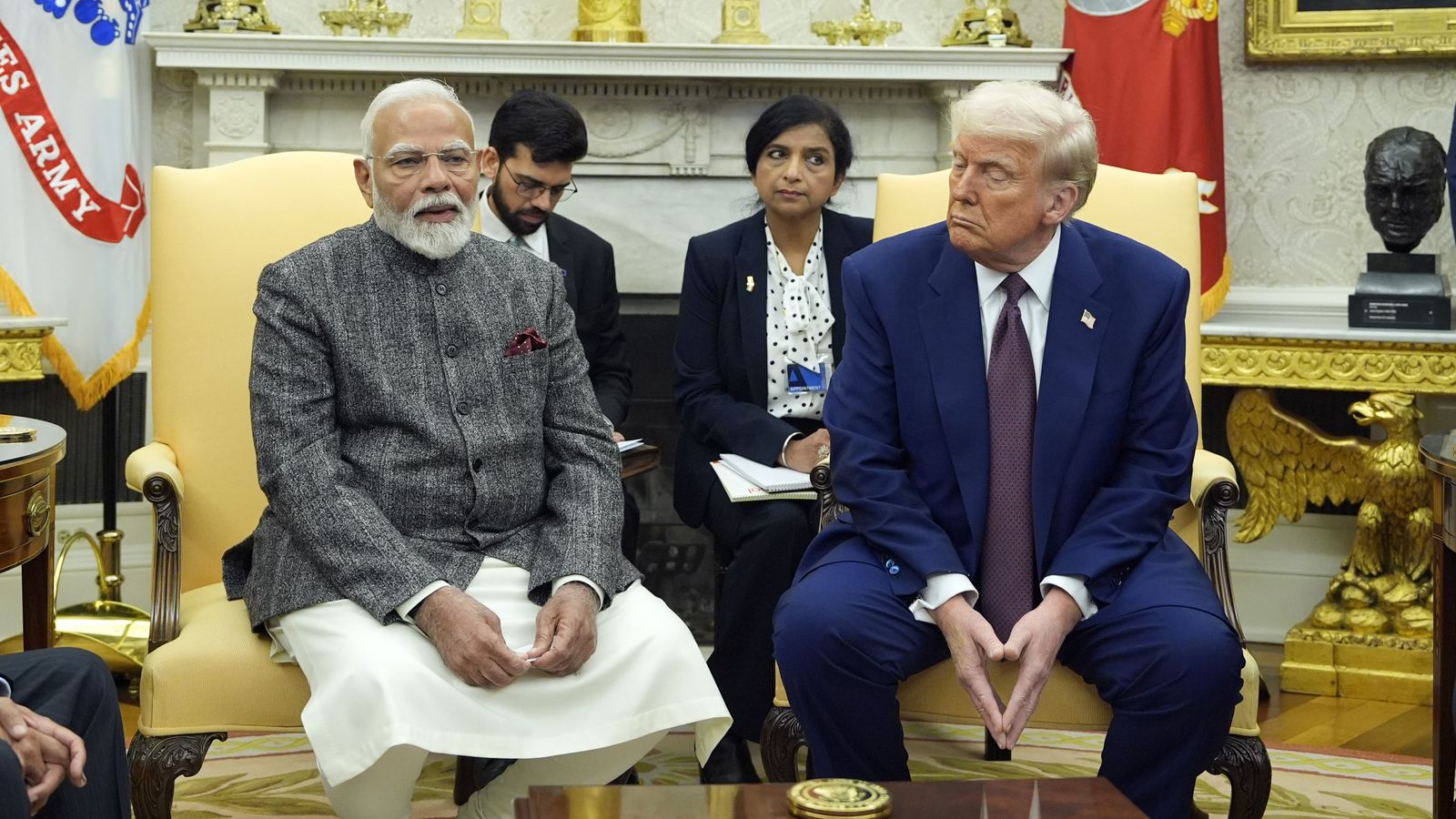
Numerous Indian industries—including textiles and garments, gems and jewelry and shrimp-raising hatcheries—have been plunged into crisis by the Trump administration’s imposition of a 50 percent tariff on most Indian exports to the US since August 27.
In September, India’s total exports to the US contracted by 11.9 percent, falling to $5.5 billion, and while they rose to $6.3 billion last month, they were still down 8.6 percent from October 2024.
So serious has been the tariffs’ impact, Prime Minister Narendra Modi and his Hindu-supremacist Bharatiya Janata Party (BJP) government have cobbled together a bailout package of Rs. 450.6 billion ($5.2 billion), equivalent to about 1.3 percent of total central government programme spending. Announced on November 12, the bailout package includes collateral-free loans for enterprises with cash flow problems and access to trade finance.
Notably, the bailout includes no funds to assist laid off and furloughed workers, even though the poverty wages that these workers earn when they are employed are generally barely enough to support them and their families.
For months, the Modi government has been desperately trying to persuade the Trump administration to reduce its tariffs on Indian exports, which at 50 percent, are currently higher than those Washington is imposing on any other country’s goods. Brazil is also subject to a 50 percent US tariff, but a much larger portion of its exports are exempt.
Trump recently said that the tariffs on India “may be reduced.” But the would-be dictator US president has also repeatedly chastised India, charging that its barriers to US trade and investment are among the highest in the world.
The Modi government has offered to make steep cuts in India’s tariffs on a raft of US imports, including machinery, aircraft and mineral fuels, but to no avail. In a further attempt to placate Trump, India’s government-owned oil companies announced Monday that they have concluded a one-year deal with US producers to import 2.2 million tonnes of US liquefied petroleum gas (LPG), equal to about 10 percent of India’s total annual LPG imports.
Whatever reduction the Trump regime is offering to India, the US tariffs on Indian goods will almost certainly remain at 25 percent or higher even if Washington and New Delhi conclude a deal.
Earlier this year, Indian officials had expressed confidence they would not only reach a satisfactory deal on Trump’s “reciprocal tariffs,” but that they would also soon conclude a broader trade and investment deal with Washington.
However, all of this was upended by Washington’s demands for India to open up its agricultural sector to large-scale US agribusiness exports and dramatically curtail its imports of cheap Russian oil. The former would squeeze the incomes of hundreds of millions of small farmers, and the latter would drive up inflation and undercut New Delhi’s long-term strategic partnership with Russia.
When negotiations failed and the US slapped a 25 percent tariff on Indian goods at the end of July, New Delhi took solace in the fact that this was lower than the US tax on Chinese exports.
But only days later Trump slapped an additional 25 percent tariff on India, as punishment for its refusal to buckle to US demands that it curtail its Russian oil imports. The Trump administration is seeking to choke off Russian government oil export revenue as part of its efforts to weaken Moscow and force an end to the US-NATO instigated Ukraine war on terms favourable to US imperialism.
Exports to the US are critical to many Indian industries and the overall Indian economy. The US has been India’s largest export market in recent years, accounting for 20 percent of India’s export income. In the 2024–25 financial year, ending in March 2025, total exports to the US amounted to $86 billion. Of this, an estimated $50 billion worth of goods are now subject to 50 percent tariffs, making them much more expensive for American consumers.
Less than three months into Trump’s economic war on India, the consequences have been severe: factory closures, mass unemployment, reduced working hours and indefinite furloughs, further impoverishing already poverty‑stricken working class families.
India’s textile industry, with its deep historical roots, provides direct employment to at least 45 million workers and supports another 60-100 million people, including small cotton farmers, truck drivers and food vendors near textile mills.
The textile sector is dominated by small- and medium‑sized enterprises (SMEs) producing synthetic and cotton fabrics. SMEs account for at least 60 percent of the industry. They now face acute cash‑flow problems, with many on the brink of bankruptcy due to unsold inventories. Small‑scale industries are defined as enterprises with less than Rs. 10 million ($115,000) in fixed or leased assets, while medium-sized enterprises are those with less than 10 times that amount in investments.
A significant portion of India’s textile production is carried out by home‑based cottage industries, where workers endure long, back‑breaking hours for meagre pay. Many of these enterprises are financed through “micro‑finance,” championed by Bangladesh’s current president, Muhammad Yunus, as a supposed solution to the poverty created by capitalism.
The textile industry is a major contributor to India’s economy, accounting for about 2.3 percent of GDP and 12 percent of total exports. It is also the largest employer after agriculture, which absorbs roughly 46 percent of India’s workforce while contributing only 16 percent of GDP. This imbalance highlights India’s economic backwardness: the proportion of workers employed in agriculture is higher than even in Afghanistan, one of the world’s poorest and least developed countries.
Reports indicate that numerous textile factories in Tiruppur, Tamil Nadu—known as the “Knitwear Capital of India”—have halted or scaled back production. Similar cutbacks have occurred in other textile hubs such as Surat in Gujarat and Ludhiana in Punjab. Orders have been cancelled, payments delayed, and many small and medium export units have shut down entirely. In Tiruppur, thousands of migrant workers from Bihar and Odisha have been sent home, while women working on piece‑rate contracts have been told there will be “no work for weeks.”
In Surat, Gujarat—the state from which Prime Minister Narendra Modi hails and where he presided over an anti-Muslim pogrom in 2002, earning the epithet the “Butcher of Gujarat”—power looms are running at half capacity. Average earnings for loom operators are less than Rs. 21,000 ($100) per month, barely enough to cover food and rent.
In Noida, Uttar Pradesh—one of India’s poorest states—finished garments lie unsold because foreign buyers refuse delivery. Exporters admit they cannot compete with Bangladesh or Vietnam, which face far lower US tariffs of 20 percent. The industry is trapped: unable to repay bank loans, facing delayed orders from the US, and most critically, compelled by the logic of capitalism, throwing hundreds of thousands of textile workers out of work.
Another sector hit hard is gems and jewellery. The US accounts for 37 percent of India’s diamond exports and 28 percent of its jewellery exports. This sector employs 5 million workers directly and contributes 7 percent of India’s GDP. Exports include cut and polished diamonds, coloured gemstones, and gold jewellery. Around 65 percent of production comes from small, home‑based workshops, which are bearing the brunt of the collapse in US demand.
The US is also the largest market for Indian seafood exports, accounting for about a third of all exports. With Indian seafood exports to the US already subject to 5.76 percent countervailing duties and 3.96 percent anti-dumping duties, the effective tax on India’s seafood exports to the US is now almost 60 percent, making seafood exports there unviable.
Despite the Trump administration’s punishing tariffs, the BJP government, and indeed the entire Indian ruling class, remain committed to the reactionary anti-China Indo-US global strategic partnership that has been the foundation of their foreign policy and geo-economic strategy for the past two decades.
On the sidelines of the recent ASEAN summit, India’s Defence Minister Rajnath Singh and US Secretary of War Pete Hegseth, signed a new 10-year Defence Framework Agreement (DFA). The agreement expands on that reached in 2015, and is meant to integrate India ever more fully into US military operations throughout the Indo-Pacific. At the signing, Singh boasted that it pointed to the growing “strategic convergence” between the Indian bourgeoisie and US imperialism, while Hegseth, a notorious anti-China war-hawk, hailed the DFA saying, it “advances our defense partnership, a cornerstone for regional stability and deterrence.”