
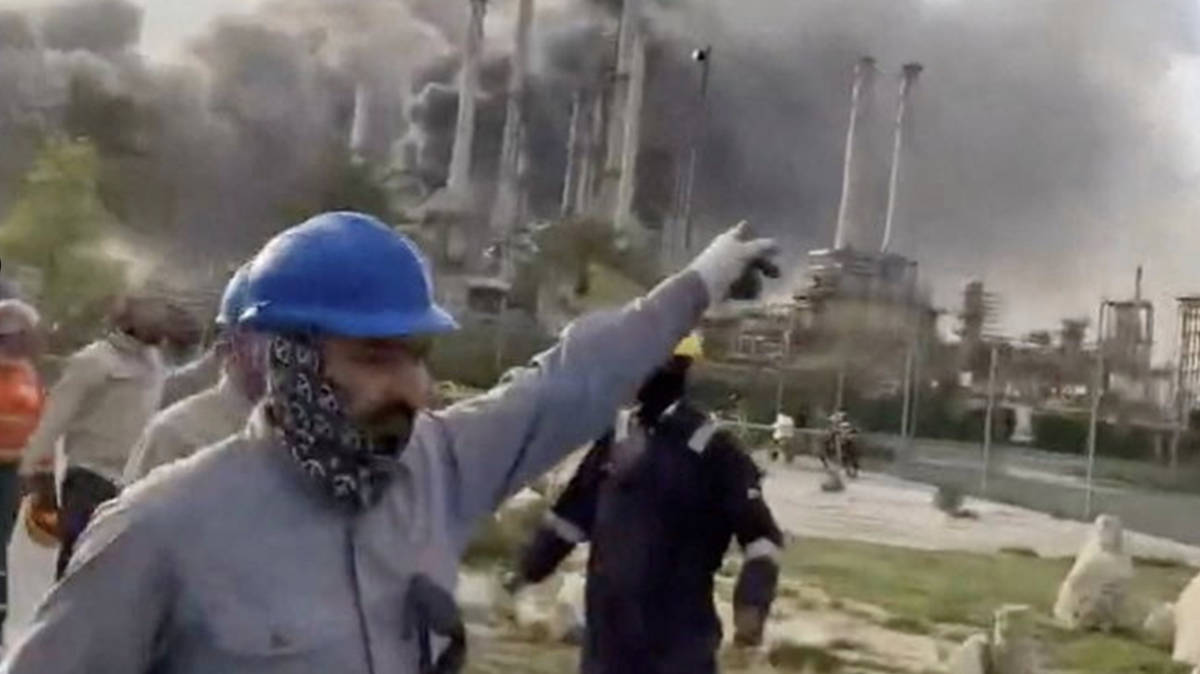
The country’s state oil giant Aramco announced it had closed the Ras Tanura refinery on Monday after missiles were fired at the crucial export terminal

Picture:
X
Saudi Arabia’s biggest oil refinery has been temporarily shut down after it was hit by a drone strike, as global oil and gas prices soar amid the ongoing conflict in the Middle East.
The country’s state oil giant Aramco announced it had closed the Ras Tanura refinery on Monday after missiles were fired at the crucial export terminal.
A Saudi military spokesman said the incoming aircraft were intercepted before reaching critical infrastructure, while footage showed thick black smoke rising from the site.
Read more: US fighter jets shot down by Kuwaiti anti-air defences in friendly fire incident
Read more: Iran – US strikes LIVE

Picture:
X
Two drones were intercepted at the facility, with debris causing a limited fire, the Saudi defence ministry’s spokesman told Al Arabiya TV.
There were no injuries reported.
Ras Tanura, located near Dammam, is a key part of the Gulf coast’s energy complex and has a daily crude oil production capacity exceeding half a million barrels.
The refinery’s shutdown is one of many in the region, as oil and gas production halts amid escalating violence across the Middle East, with suspected Iranian strikes hitting the UAE, Bahrain and Qatar in response to the US and Israeli blasts on Saturday morning.
On Monday, missiles fired by Iran and its proxies struck Israel and Arab states, reportedly hitting the US Embassy compound in Kuwait.
In response, Israel and the US have carried out airstrikes on targets in Iran.
The refinery closures, combined with Qatar’s decision to halt liquefied natural gas production, have caused European wholesale gas prices to surge by 52 per cent, the steepest jump since March 2022.
Oil prices have also shot up by nearly 9 per cent, after fossil fuel facilities in the Gulf region halted production in the face of missile strikes.
The FTSE 100 was down 1.3pc as Brent crude oil, the international benchmark, spiked by as much as 13pc to more than $82 a barrel.

Picture:
Getty
Prices began to ramp up after energy giant QatarEnergy said it had “ceased” production following strikes on its facilities.
Qatar’s defence ministry had earlier said one Iranian drone “targeted an energy facility in Ras Laffan Industrial City, belonging to QatarEnergy”, referring to its onshore gas processing base 80 kilometres (50 miles) north of Doha.
It caused the Dutch TTF natural gas contract, considered the European benchmark, to jump to more than €47 per megawatt hours, having been below €27 in December.
Gas prices earlier gained more than 20 percent on fears that the Iran war would would lead to the closure of the Strait of Hormuz.
Energy companies are now one of the strongest performers on the FTSE 100 because of the turmoil in the Middle East, alongside defence stocks and miners.
Weapons maker BAE Systems hit a record high and was the biggest gainer on the index, rising by 4.7 per cent by lunchtime.
It was followed by oil giants Shell and BP, up by 2.2 per cent and 2 per cent respectively, as the price of oil remained 7.7 per cent higher on the day at more than $78 a barrel.
The conflict is also expected to disrupt global trade and push up inflation, with US stock indexes on track to drop heavily at the opening bell.
In premarket trading, Delta and United Airlines were down 6 per cent each while major lenders like Bank of America and Citi dropped around 2 per cent.
Ahead of the opening bell, the Dow Jones Industrial Average and S&P 500 were down 1.1 per cent and the Nasdaq 100 had fallen 1.5 per cent.