
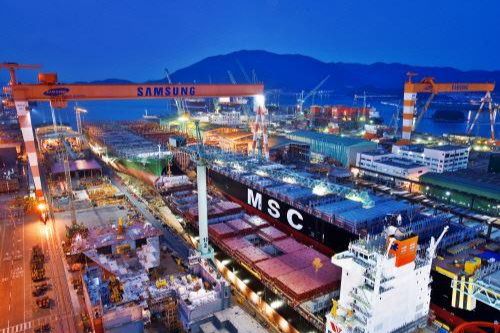
Samsung Heavy Industries (SHI) is facing allegations that the shipbuilder unfairly dismissed migrant workers, withheld wages and violated their human rights.
A union of subcontracted shipyard workers under the Korean Metal Workers’ Union said in a recent press release that SHI forced three migrant employees, who had worked at its shipyard for about six months under E-7-3 visas for skilled workers, to resign this month despite having two-year contracts.
The union said it was unreasonable to believe the E-7-3 visa holders voluntarily resigned, noting that the workers each paid at least 10 million won ($6,800) to come to Korea and would need to return home if they quit voluntarily.
“If their skills were unsatisfactory, the employer could simply decide not to renew their contracts once the terms expired,” the union said. “Migrant workers whose contracts are not renewed can still seek other employment with a D-10 visa for job seekers.”
The union also pointed to discrimination in meal services at the shipyard.
Unlike Korean workers, who receive free lunches and pay 1,000 won for each breakfast and dinner, migrant workers have reportedly had 180,000 won in meal fees deducted from their monthly salaries since last year, regardless of whether they eat the meals.
“The deduction allows the company to pay lower overall wages while still meeting the legal requirement to provide a salary equal to at least 80 percent of the annual per capita gross national income,” the union said.
The union also cited SHI’s “yellow and red card” system as an example of human rights violations. The company allegedly displays yellow or red cards in public areas to warn migrant workers about safety, quality control or performance issues.
“Because the practice is humiliating, the company does not apply it to Korean workers,” the union said.
In July, President Lee Jae Myung condemned discrimination and abuse involving migrant workers as “serious crimes,” after viewing footage showing a Sri Lankan worker tied to a forklift at a brick factory in Naju, South Jeolla Province.
SHI said it is reviewing the union’s claims to determine whether they are accurate.