
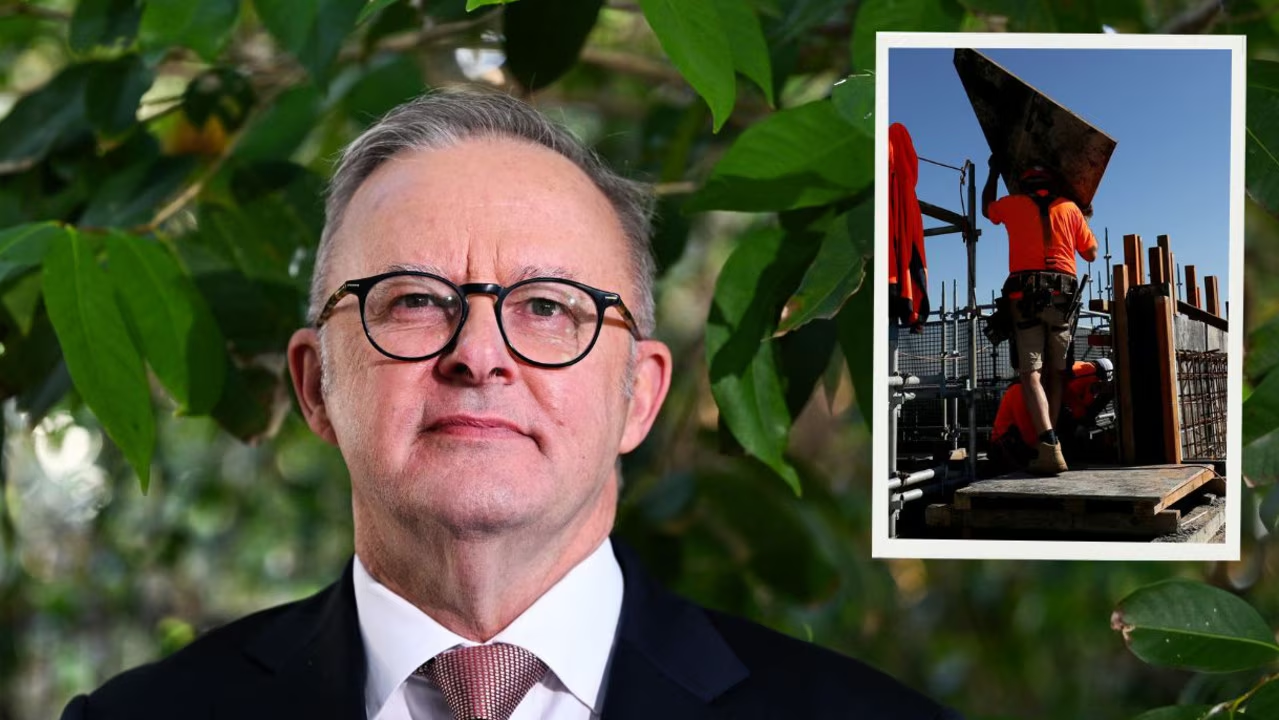
Australians have overwhelmingly backed a campaign to bring manufacturing back to our shores, as industry groups warn the sector is at a “tipping point”.
More than 10,000 people responded to a poll as part of News Corp’s Back Australia campaign, which aims to turbocharge Australian industry.
Of those who responded, 95 per cent said they wanted to “bring back manufacturing to Australia” and 50 per cent said they bought Australian made products to support jobs here.
Prime Minister Anthony Albanese, who along with some of Australia’s biggest businesses including Westpac, Coles and Bunnings and business leaders Andrew Forrest, Dick Smith and Katie Page, has supported the Back Australia campaign.
Australia’s manufacturing industry is under pressure from high energy prices and aggressive dumping of Chinese goods, demanding a strong rearguard action to protect up to 1 million Australian jobs in the sector.
Innes Willox, chief executive of the Australian Industry Group, said manufacturing has contracted 4 per cent in a year with manufacturing at its lowest level since his organisation began that survey in 1992.
“Australia is at a tipping point,” Mr Willox said.
He said businesses were “agnostic” to how power was supplied, either through renewables or gas or coal, but they wanted certainty about pricing.
“Manufacturers are looking at their businesses and are considering what they will keep in Australia and what will go offshore,” he said.
Want to read more of the stories you love on one of our state news websites? Click here to sign up for a free trial and access 12 locked articles on web over 12 weeks. Limits and T & Cs apply.
Readers have reacted to the front page of the Sunday Telegraph, which encouraged Australians to spend more on local goods.
“ I would be delighted to buy Aussie products as much as possible,” Norm wrote.
Greg added: “I do my best to buy Australian whenever I can.”
The Albanese government claimed it had “the most ambitious pro-manufacturing policy since World War II” with its green “Future Made in Australia” policy.
The $22 billion program will supercharge our solar panel, battery and wind farm manufacturing sectors.
Industry and Innovation Minister Tim Ayres said: “We’re backing Australian manufacturers to secure high-quality jobs, and ensure a fairer playing field in international trade.
Mr Albanese also signed a deal with US President Donald Trump last week to process rare earth minerals in Western Australia.
“With world-class renewable energy and critical minerals, Australia is ready to lead the next generation of clean industries,” Mr Ayres said.
He also pointed to the $2.4 billion deal with the South Australian government to save the Whyalla Steelworks.
But maverick Liberal Andrew Hastie who sensationally quit the Liberal front bench over his opposition to the Coalition’s energy policy, said “the PM is the GOAT (greatest of all time) of climate hypocrisy”.
“Aussie energy prices are way too expensive for us to be globally competitive. Energy is expensive because of Labor’s climate obsession,” he said.
“They force us to pay big bucks for inefficient Chinese-made industrial solar and wind farms. Meanwhile, they ship cheap and efficient Aussie coal and gas to China to power their manufacturing.”
Australia’s manufacturing sector was 15 per cent of the economy in the 1970s, compared with just 5.1 per cent in 2025.
That’s the smallest manufacturing sector of any country in the Organisation for Economic Co-operation and Development (OECD) group of countries.
Oceania Glass, one of the key supplies of glass across Australia, shut its doors in February this year because of the impact of China “dumping” cheap products on Australian markets.
The 169-year-old company, which supplied large panes of glass for Canberra’s Parliament House, was unable to compete with subsidised Chinese products.
Alcoa shut its aluminium smelter in Western Australia last year, while high energy prices have been blamed for the shut down of plastics manufacturer Qenos, which had a plant in Altona, Victoria.
Incitec Pivot closed its fertiliser factory on Gibson Island in Brisbane in 2022 because it was unable to get a long-term gas supply deal.
Alex Hawke, opposition spokesman for Industry and Innovation, said: “The Coalition backs a strong, modern and diverse manufacturing sector.
“We have some of the most talented workers in the world, but they’re being smashed by Labor’s trifecta of soaring energy prices, higher taxes and rigid regulations.”
This article is part of the Back Australia series, which was supported by Australian Made Campaign, Harvey Norman, Westpac, Bunnings, Coles, TechnologyOne, REA Group, Cadbury, R.M.Williams, Qantas, Vodafone and BHP.
Originally published as Manufacturing crisis: The numbers that have industry leaders worried