
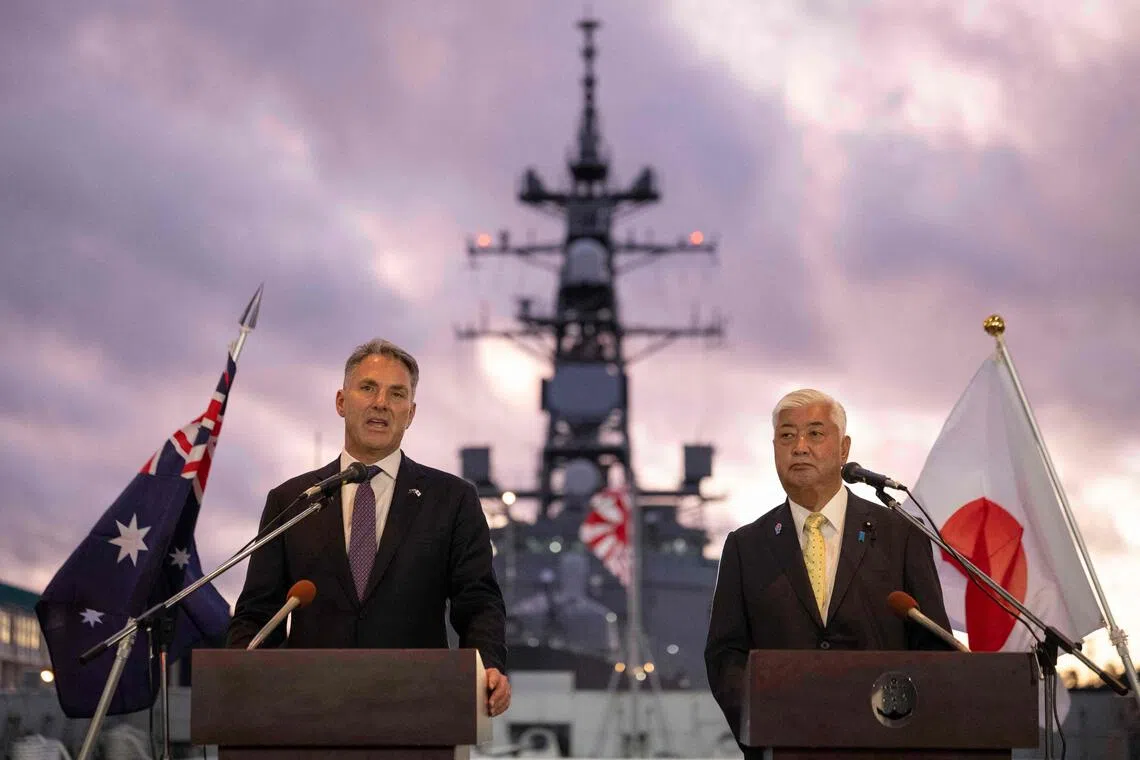
TOKYO – Japan is taking off the gloves as it seeks to become an international arms powerhouse amid a political realignment under new Prime Minister Sanae Takaichi, who has embraced a coalition partner eager for major defence liberalisation.
Ms Takaichi’s Liberal Democratic Party (LDP) and the Japan Innovation Party plan to
roll back restrictions
on defence exports, build weapons factories and accelerate investment in the nation’s military.
Japanese Defence Minister Shinjiro Koizumi on Oct 24 convened a meeting of senior ministry officials to discuss a successor to
a five-year defence spending plan
that runs through 2027, as well as updates to the national security and national defence strategies.
A priority is to help Japanese weapons makers thrive as military budgets swell around the world. The country’s five biggest defence companies account for less than 2 per cent of global defence shipments, but their share prices have risen on expectations of fresh orders.
Ms Takaichi’s government also aims to show the United States, Japan’s only security treaty ally, Tokyo’s commitment to investing in their alliance and deflect pressure from US President Donald Trump over defence spending during a visit to Tokyo this week.
Mr Trump has called on US allies to spend 5 per cent of their gross domestic product on defence; Japan currently spends about 1.8 per cent.
On Oct 24, Ms Takaichi said she would bring forward by two years a plan to reach 2 per cent and hit the goal during the current fiscal year ending in March, with funds from a supplementary budget.
“I will boost the deterrence and response ability of our military alliance with the US,” Ms Takaichi said in her first speech to Parliament as prime minister.
Mr Trump is en route for Japan and is expected to visit a US naval base south of the capital on Oct 28.
The new enthusiasm marks a sea change from just a few years ago, when there was little coordinated effort to build up Japan’s small defence industry, thanks to lingering taboos in the country about the “industry of death” and high barriers to defence exports imposed in the wake of World War II.
“We’d often go in to make a presentation to try and win a contract overseas after a European competitor,” said Mr Masahiko Arai, senior vice-president of defence and space systems at Mitsubishi Electric, a maker of radars and missile guidance systems. “They’d come out with a large delegation, including uniformed military officers and embassy staff, but we’d get none of that support.”
Government backing has improved, Mr Arai said.
Evidence of that came in August when a Japanese consortium
was selected as the preferred bidder
to provide 11 warships worth up to US$6.8 billion (S$8.8 billion) to Australia, aided by lobbying from former prime minister Shigeru Ishiba and Japan’s defence minister, as well as a public relations campaign in Sydney that involved billboards promoting the main contractor, Mitsubishi Heavy Industries.
“It was almost too much,” said one Australian government official who took part in the talks, adding that it was quickly clear that the capabilities of the Japanese ship were superior to those of a rival German offer.
If a contract is signed as expected early in 2026, it would be only the second major post-war defence export deal by a Japanese company.

The Mogami-class Japanese stealth frigate JS Mikuma is seen anchored at a naval base in Yokosuka, Kanagawa Prefecture.
PHOTO: AFP
New Zealand is also considering acquiring the same Japanese frigates, and its defence minister recently discussed the issue with his Japanese counterpart, according to a statement from New Zealand’s military provided to Bloomberg.
To map out a plan for sustained export progress, Japan has benchmarked itself against other countries, including South Korea, which has a more developed defence sector and has signed multi-billion-dollar agreements to supply equipment such as howitzers, rocket systems and ammunition to countries including Poland.
Japan can emulate that success higher up the technology chain in areas such as missile systems and space technology, said Mr Hirohito Ogi, a former Japanese defence ministry official.
A plan by the new government to scrap a general ban on the export of lethal military equipment unless the items are for defensive purposes, such as cannons used to clear mines, could help.
The LDP’s former coalition partner Komeito insisted on that ban and, although the government found ways to make some exceptions, it now aims to remove the restrictions completely in 2026.
“In the broadest sense, Japan may start to see itself as a normal country when it comes to its defence and strengthen its capabilities while engaging freely with other nations’ militaries,” said Colonel Grant Newsham, a former US Marine Corps liaison officer to the Japanese military.
Japan is also looking into adding capacity to build missiles and other weapons, which will help boost inventories and potentially help the US, which has warned of its own munitions shortages. The coalition says it would consider state-owned armouries operated by private companies.

Prime Minister Sanae Takaichi plans to roll back restrictions on defence exports, build weapons factories and accelerate investment in Japan’s military.
PHOTO: REUTERS
Unlike large defence-focused contractors in countries like Britain and the US, in Japan the sector consists of a handful of manufacturing and technology conglomerates that are primarily focused on other businesses.
For most of these companies, defence has long accounted for less than 20 per cent of company-wide revenue and mostly involved supplying the Japanese military, known as the Self-Defence Forces.
The limited market has deterred them from adding production capacity and many smaller businesses have exited the defence sector because of low margins.
“If we are tied to the fluctuations of Japan’s defence budget, we can’t make solid investments or really build a strong production and technology base,” Mitsubishi Electric’s Mr Arai said.
The company is one of the most bullish about the overseas market and is part of a Japan-Britain-Italy consortium working to develop a sixth-generation fighter jet.
In April, Nato Secretary-General Mark Rutte toured a Mitsubishi Electric satellite production facility just outside Tokyo, before meeting Mr Ishiba to discuss closer defence industrial cooperation, among other topics.
Like other Japanese companies in the sector, Mitsubishi Electric does not break down its defence revenue by location, but Mr Arai said exports were still limited.
A ratio of about 20 per cent of revenue from shipments overseas, similar to that of major US defence contractors, would be “healthy”, he said.
The company is ahead of its goal of almost doubling its 2024 revenue in the defence sector to US$3.9 billion by 2030 based on its latest order book, he added.
A change in Japan’s thinking over the defence sector came in 2022 after
Russia’s invasion of Ukraine
elevated concerns about a similar conflict in Asia, possibly over Taiwan.
Tokyo committed to investing 43 trillion yen (S$364 billion) over five years in military equipment such as long-range cruise missiles and military satellites, and to lifting overall defence spending to 2 per cent of gross domestic product by 2027 from an informal cap of 1 per cent.
Missiles and satellites have become part of a new strategy of trying to deter rivals such as China and North Korea by having the ability to hit military sites in those countries from land, sea and air.
Mitsubishi Heavy has been one of the big beneficiaries of Japan’s rising defence budget, with major orders that include long-range cruise missiles.
In May, the company said it expected operating profit from its aerospace and defence segment to grow 40 per cent in the current fiscal year through March. The company is also the lead contractor on the frigate deal with Australia. (Mitsubishi Heavy and Mitsubishi Electric originated from the same shipping business but are now independent companies.)
Mitsubishi Heavy CEO Eisaku Ito said in a recent interview that the company was seeking to get ahead of defence industry trends such as closer integration between air, land and sea forces.
“When unmanned systems like drones come into play, or when more automation is required, we have plenty of cutting-edge technologies internally,” he said. “We’re looking to put forward ideas for future trends in the sector.”
NEC, which supplies satellites, submarine sonars and drone technology, is seeing stronger-than-expected demand for its defence-related products.
In 2023, the company delivered a small radar satellite to Vietnam as part of a disaster-forecasting system, and it has developed search-and-rescue drones for potential customers overseas.
NEC’s aerospace and national security unit increased headcount by 1,000 in two years and plans to add another 200 in 2025.
There are still challenges for Japanese companies, executives and government officials say. Some are hesitant about directing investment into defence and away from other larger business segments.
A lingering stigma among older generations in Japan over the defence industry after the country’s militarism during World War II can also be a concern, and then there are the difficulties of connecting to the supply chain overseas.

Anti-war activists in South Korea protest against a joint military exercise by South Korea, the US and Japan.
PHOTO: AFP
“There are still some companies saying, ‘No, we don’t want to be engaged with these things,’” said one government official handling defence industry policy.
But with a strong tailwind now from the new government as it seeks to remove remaining barriers to growth, the incentive of spiralling global defence budgets and a growing social acceptance in Japan of the legitimacy of a strong military, there is a general optimism about the country’s potential.
“The pieces are being put into place for Japan to become a global defence player,” said Mr Frank Clark, a former military attache at the US embassy in Tokyo who now heads Pacforce, a Tokyo-based advisory for defence companies. BLOOMBERG