
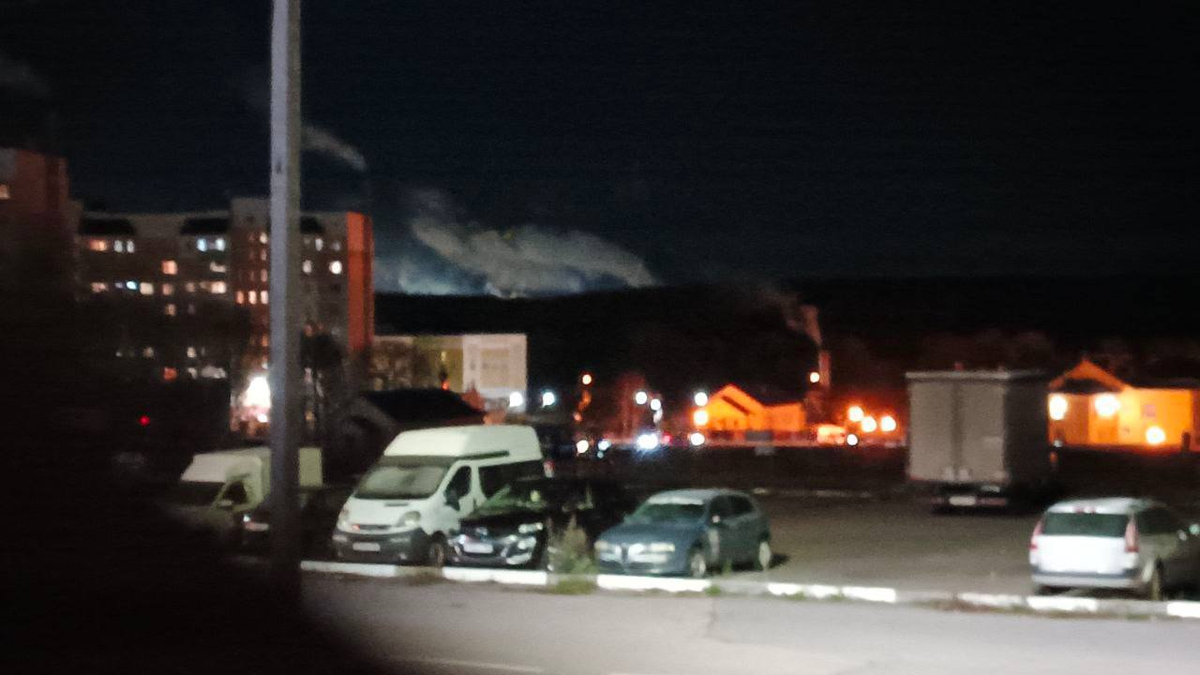
Explosions were heard in the Russian city of Oryol late on Sunday, Nov. 16, amid reports that the local thermal power plant (TPP) may have been hit.
Around 8 p.m., Russian Telegram channels warned of a large drone swarm heading toward the region.
JOIN US ON TELEGRAM
Follow our coverage of the war on the @Kyivpost_official.
Soon after, residents reported loud blasts across the city and smoke rising from the area of the energy facility. Local Telegram channels circulated photos and videos of explosions and their aftermath.
On Monday morning, Nov. 17, regional governor Andrey Klychkov said air defenses had destroyed 10 drones over the past 24 hours. He reported damage to a private home, two apartment buildings, and several vehicles, but made no mention of a strike on the TPP.
The incident comes days after multiple explosions shook Oryol on Nov. 13, when Ukraine launched long-range “Flamingo” cruise missiles deep inside Russian territory.
Ukraine’s General Staff confirmed coordinated strikes on “several dozen” military and logistical targets across Russia and occupied Ukrainian territory.
For the first time, the General Staff acknowledged the use of Ukraine’s new domestically produced long-range systems – including the “Flamingo,” “Bars,” and “Liutyi” missile and drone platforms.
The Supernova+ channel said debris seen in Oryol matched the new “Flamingo” missiles.

Other Topics of Interest
‘Indo-Pacific Begins in Ukraine’ – US Think Tank Head Says Trans-Siberian Strike Rewrites Global Strategy
Longtime Russia strategist Glen Howard argues Kyiv’s disruption of the North Korean arms route decisively proves the connectivity of the Europe and Indo-Pacific theaters.
Earlier, on Nov. 5, Ukraine also struck a thermal power plant in Oryol, following a wave of drone attacks on Oct. 31 that hit energy facilities in the Vladimir, Yaroslavl, and Oryol regions.
During October strike, drones damaged the city’s main TPP, knocking out equipment and cutting heat and hot water to three of Oryol’s four districts.
The Ukrainian Navy later said Neptune cruise missiles were used to hit the plant’s outdoor switchgear, which distributes electricity from its generators to the grid.
In the early hours of Nov. 16, Ukrainian forces also hit facilities at the Novokuybyshevsk oil refinery in Russia’s Samara region – one of the country’s key refineries, processing around 9 million tons of oil annually.
Ukraine’s General Staff confirmed explosions and a fire at the site. Russian media said the strike involved Bars jet drones.
Robert Brovdi, commander of the Unmanned Systems Forces (USF) and known by the call sign “Madyar,” said the strike was carried out by his units with support from Ukraine’s Special Operations Forces (SSO) and military intelligence (HUR).
“This refinery produces high-quality jet fuel, as well as gasoline and diesel of all grades,” he wrote on Telegram.
The Novokuybyshevsk refinery in Russia’s Samara region – roughly 1,000 km from the Ukrainian border – is owned by Rosneft, has an annual capacity of 8.3 million tons, and manufactures more than 20 types of products.
Ukraine previously hit the plant on Oct. 19, halting its primary oil processing.
Since early November, Ukrainian drone strikes have disrupted at least three Russian refineries.
Rosneft’s Saratov refinery shut down entirely on Nov. 11 and is not expected to restart before December. Lukoil’s Volgograd refinery was damaged on Nov. 6, and Rosneft’s Tuapse refinery stopped processing on Nov. 3.