
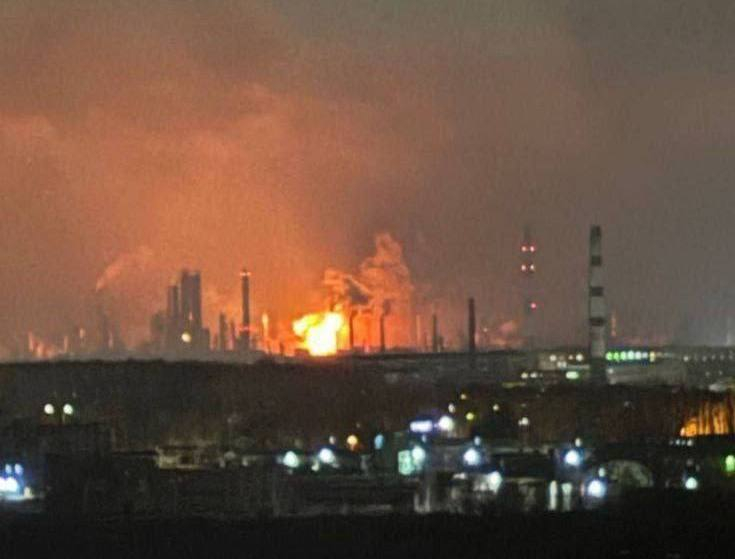
Ukraine’s Defense Forces carried out a series of precision strikes on key Russian military and infrastructure targets, including the Ryazansky oil refinery, a Nebo-U radar station, and a Russian military echelon, the General Staff reported.
The Ryazansky refinery, which produces gasoline, diesel, liquefied gas, and around 840,000 tons of TS-1 aviation kerosene annually for the Russian Aerospace Forces, was hit by multiple explosions that triggered a large fire, as per the report on Telegram.
JOIN US ON TELEGRAM
Follow our coverage of the war on the @Kyivpost_official.
The head of the Unmanned Systems Forces (USF), Robert “Madyar” Brovdi, also confirmed the strike on the Ryazan Oil Refinery, writing on Telegram:
“The Ryazan Oil Refinery (Rosneft) was pecked by the USF Birds early on the morning of Nov. 15. It’s a producer of jet fuel and TS-1 aviation kerosene – about 8% of total output in the ‘swamps’ [Russia] – as well as gasoline and diesel of all grades.”
According to Brovdi, the operation was carried out by fighters of the 1st Separate Center of USF (formerly the 14th Regiment). He added that gasoline is becoming increasingly scarce in Russia – and that both gas and oil “burn very easily.”
Russian media reported more than a dozen explosions at the refinery, while videos circulating online showed a glow, fire, and heavy smoke. Local Telegram channels described drones flying at the height of multi-story buildings.

Other Topics of Interest
Russian Economy Barely Grows in Q3 as War Spending Bites
That is significantly lower than in the previous quarter, when the GDP added 1.1 percent.
Ukrainian forces also destroyed the Nebo-U radar system in occupied Crimea – one of Russia’s key long-range surveillance assets.
The Nebo-U radar was first tested in 1992, with serial production starting in 1994, according to a 2018 RT report.
Its exact price is unclear: Ukraine’s outlet Suspilne estimated the system at about $100 million after a similar strike in Bryansk in April 2024, while RT listed the upgraded Nebo-UM at 394 million rubles (about $4.7 million as of September 2025).
In the occupied Tokmak area of the Zaporizhzhia region, a Russian military echelon was struck, while another attack targeted enemy manpower near Vovchansk in occupied Kharkiv. Russian losses are still being assessed.
“The Defense Forces continue to take all measures to undermine the military-economic and offensive potential of the occupiers,” the General Staff said.
The strike followed another overnight attack on Novorossiysk, Russia’s largest Black Sea port, on Nov. 14, where drones hit the Sheskharis oil terminal, temporarily halting 2% of global oil shipments, according to Reuters.
The attack forced pipeline operator Transneft to suspend shipments, though the company declined to comment.
A senior SBU source told Kyiv Post that the strike was carried out by the SBU’s “Alpha” unit together with HUR, Ukraine’s Special Operations Forces, the Border Guard Service, and Navy missile-artillery units.
The teams hit loading stands, pipeline infrastructure, and pumping systems, igniting a large fire, and also struck S-300/400 air-defense positions at military unit 1537, causing powerful secondary detonations.
“We will continue to deprive the aggressor of resources until it loses the ability to wage this war,” the source said.
Local authorities confirmed additional damage across Novorossiysk. More than 170 emergency personnel were deployed to extinguish fires, evacuate residents, and assess structural damage.