
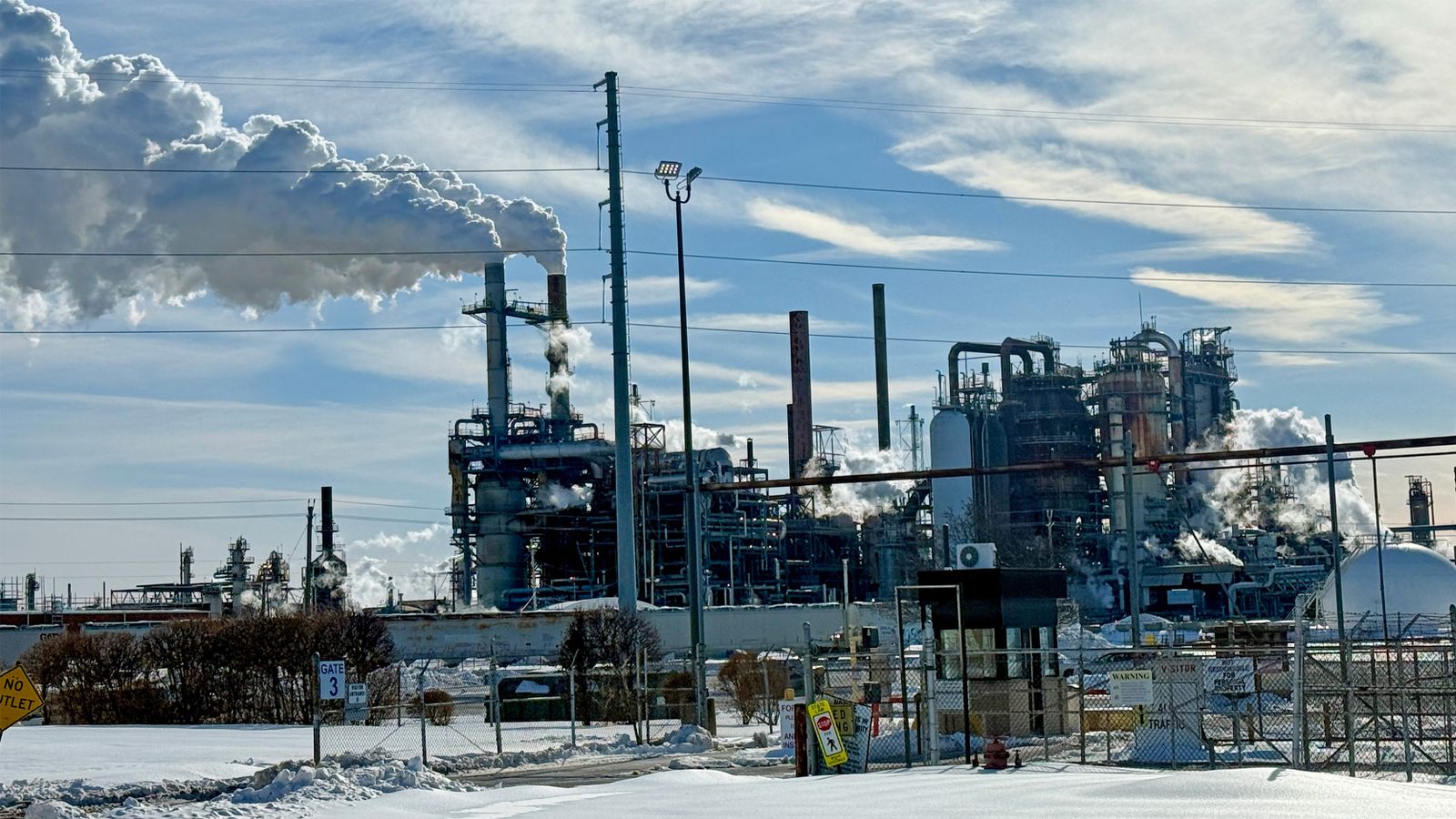
Oil refinery workers: Build rank-and-file committees to oppose the contract extension and prepare a strike! Fill out the form below to learn more; all submissions will be kept anonymous.
The contract for 30,000 oil refinery workers in the United States expired on Sunday, but the United Steelworkers (USW) union is keeping workers on the job under indefinite, 24-hour rolling extensions. Marathon Petroleum, the lead negotiator for the oil companies, is demanding sweeping concessions that would cut real wages and pave the way for automating away workers’ jobs.
Together, the workers at these facilities account for about two-thirds of the refinery capacity in the United States, meaning they have immense economic power. Under conditions of growing calls for a general strike against ICE murders in Minneapolis and tens of thousands of striking nurses, a refinery workers’ strike would meet instantly with wide support. It would also encourage the 25,000 steelworkers at US Steel, Cleveland-Cliffs and other companies whose USW contracts expired on September 1.
Fear of such a development is precisely why the union bureaucrats, with their close connections to management and the government, are refusing to call a strike. The decision to extend the contract was announced in a short post to the USW website late in the night on January 31 without any explanation or reason given. In a text, the USW instructed workers: “Continue to show up to work as scheduled, show your support and solidarity and look out for updates from your local leadership.”
According to a Reuters report on Monday, the USW has “neither accepted nor rejected” Marathon’s demand for 15 percent wage increases over four years. This is in keeping with the pathetic 11 percent increase over three years in the previous deal, negotiated under conditions of the highest inflation in over 40 years.
The USW openly bragged that the last contract in 2022, worked out in close consultation with the Biden White House, “did not contribute significantly to inflation”—that is, wages did not keep pace with the rising cost of living. That contract was also worked out past the expiration date, on rolling 24-hour contract extensions. The contract was also reached, as the current one also is, on the cusp of major wars—the US proxy war against Russia in Ukraine in 2022 and wars against Venezuela and Iran today.
Workers are furious at the news. They are demanding a minimum of 25 percent, according to social media posts.
Comments include:
“If we are going to strike you shouldn’t just do one refinery. Do them all!”
Another, denouncing the near total silence on negotiations from the union, wrote: “It’s sad that I have to come here for contract information.”
Another proposed a new demand: “Yearly wage increase to percentage match the average cumulative percentage raise of the CEO, CFO, and COO of each corporation.”
Unconfirmed reports indicate that other aspects of the offer currently include no COLA (Cost-of-Living Allowance), no shift differential increase, no vacation increases, no retirement medical assistance and no AI protection.
The last one is crucial because companies are introducing AI to refineries for predictive maintenance, real-time operations adjustments and other purposes. As in other industries, such as on the railroads or at UPS and Amazon, this technology will be used to slash thousands of jobs.
The companies are tightening capacity, having closed two large facilities last year and preparing a third this year. Oil and gas output is at record levels in spite of a dramatic fall in employment, according to a Bloomberg report. Greater work is being placed on fewer workers’ shoulders creating deadly conditions, as shown by the massive explosion last October at Chevron’s El Segundo refinery in suburban Los Angeles and the 2022 deaths of brothers Max and Ben Morrissey at the BP Husky refinery near Toledo, Ohio.
The struggle must be waged against the union bureaucrats, who are working with management as well as the Trump administration to impose another concessions contract. Workers should demand an end to the rolling extensions and an immediate strike to bring the oil companies to their knees. They must organize rank-and-file committees to prepare to enforce a democratic decision to strike, not wait for permission from above.
To provide itself with some cover, USW locals are holding a series of plant rallies calling for a “fair contract.” No doubt the participation by workers in these rallies reflects a determination to fight. But a real struggle can only begin once workers wrest the initiative out of the hands of the union bureaucrats, assert control over the bargaining process and link up with each other across the country to prepare joint actions.
Workers must oppose attempts to isolate workers at individual refineries. BP is maneuvering to remove its large facility in Whiting, Indiana, from the national pattern bargaining framework.
According to a January 30 post by Local 7-1, the company is “demanding we waive all our ‘rights under applicable federal, state, or local labor laws’ related to the implementation of artificial intelligence in the workplace.” The company is also demanding the elimination of several crafts and a reduction in staffing for instrumentation and electrical technicians, machinists and metals mechanics, “to name a few,” the statement continued.
Workers cannot allow BP Whiting workers to be isolated the way the USW did in 2022 with 500 workers at the Richmond refinery in California. This was also preceded by a 10-month lockout at ExxonMobil in Beaumont, Texas, where the USW allowed the company to remove itself from the national bargaining framework as a prelude to sweeping concessions. In 2024, the Teamsters union betrayed a three-month strike with a new seven-year agreement at the Marathon refinery in Detroit.
The last national strike in 2015 was limited initially to only nine sites, eventually rising to 15. When it was shut down, the union left workers at the Galveston Bay refinery on the picket line for months. Part of that facility had suffered an explosion in 2005 that killed 15 and injured 180 when it was owned by BP.
Wars for oil and “America First”
Workers are not only in a battle against the energy giants but the Trump administration, which has fully backed the corporations by stealing Venezuelan oil and dismantling environmental and workplace safety regulations.
That is why the fight to defend jobs and living standards must be combined with a fight against imperialist war and dictatorship. New wars for oil in Venezuela and Iran would kill workers all over the world for US profits. At the same time, the violent suppression of popular protests against ICE in Minneapolis is a demonstration of the methods being prepared against all workers who resist the demands of the corporate oligarchy.
The USW and officials in other unions support “America First” trade war policies on the false grounds that they will create jobs in America, even when they themselves are allowing companies to carry out deep layoffs. There were 1.2 million layoffs announced last year, the highest since 2020 and, before that, the 2008-2009 recession.
Earlier this month, the heads of several maritime unions responded to the abduction of Venezuelan President Nicolas Maduro by demanding a US flag shipping requirement on all vessels carrying oil stolen from the country. International Longshoremen’s Association President Harold Daggett is in particular a pro-war hawk, issuing a statement supporting the attack on Iran last summer.
In a statement on January 26, USW President David McCall denounced Trump’s economic policies, which he says have led to 70,000 lost manufacturing jobs. “Companies seek stability before investing in facilities, workers, materials and components,” he said, denouncing Trump as being too erratic with “here-today, gone-tomorrow sanctions.”
McCall’s opposition to Trump, dominated by complaints about business “stability,” come from a management lens, not that of workers. He has not said anything about the sweeping attacks on democratic rights in the United States. The immediate target is immigrant workers, but the attack is directed against the entire working class. Basic democratic rights, including the right to strike, are at stake.
Most importantly, McCall has no proposal for workers to do anything to defend their jobs or democratic rights. His answer is 24-hour rolling extensions, essentially stripping workers of their right to strike. In doing so, the USW bureaucracy leaves workers without any means to defend themselves against corporate exploitation.
In response, workers must take matters into their own hands by forming rank-and-file committees independent of the union apparatus. These committees should establish communication with workers at other refineries across the country and with other sections of workers entering into struggle, including nurses, steelworkers and autoworkers.
They must demand an immediate end to the rolling extensions and prepare for an all-out strike that would shut down the oil industry and mobilize the power of the working class. Only through such independent action, linked to a broader fight against inequality and the movement towards dictatorship, can workers defend their jobs, their living standards and their democratic rights.