
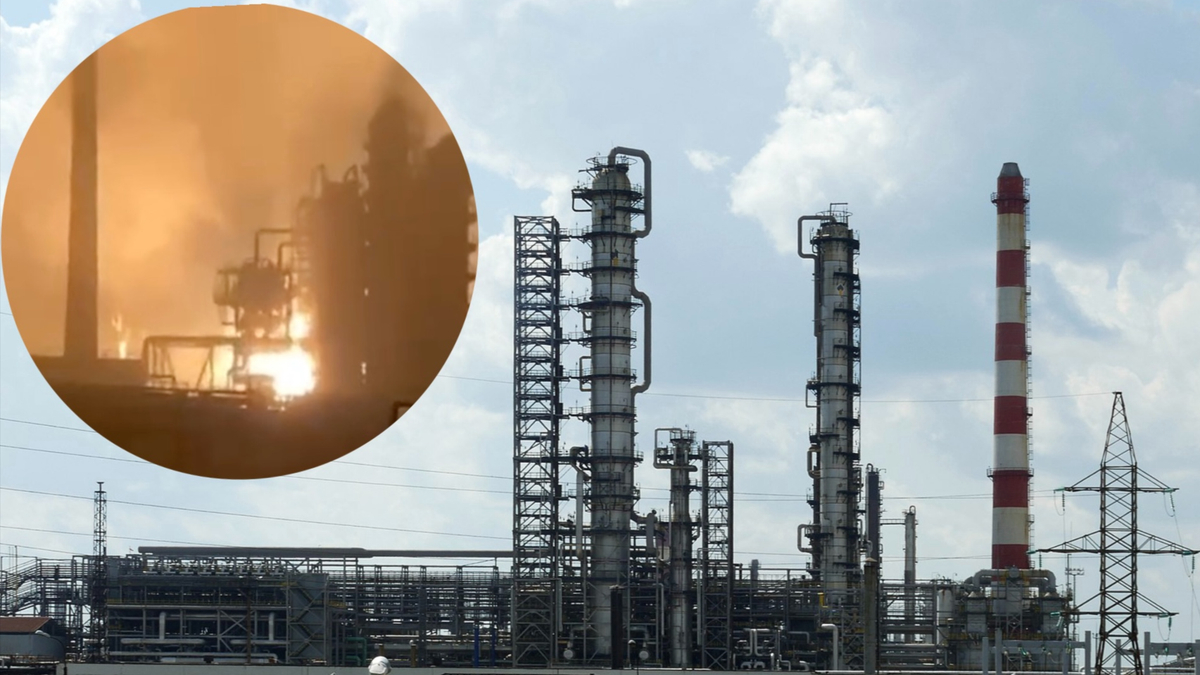
Long-range kamikaze drones hit Russia’s fourth-biggest oil refinery, the Rosneftt Ryazan Oil Refinery (RNPZ), on Friday setting fires and partially shutting down production – the fourth strike against that energy industry-critical facility in the past three months.
Ukraine’s Army General Staff (AGS) credited elite Unmanned Systems Forces (USF) operators for “explosions in the area of the target and a large-scale fire on the territory of the enterprise,” in a Friday morning statement.Ryazan residents reported in social media that the attack took place in the early morning hours of Friday and of hearing explosions and seeing fires in the vicinity of the RNPZ.
JOIN US ON TELEGRAM
Follow our coverage of the war on the @Kyivpost_official.
The plant has a capacity to process about 17 million tons of oil per hour to produce automobile gasoline of all octanes, diesel fuel, aviation kerosene, fuel oil, liquefied gas, bitumen and petrochemical raw materials. The plant’s main customers are in Moscow and surrounding regions. The facility is more than 450 kilometers (280 miles) from the nearest likely Ukrainian drone launch sites.
Geo-located video and photographs uploaded to local social media showed fires and explosions in the vicinity of the facility’s fuel storage reservoirs and two of the site’s cracking towers – the main fuel processing equipment in a refinery – with flames reaching heights of at least 20 meters (65 feet) from fire at the base of one of the cracking towers.

Other Topics of Interest
Kyiv City to Redirect Funds to Ensure Water Supplies Ahead of Winter
Kyiv Mayor Vitaly Klitschko said backup power sources are being set up to ensure the functioning of water supply and drainage systems amid intensified Russian strikes on infrastructure.
Unconfirmed posts also reported explosions in the vicinity of the region’s Diagelovo military airfield, a base often used by the Russian Air Force to launch Tu-95MS and Tu-22M3 heavy bombers for cruise missile strikes against Ukraine. Kyiv Post could not yet verify these claims.
Ryazan governor Pavel Malkov said on Monday morning “a fire occurred on the territory of one of the enterprises in the region due to the fall of UAV debris” without specifying the refinery by name or making any mention of actual hits by Ukrainian drones on ground targets. Malkov claimed that local air defense forces had detected 14 Ukrainian drones and shot them all down.
Kyiv Post requested but did not receive comment from the Ryazan Mayor’s office. Former Mayor Vitaliy Artemov was sacked by Malkov on Thursday for fiscal mismanagement and possible corruption while in office, the SOTA news agency reported.
Ukraine’s ongoing campaign against Russian energy infrastructure and particularly Russian oil processing and oil export capacity has used both domestically developed propeller- and jet-powered drones to attack Russian oil refineries up to 2,000 kilometers (1,250 miles) from Ukrainian-controlled territory.
Since late July the Ukrainian bombardment has hit one or more Russian oil refineries every day with follow-up strikes on high-value targets that were already hit over the last two months.
Kiv Post records show that Friday morning’s drone attack against the Ryzan facility was the fourth hit on the plant matched in number only by the oil refinery in the Volga basin city of Saratov.
It is estimated that more than 20 Russian refineries were hit and confirmed to have been damaged in central and west Russia since early August. Of those more than half were struck at least twice and about one in five three times. According to Russian energy industry news reports, the strikes have cut Russian Federation oil processing capacity by about 20 percent, citing government-sanctioned production data.
Estimates of the total number of Russian oil refineries hit by Ukraine, and precisely when, are complicated by the raids’ often taking place late at night, and because the Russian state suppresses information about Ukrainian attacks on its territory – with limited success.
Following the drone strike on the Makhachkala oil refinery in the Dagestan region on Wednesday, officials in the Caucasus region told citizens that all drones had been shot down, no one was hurt, and that aside from broken windows there was no significant property damage.
Meanwhile thousands of Makhachkala residents reported hearing a dozen or so heavy explosions overnight from the direction of the city’s Dagnoteks oil refinery. Some recorded orange-red fire balls billowing above the plant lighting up the night sky and, after sunrise, still-burning fires were visible to city residents three kilometers (2 miles) away – according to the independent Russian Astra news agency.
Video uploaded to the internet showed at least one direct hit on the refinery’s main processing unit, more drones diving in to hit ground targets, a building with its street facade demolished by an explosion or explosions, severed high-power lines lying on the ground and black smoke shrouding the central streets of the predominantly Muslim city.
Scattered rifle and machine gun bursts were audible behind the images as the slow-flying Ukrainian aircraft seemingly flew onwards unaffected by the ground fire.
The Makhachkala oil refinery is more than 900 kilometers (560 miles) from likely Ukrainian drone launch sites. The longest-range Ukrainian drone strike, according to open sources, was an Aug. 8, hit on a a Voronezh-M regional air defense radar system, near the city of Orsk in the Orenburg region – a distance of at least 1,800 kilometers (1,100 miles).
According to a Kyiv Post unofficial count Ukrainian USF units have launched at least 83 long-range drone attacks against energy-related targets inside Russia and occupied Ukrainian territories since July 26, and possibly more, that includes non-oil related industry facilities directly linked to Russian energy infrastructure. This includes power transmission infrastructure servicing refinery and pipeline nodes or ports needed for Russian oil export.
Over the period Oct. 17-23 Ukrainian drones attacked Russian energy industry-related facilities in the Sochi region, occupied Crimea, Volgograd, Orenburg, Samara, Dagestan, Ryazan and Rostov for a total twelve strikes.
The single most-damaging attack was probably on Sept. 19 when the world’s biggest gas refinery in Orenburg was struck sparking multiple explosions and massive fires – it was also probably the second longest drone strike executed by USF forces.
Some Ukrainian military information platforms have pointed to unexplained but similarly substantial fires and explosions at refineries associated with the Russian energy giant Lukoil, in Hungary, Romania and Slovakia, on Tuesday and Wednesday, suggesting possible Kyiv inspired sabotage – claim Kyiv Post could not confirm.
Since August retail fuel shortages and outages have been reported across most of the Russian Federation as Ukraine’s campaign against Russian oil-processing capacity has proceeded. Notably the politically important Moscow, St. Petersburg and Krasnodar metropolitan areas have largely escaped. Worst-hit appear to have been outlying, politically less-influential, economically weaker territories including Russian-occupied Crimea and the central Siberian region of Buryatia.
News reports from Russia’s central Siberian region of Irkutsk on Thursday warned viewers of rising prices, shortages, rationing and outages in automobile gasoline and diesel, particularly if sold at independently-operated fuel stations.
According to the Moscow Times, new rules have been in effect at gas stations of the Baikal Regional Company (BRK) in the Irkutsk region of Buryatia, and Transbaikalia since Oct. 21, with drivers only allowed to buy no more than 20 liters of AI-92 gasoline at a time.
As this article was being prepared some Ukrainian information platforms reported a further two facilities in Russia’s Krasnodar region, the Iliskiy and Afinsikiy oil refineries, had been hit overnight. If confirmed the strikes would mark the second and fourth time the facilities, respectively, had been attacked by Ukrainian drones.