
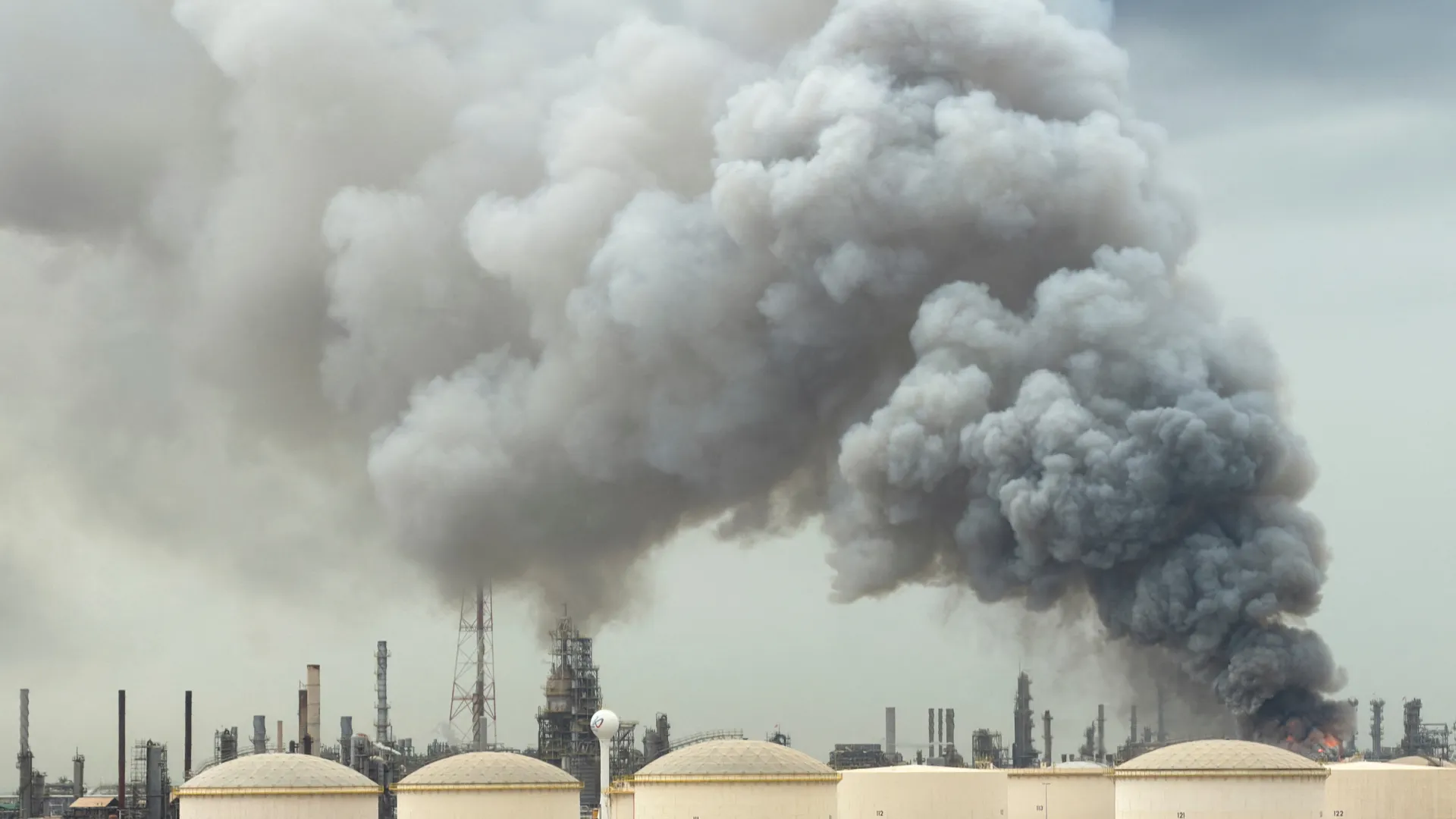
FLAMES raged at an oil refinery in Bahrain after an Iranian drone strike in the early hours of this morning, further fuelling fears for the global economy.
Footage shows a fireball erupting, sending plumes of thick smoke into the skies in the area of Sitra, south of the capital, Manama.
Bapco Energies – the Gulf nation’s state-owned oil giant – declared “force majeure” on its operations – a measure saved only in cases of mass war and natural disasters.
The move frees the company from supply obligations if the disruptions are caused by events beyond its control.
While the refinery inferno did not cause any casualties, the broader wave of attacks across the country has injured dozens of civilians.
Bahrain’s health ministry said at least 32 people were wounded, including several in serious condition.
Read more on the Middle East


The incident follows a string of attacks at the heart of the world’s biggest oil producing region as the Iranian regime seeks to impose economic pain on Israel, the US and their allies.
Bahrain’s Defence Force later revealed that it has intercepted 102 Iranian missiles and 171 drones since the beginning of what it called the regime’s “brutal aggression” on the country.
It warned that these “indiscriminate and criminal” attacks pose a direct threat to regional peace and security.
“The public is urged to remain indoors and only leave for essential needs, exercising extreme caution to ensure their safety,” it said in a statement to civilians.
“They should stay away from damaged sites and suspicious objects, refrain from filming military operations or debris impacts, and avoid spreading rumours.”
The strike on Bapco is the latest sign that the widening regional conflict is increasingly targeting critical infrastructure across the Gulf.
Almost half of the world’s oil reserves and exports come from the Middle East, which has five of the world’s seven biggest reserves of oil.
This comes as oil prices skyrocketed by more than 25 per cent today to the highest levels since mid-2022.
Major producers have been forced to cut supply amid Iran‘s stranglehold on the Strait of Hormuz, as they cannot safely send shipments to refiners worldwide.
Traffic through the critically important shipping lane has been largely closed after Iran attacked at least five ships.
Only a limited number of tankers are transiting, choking off a key artery accounting for about 20 per cent of global oil and LNG supply.
As global economic concerns grew, Donald Trump downplayed the spike in prices as temporary.
“Short term oil prices, which will drop rapidly when the destruction of the Iran nuclear threat is over, is a very small price to pay for the US, and World, Safety and Peace,” the US president wrote on Truth Social.
“Only fools would think differently.”
Finance ministers from the G7 – the UK, US, Canada, France, Germany, Italy and Japan – will today discuss the possible release of emergency reserves in response.
Three G7 countries, including the US, have so far expressed support for the idea, the Financial Times reported.
French finance minister Roland Lescure earlier told Franceinfo that the idea is “to see how the conflict develops, how the markets evolve”.
“We are going to listen to what is coming up from the ground, from businesses, from economists in these different parts of the world,” he added.
“The idea is to be able to discuss the state of the situation, so that we can assess any responses that might be needed, if we have to act.
“In a conflict which is currently a local conflict in one region but has global repercussions, it is obviously essential that we coordinate.”