
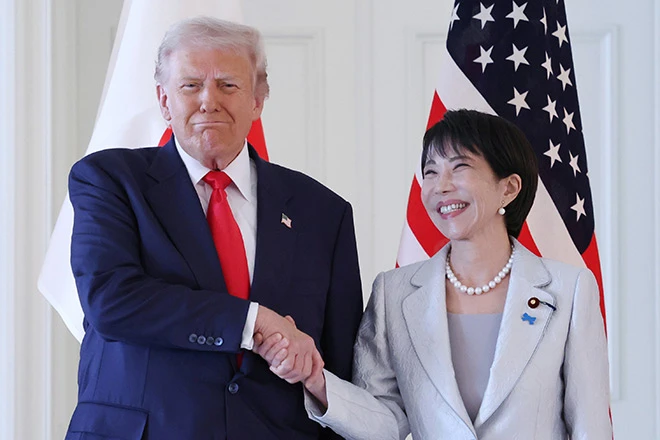
Japan and the United States unveiled a joint investment framework totaling $550 billion (80 trillion yen) on Oct. 28 alongside the Tokyo summit between Prime Minister Sanae Takaichi and U.S. President Donald Trump.
The initiative, proposed by Japan as part of a broader tariff agreement, outlines 21 strategic projects across sectors such as energy infrastructure, artificial intelligence and critical mineral procurement.
Key projects outlined in the framework include Mitsubishi Heavy Industries Ltd. and Toshiba Corp. exploring participation in nuclear and small modular reactor (SMR) construction led by U.S. firm Westinghouse Electric Corp.
Mitsubishi Electric Corp. is expected to supply power systems for data centers, while Panasonic Corp. plans to provide energy storage solutions.
SoftBank Group Corp., Hitachi Ltd. and Murata Manufacturing Co. are also among the companies expressing interest in contributing to the U.S.-bound investments.
The total scale of the 21 projects exceeds $400 billion, with Japanese firms eligible for financing and loan guarantees from government-backed institutions.
The framework stems from a memorandum signed in September, which established a bilateral committee and a separate investment committee chaired by U.S. Commerce Secretary Howard Lutnick.
Final investment decisions will be made by Trump following committee deliberations.
In an interview on Oct. 27, Lutnick noted that power infrastructure would be a priority for the first project, citing Japan’s expertise in the field.